
Subscribe
Subscribe
- Latest Legal News
- News
- Law Firms
- Columns
- Interviews
- Law School
- Legal Jobs
- हिंदी
- ಕನ್ನಡ
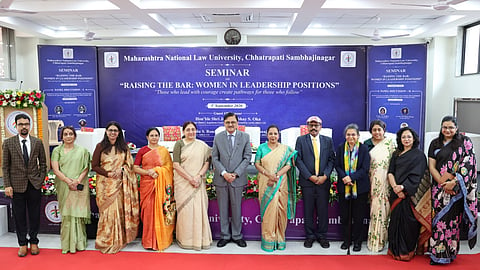
Maharashtra National Law University (MNLU), Chhatrapati Sambhajinagar recently held a seminar titled "Raising the Bar: Women in Leadership Positions".
Eminent members of judiciary, senior advocates, academicians and professionals discussed women representation in leadership, structural barriers they face and need to create inclusive institutions where equality, dignity and justice prevail. The programme was especially meant for girl students and young women to pursue leadership positions in judiciary, legal profession and academic institutions.
The inaugural session began with welcome address by Vice-Chancellor (VC) Prof (Dr) Bindu S Ronald and setting of theme by Justice Abhay S Oka — former Judge of Supreme Court of India.
Justice Oka said that women should not be counted only in numbers but also in terms of presence in positions of authority and decision making; women should be encouraged to go down the ladder from lower judiciary to higher judiciary, senior administrative and leadership positions in academic institutions etc.; create an environment where young girls can see themselves as judges, heads of institutions, legal scholars and decision makers.
Panel Discussion I
Representation, Institutional Transformation and Inclusive Pathways
The first panel was moderated by Senior Advocate Deepa Chawan of Bombay High Court. Equality of opportunity, level playing field and unequal power dynamics in professional spaces were discussed. Speakers referred to the difference between formal equality and substantive equality; institutions need to recognise structural disadvantages for meaningful inclusion to happen.
Justice Bharati Dangre talked about breaking the glass ceiling and creating pathways for women advancement (persistence and institutional support); Justice Gauri Godse talked about how women leaders support and uplift others (mentorship and collaborative leadership) and discussed an “osmosis of learning” — knowledge, experience and professional values are passed across generations of women in law profession.
Palak N Jamadar, Judge of Family Court Satara, spoke about women judges in family courts and how they make justice more accessible and responsive to women’s lived experience; sensitivity understanding and appreciation of social realities underlying family disputes were the key messages from her contribution. Prof (Dr) Bindu S Ronald talked about reimagining legal education as a basis for women’s leadership stressing that academic institutions are responsible for building confidence competence and leadership skills among young women.
The panel also discussed work-life balance and how women can reconcile their professional responsibilities with social expectations. Liberal feminist views on equal opportunity, individual agency and institutional barriers were seen as relevant here, particularly in connection with the theme addressed by Justice Godse.
Partner and family support, which also linked to Justice Godse’s theme, reinforced the idea that women’s professional advancement is helped by shared responsibilities and supportive personal relationships. Assertiveness was identified as a leadership quality. Women, the panel said, need to speak out clearly, exercise authority and take part meaningfully in decision making.
Panel Discussion II
Beyond the Black Robe—Experiences, Challenges and Leadership Journeys of Women Lawyers
The second panel was moderated by Prof (Dr) Bindu S Ronald and discussed the professional journeys, challenges and leadership experiences of women lawyers in traditionally male dominated legal spaces. It brought out realities of courtroom practice, career progression, professional credibility and barriers that prevent women from reaching senior positions.
Senior Advocate Liz Matthew of the Supreme Court of India spoke on women’s leadership at the Supreme Court Bar. She emphasised that professional excellence, resilience and the ability to cope with demanding legal environments were key. Senior Advocate Deepa Chawan spoke about finding one’s voice in the courtroom, and about building confidence and leadership among women litigators.
Advocate Ujwala Pawar spoke about the realities of trial-court practice, stressing persistence and commitment. Mohini Kelkar spoke about women’s leadership in industries that have traditionally been dominated by men, including the need to challenge stereotypes and give women opportunities to take responsibility.
The seminar ended with a reminder that symbolic representation alone is not enough — substantive equality and inclusive leadership are needed. Girl students and young professionals were given insights into the different pathways through which women can influence judiciary, legal profession and academic institutions; “Raising the Bar: Women in Leadership Positions” by bringing together eminent women leaders and senior members of the legal fraternity reinforced mentorship, institutional reform, supportive professional environments and collective responsibility as levers for advancing women’s leadership. The programme was concluded with a summary of the seminar followed by vote of thanks by Manika Kamthan, Assistant Professor MNLU-CS.
<Sponsored by the brand>