
Subscribe
Subscribe
- Latest Legal News
- News
- Law Firms
- Columns
- Interviews
- Law School
- Legal Jobs
- हिंदी
- ಕನ್ನಡ
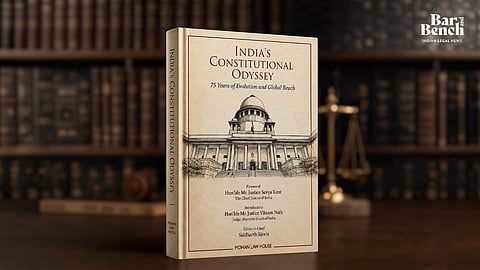
Published to commemorate the 75th anniversary of the Constitution of India, India's Constitutional Odyssey: 75 Years of Evolution and Global Reach, edited by Siddharth Sijoria, brings together contributions from judges, scholars and practitioners to examine the evolution of Indian constitutionalism and its influence on comparative constitutional law.
Rather than serving merely as a commemorative volume, the book argues that the Constitution's 75 year endurance reflects its ability to adapt to changing political, social and technological realities while preserving its constitutional identity.
The volume adopts a comparative perspective, demonstrating how doctrines such as the Basic Structure doctrine, transformative constitutionalism, constitutional morality and Public Interest Litigation (PIL) have shaped constitutional reasoning both within India and across the Commonwealth.
Organised into three sections, it examines the global influence of Indian constitutional thought, the institutional foundations of the Indian constitutional order and contemporary constitutional challenges, including freedom of expression, digital privacy, environmental constitutionalism and emerging technologies.
Overall, the book presents the Indian Constitution as a living constitutional framework whose resilience stems not only from its text, but also from judicial interpretation, institutional integrity and democratic commitment. In doing so, it offers an important contribution to comparative constitutional scholarship by illustrating the growing international influence of Indian constitutional jurisprudence.
The volume is organised into three interconnected sections that examine the Indian Constitution from international, institutional and contemporary perspectives. The first section explores the global influence of Indian constitutionalism within the Commonwealth, showing how doctrines such as the Basic Structure doctrine, judicial review and constitutional interpretation have shaped constitutional reasoning in jurisdictions including Ghana, Kenya, Malaysia, Sri Lanka and the Caribbean. It also highlights India's transformation into a republic within the Commonwealth.
The second section focuses on the institutional foundations of the Indian constitutional order. It emphasises the Basic Structure doctrine as a safeguard against constitutional amendments that threaten the Constitution's core identity and examines related concepts such as constitutional morality, judicial review, the rule of law and constitutional remedies. Collectively, the chapters portray the Constitution as a living framework whose resilience depends on judicial interpretation, institutional integrity and democratic values.
The final section addresses contemporary constitutional challenges, including freedom of expression, digital privacy, surveillance, artificial intelligence, environmental constitutionalism, parliamentary democracy, affirmative action, federalism and the separation of powers. Together, these chapters argue that the enduring legitimacy of the Indian Constitution lies in its ability to adapt to emerging social and technological realities while preserving its foundational constitutional principles.
The book's greatest contribution lies in presenting the Indian Constitution as a dynamic constitutional project whose influence extends far beyond national borders. For example, the Basic Structure doctrine, developed in Kesavananda Bharati v. State of Kerala (1973), which limits parliament's amending power by protecting the Constitution's essential features, has become one of India's most significant contributions to comparative constitutional law. Indeed, this doctrine inspired constitutional reasoning across several Commonwealth jurisdictions and also countries such as Colombia. The Substitution of the Constitution Doctrine, adapted by the Colombian Constitutional Court in 2003, limits the power to reform the Constitution and keep its identity and its substantial principles.
Another major theme is transformative constitutionalism, which portrays the Constitution as an instrument of social change rather than merely a framework for government. Through judicial interpretation, the Supreme Court of India has expanded the scope of fundamental rights, strengthened access to justice through PIL and promoted constitutional values such as equality, dignity and constitutional morality. At the same time, the contributors acknowledge the tension between judicial activism and democratic legitimacy, emphasising the need to balance constitutional protection with respect for representative institutions.
The book also highlights the growing global influence of Indian constitutionalism, particularly within the Commonwealth, where Indian jurisprudence has shaped debates on judicial review, constitutional interpretation and democratic governance. It presents democracy as inseparable from the protection of fundamental rights, judicial independence and institutional accountability, rejecting purely majoritarian conceptions of constitutional government.
In addition, the text addresses contemporary constitutional challenges, including digital privacy, surveillance, artificial intelligence, environmental constitutionalism, freedom of expression and the separation of powers. Overall, the volume successfully demonstrates that the resilience of the Indian Constitution derives not only from its text, but from its capacity to adapt to changing social and technological realities while preserving its constitutional identity.
India's Constitutional Odyssey makes a significant contribution to comparative constitutional scholarship by demonstrating that Indian constitutionalism has become an influential source of constitutional ideas beyond its national context. Its greatest strengths are its comparative methodology, multidisciplinary authorship and broad thematic scope. Also the book is a valuable resource for scholars and practitioners of constitutional law. By highlighting the reciprocal exchange of constitutional ideas and the growing global influence of Indian constitutional jurisprudence, it offers an important contribution to comparative constitutional law and demonstrates that the significance of the Indian Constitution lies not only in its longevity, but also in its continuing impact on constitutional thought worldwide.
By examining the evolution of the Indian Constitution and its influence beyond national borders, the volume demonstrates that constitutional resilience depends not only on constitutional design but also on judicial interpretation, democratic institutions and constitutional culture. The book remains an important resource for scholars and practitioners, illustrating how the Indian constitutional experience continues to inspire constitutional innovation and democratic governance worldwide.
Gonzalo Ramirez-Cleves is a lecturer and researcher in the Department of Constitutional Law at Externado of Colombia University.