
Subscribe
Subscribe
- Latest Legal News
- News
- Law Firms
- Columns
- Interviews
- Law School
- Legal Jobs
- हिंदी
- ಕನ್ನಡ
Political movements are usually born in party offices, university campuses or public squares. The Cockroach Janta Party (CJP) owed its existence to a courtroom remark.
Within days, what began as a satirical response to a judicial observation had grown into a nationwide social movement. It attracted millions of followers, dominated social media, reached Jantar Mantar, marched towards parliament and ultimately resulted in the resignation of the Union Education Minister. Few occupying high public office would imagine that a few spoken words could trigger such a chain of events.
That alone makes this episode worthy of reflection.
Chief Justice of India (CJI) Surya Kant may never have intended his remarks to produce the reaction that followed. But intention ceased to matter the moment those words entered the public domain. He later clarified that his comments had been misunderstood and were directed at those who entered noble professions through fake and bogus degrees, not at India's youth. By then, however, the debate had moved well beyond the speaker's intention. Once spoken, words no longer belonged exclusively to the courtroom. They acquired a public life of their own, shaped by emotion, interpretation and the speed of digital communication.
The CJP was neither the product of an election campaign. It emerged almost overnight as thousands of young people adopted a courtroom expression and transformed it into a rallying cry. Its extraordinary rise demonstrated how years of accumulated frustration over examination failures, unemployment and perceived governmental indifference could suddenly crystallise around a single moment. What might otherwise have faded as a passing courtroom exchange became the vocabulary of a generation that felt ignored.
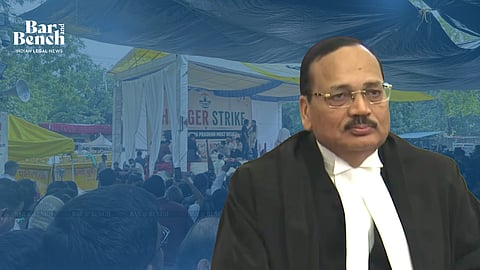
The movement soon left social media behind. Students gathered at Jantar Mantar, demanding accountability over examination failures and expressing a wider sense of disillusionment with public authorities. As the protests intensified and marchers were stopped on their way to parliament, allegations of excessive police force further fuelled public anger. What had begun with a courtroom remark had become a national controversy.
Ironically, the issue returned to the Supreme Court itself.
When counsel later sought to place before the Court video material relating to the alleged police action, the Bench declined to view it during the mentioning, observing that it had no time to watch the videos and asking counsel not to waste the Court's time. Once again, a few spoken words travelled far beyond the courtroom before the legal proceedings themselves assumed significance. Public debate moved faster than the judicial process.
The Chief Justice later clarified that no formal petition had been before the Court when those observations were made. The clarification explained the Court's procedural position, but it did not entirely answer the question many citizens were asking. The Supreme Court is not an ordinary court confined to the pleadings before it. Over the years, it has repeatedly exercised its suo motu jurisdiction whenever it considered an issue to involve a larger public interest. It has intervened in matters ranging from environmental concerns and the management of stray dogs to educational issues, including taking suo motu cognisance of concerns relating to NCERT textbooks.
Against that background, it was only natural for many to ask why allegations of police action against protesting students, already dominating the national conversation, did not evoke a similar response. Judicial discretion is, of course, the Court's prerogative. But the exercise of that discretion inevitably invites public scrutiny, especially in matters attracting widespread attention. Those unanswered questions, more than the later clarification, kept the debate alive.
Every spoken word from the Bench now carries a weight that earlier generations of judges never had to confront. A remark once heard only by a handful of lawyers inside a courtroom can now be clipped into a 30-second video, viewed millions of times and interpreted by audiences with no knowledge of the case in which it was made. Control over the narrative is often lost the moment the words are spoken.
The episode also prompted a response from the Supreme Court. While making it clear that fair and accurate news reporting and legal analysis would remain unaffected, the Court restricted the unauthorised extraction and circulation of clips from court proceedings. The concern was understandable. Selective snippets, detached from the full hearing, can create impressions that are incomplete or misleading. Yet, the episode raises a larger question. If a few spoken words can so quickly shape public opinion, is regulating their circulation the complete answer? Or does the greater responsibility lie in recognising that every word spoken from the Bench today may influence public debate long before the Court speaks through a reasoned judgment? In the age of live-streaming and social media, restraint before speaking is often a better safeguard than regulation after the event.
The lesson is not confined to judges. Ministers, governors, chief ministers and everyone occupying high public office speak with an authority that magnifies the impact of every public statement. In an age where every word can be recorded, clipped and endlessly recirculated, an unguarded remark may become impossible to retrieve.
Courtroom hearings are spontaneous. Judges are not expected to speak in carefully drafted sentences while hearing arguments. Oral observations remain an essential part of the judicial process. They test arguments, expose weaknesses and assist the court in reaching the correct conclusion. But technology has changed the environment in which those observations are made. A fleeting courtroom exchange can now shape social movements, political narratives and public confidence long before a written judgment is delivered. That reality demands greater care before speaking.
Those who occupy high public office must, therefore, think twice before making remarks capable of shaping public debate. In the digital age, words travel faster than intentions, faster than clarifications and sometimes even faster than judgments themselves.
There is an old Hindi saying: " ज़बान से निकली बात और कमान से निकला तीर कभी वापस नहीं आते."
Social media has given that old wisdom a new force. Once words leave the courtroom, they no longer belong to the speaker alone. They belong to millions who hear them, interpret them and sometimes build movements around them.
Jitendra Mohananey is a practising advocate.