
Subscribe
Subscribe
- Latest Legal News
- News
- Law Firms
- Columns
- Interviews
- Law School
- Legal Jobs
- हिंदी
- ಕನ್ನಡ
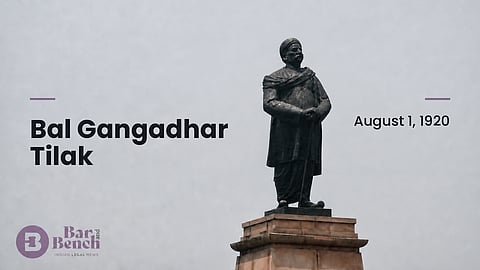
Two important events occurred on August 1, 1920. The first was the passing away of Lokmanya Tilak, amongst the tallest leaders of the freedom movement. The second was the launching of the non-cooperation movement by Mahatma Gandhi, a remarkable coincidence. It is important that we remember the trials that Tilak faced and the imprisonments he endured, which greatly contributed to India attaining freedom in the next three decades.
Tilak was the editor and proprietor of a Marathi weekly called Kesari, which published a report of the Shivaji festival that was held at Poona earlier that year. The second publication was a poem titled “Shivaji’s utterances”. Both were in June, 1897. A few days later, the Plague Commissioner of Pune, W.C. Rand, was assassinated. Tilak was charged with a sedition under section 124A of the erstwhile Indian Penal Code, 1860 for exciting and attempting to excite feelings of disaffection by these publications. He was tried before a nine-member jury, of which six were Englishmen and three Indian, in the Bombay High Court. Justice Strachey presided over the trial. The jury reached a split 6: 3 verdict with the three Indians voting in favour of Tilak. Justice Strachey accepted the view of majority and sentenced Tilak to 18 months rigorous imprisonment. The details of the trial are reported in Queen Empress v. Bal Gangadhar Tilak, ILR (1897) 22 Bom 112. It was in this case that Justice Strachey interpreted the word “disaffection” to simply mean the absence of affection, and that incitement of violence was not an ingredient of the offence. This was also the view of Petherman J. in Queen Empress v. Jogendra Chunder Bose, ILR (1897) 19 Cal 35. The judgment was clearly wrong as it failed to consider the scope of the three Explanations to section 124A. A reading of both the articles, which are reproduced in the judgment, do not indicate how they amounted to sedition under section 124A. Further, there was no link of these articles to the assassination of Rand. Tilak was represented by Dinshaw Davar before the Bombay High Court.
In the appeal to Privy Council, Tilak was represented by an eminent barrister H.H. Asquith, who later became Prime Minister. The decision of the Privy Council is reported in Bal Gangadhar Tilak v. Queen Empress ILR (1897) 22 Bom 528 (PC). It contains a summary of the submissions of Asquith, which deserve careful reading. He pointed out that the impugned judgment was contrary to the language of section 124A and that there was no link between these articles and the charge of sedition. The Crown was represented by another eminent barrister Cohen, who only submitted that: “The Privy Council will not interfere in criminal proceedings unless it is shown that there was a disregard of the forms of legal process or violation of principles of natural justice or substantial grave injustice had otherwise been done.” There was no submission on merits.
The Privy Council decision was by Lord Halsbury who merely stated that they considered the arguments of the petitioner and the summing up by the Bombay High Court and did not think it a fit case to grant leave. It is submitted that the decision of the Privy Council is also erroneous, as the case did require a judgment on the scope of section 124A and its Explanations. In particular, the meaning of the word “disaffection” ought to have been considered by the Privy Council. It is submitted that grave injustice was done to Tilak.
On April 30, 1908, Khudiram Bose threw a bomb on a train with the intention of assassinating Magistrate Kingsford. However, Kingsford had not boarded the train, but the bomb killed two Englishwomen.
On May 12, 1908, Tilak wrote an article pointing out the increasing oppression by the British. While he condemned the attempted assassination, and the death of the two English ladies, he pointed out that such acts could occur if the British administration continued its oppressive measures. The British should not feel that whatever they do would be uncomplainingly accepted by the people of India as a blessing. He also called for increasing delegation of power to Indians. On June 9, 1908, he wrote another article once again complaining about the repression by the British and pointed out that the real method of stopping the violence was to stop repressive measures, and to grant important rights of Swarajya to the people of India. Once again, Tilak was tried before a nine-jury bench before Bombay High Court, with the charge that these two articles amounted to sedition under section 124-A.
Ironically, his case came up before Justice Dinshaw Davar the very same person who represented him as advocate. It is submitted that Justice Davar should have recused himself. After an eight-day trial, he accepted the views of the majority of the seven Englishmen, and rejected the view of the two Indians who voted in favour of Tilak. The judgment of the Bombay High Court is reported in Emperor v. Bal Gangadhar Tilak 1908 (10) BLR 848. This judgment contains the text of both the articles. They do not contain anything that attracts section 124A. Justice Davar followed the earlier view that “disaffection” simply meant the absence of affection. The judge used very strong language, and held it would be a most perverted mind that would think that these articles were legitimate.
In his address to Tilak, Davar remarked that his articles were “seething with sedition” and that such journalism was a curse on the country. He pointed out that Tilak could face transportation for life, but he sentenced him only to six years of transportation to Mandalay in Burma. The following part of the judgment is memorable:
“Davar J. to Tilak: Do you wish to say anything more?
Tilak: All that I wish to say is that inspite of the verdict of the Jury I still maintain that I am innocent. There are higher powers that rule the destinies of men and nations and I think it may be the will of the Providence that the cause I represent may be benefitted more by my suffering than by my pen and tongue.”
Tilak’s words are now inscribed in marble at the entrance of the Chief Justice’s Court in Mumbai.
The horrible conditions at Mandalay Jail are set out in great detail in the authorized biography of Tilak by D.V. Tahmankar. It greatly affected his health and perhaps caused his death at the age of 64 years. However, it is remarked that he wrote a classic commentary on the Bhagavad Gita while in prison at Mandalay.

After his return from Burma in 1914, he was once again tried for sedition for delivering some speeches on Home Rule and Swarajya, but this time, the Bombay High Court held that these speeches of Tilak that called for an increasing share of political authority to Indians, and did not amount to sedition.
The law of sedition should have been replaced after independence but unfortunately continues till today. The Supreme Court also upheld its validity, particularly because of the three Explanations to section 124A. Although this section was suspended by the Supreme Court, a more regressive version of the sedition law has been enacted through section 152 of the Bharatiya Nyaya Sanhita. Similarly, section 2(1)(o)(iii) of the Unlawful Activities (Prevention) Act, 1967 defines “unlawful activity” to include any acts or words “which causes or is intended to cause disaffection against India”. It is indeed regrettable that the definition of sedition that was prevailing when India was a colony, has been made more regressive in a republican democracy. Today, virtually any criticism can be treated as amounting to “disaffection against India”, and this has serious repercussions for the freedom of the press. The trials of Tilak should have taught us punishing criticism has always proved counterproductive.
Arvind Datar is a Senior Advocate of the Supreme Court of India.