
Subscribe
Subscribe
- Latest Legal News
- News
- Law Firms
- Columns
- Interviews
- Law School
- Legal Jobs
- हिंदी
- ಕನ್ನಡ
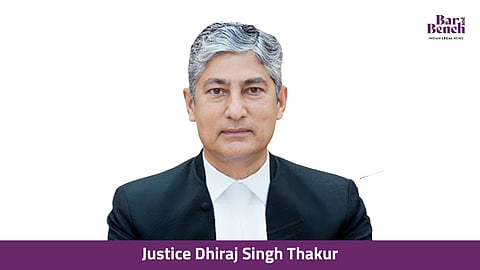
Some judges are remembered for a single judgment. Others are remembered for how they conducted their courtroom and treated the people who appeared before them. Long after his orders have settled quietly into the law reports, what those of us who appeared before Justice Dhiraj Singh Thakur will carry is harder to put into a citation: the quality of his attention and the feeling, as one rose to address the Bench, of being properly heard.
During a formative period in the life of the High Court of Andhra Pradesh, he brought to the institution a rare combination of stability, civility and judicial restraint, helping shape both its culture and its confidence.
He came to the High Court of Andhra Pradesh in the summer of 2023 as its Chief Justice, after years on the Bench in Jammu & Kashmir and a brief tenure at Bombay. In a sense, he arrived a stranger - a judge from the North taking charge of a Court still finding its feet in a young capital. Yet, it did not take him long to become the kind of presiding judge the Bar here had hoped for. His authority never depended on raising his voice; it came from the way he carried himself.
Anyone who has argued before a crowded board knows how much a judge’s undivided attention is worth and how rarely the day’s list leaves room for it. Before Justice Thakur, an advocate never had to fight for that attention. He listened. He let an argument take its own shape before he began to test it. Even when he pressed hard, he never made you feel small for having made the point.
I appeared before him in a matter that took up a good part of his last weeks on the Bench. Through every hearing, however hard-fought, the argument never gave way to heat. He met difficult submissions with patience rather than irritation and when he disagreed, he did so in a way that made you want to reconsider the point rather than abandon it. That is a rarer quality on the Bench than we like to admit and the younger lawyers who watched him will, I think, remember it as a lesson in what a courtroom can be.
AI generated summary, newsroom reviewed
The law runs deep in his family. His father was the late Devi Das Thakur, a distinguished constitutional jurist who donned many hats across law and public life. His elder brother went on to become Chief Justice of India. It is tempting to call this a judicial inheritance. Yet, what he seemed to carry forward was less a claim to office than a cast of mind, evidently passed from father to sons: that the robe is a trust and not a prize and that real authority shows itself in restraint. He held to that belief without ever feeling the need to announce it.
None of this lived only in temperament; it showed up in the work. Two judgments, to my mind, catch something of both his range and his outlook.
The first is Guntha Venkata Sai Kumar v. State of Andhra Pradesh. Sitting with Justice Challa Gunaranjan, he declined to accept that a State could not arrange bone-marrow transplantation in its own hospitals. He pressed the administration both to build that capacity and to raise the ceiling of financial assistance for the patients who needed it. It was public interest jurisdiction at its most humane: a reminder that the worth of constitutional welfare is measured by what actually reaches the people who cannot pay for it.
The second is Braithwaite & Co Ltd v. Union of India, where he restated, with his usual clarity, that the State does not leave its constitutional obligations behind simply because it has entered the field of contract. Where its conduct is so unreasonable, irrational or perverse as to fail the standard the law sets, a writ court under Article 226 will step in. The Court ultimately declined to interfere in the matter, but the judgment reflected a judicial approach that was both restrained and principled: conscious of the limits of writ jurisdiction, yet equally conscious that arbitrariness by public authorities remains subject to constitutional scrutiny.
Two very different matters, decided in different registers, and recognisably the same judge behind each.
He laid down office on April 24, 2026, after close to three years at the head of this Court. That is a long innings by present standards, at a time when many High Court Chief Justices serve only 6-15 months — barely long enough, it is often said, to learn a court before they must leave it. The length mattered. It let him settle in, take the measure of the place and become a familiar and rooted presence rather than a passing administrator, until the Bar here had come to regard him very nearly as one of its own. When he demitted office, the Court gave him a generous farewell and his successor, Chief Justice Lisa Gill, said that his work would leave a lasting mark on the judicial history of Andhra Pradesh.
The Bar at Amaravati will miss the feel of his courtroom - the unhurried hearings, the absence of rancour, the steady insistence on reasoning a matter through. Chief Justices come and go; the institution is built to outlast all of them. But now and then, one passes through who reminds the Bar why that institution is worth caring about in the first place. He was such a judge.
We are taught early that we appear before a court and never with it, and that the distance between the Bar and the Bench is real and ought to remain so. The best judges keep that distance and somehow take the chill out of it, so that even in defeat, an advocate feels the hearing was a meeting of two people working towards the same end. That is how I will remember him: a judge before whom it was a privilege to lose an argument and a greater privilege still to have stood and made one.
Shravanth Paruchuri is an Advocate-on-Record, Supreme Court of India and practises before the High Courts of Andhra Pradesh and Telangana.