
Subscribe
Subscribe
- Latest Legal News
- News
- Law Firms
- Columns
- Interviews
- Law School
- Legal Jobs
- हिंदी
- ಕನ್ನಡ
Successful careers have been built by many lawyers who have left behind significant legacies in the profession. They have pursued professional excellence and created a mark for themselves, but there are some lawyers who build and develop strong institutions. This important distinction, where individual professional standing lies independent of the more subtle but profound impact on the legal profession, is worth noting.
Those lawyers who have contributed to strengthening democratic institutions are remembered because of the influence and impact that extends beyond individual achievements.
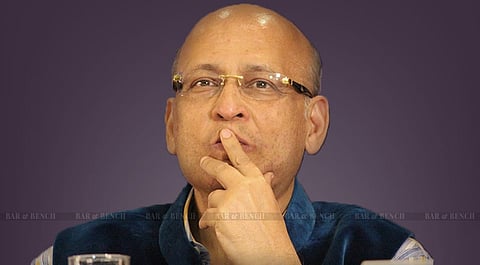
Dr Abhishek Manu Singhvi belongs to this select group of individuals who have strengthened the institution of the Indian judiciary. He is undoubtedly recognised as a constitutional lawyer, a respected parliamentarian, a prolific scholar, an inspiring speaker, a remarkable public intellectual and, most importantly, one of India's most compelling voices to protect the rule of law and to advance justice.
It is remarkable that these identities of Dr Singhvi are not separate careers but are actually running and traveling in parallel. They are interlinked facets of one single continuum of an extraordinary life. This is akin to the colours that are revealed through a prism, each manifesting a different quality while impacting the development of one coherent whole.
My inspiration for this metaphor for Dr. Abhishek Singhvi lies in a remarkable tribute by Gopal Krishna Gandhi, who described the late Dr LM Singhvi as India's Vibgyor man. The image that was reflected in that idea of the rainbow wonderfully captured the fantastic range of a life devoted to law, international relations, scholarship, public service and civic engagement. Great minds in law perform a function that is akin to a prism. They receive facts, interpret statutes, advance constitutional principles and participate in resolving conflicts. It is in this context that Dr Singhvi ought to be recognised as a prismatic lawyer.
His continuing journey and his evolving legacy cannot be bracketed through one single identity, let alone achievement. It is constantly demonstrated through multiple facets of leadership that together showcase and even illuminate the larger purpose of the legal profession.
The story of Dr Singhvi unravels itself in ten such dimensions.
1. Legacy as responsibility - There are very few people who hold public offices who inherit a legacy as distinguished as that of Dr LM Singhvi, who himself had all those great facets and remained one of India's most respected public intellectuals. Such inheritances of legacy also create expectations that few individuals can do justice to. Dr AM Singhvi decided to choose a different path. Instead of living in the shadow and the towering presence of an illustrious father, he transformed legacy and inheritance into responsibility and impact. It needs to be mentioned that the values that defined the elder Singhvi - be it scholarship, constitutionalism, civility and public service - became the foundation upon which the younger Singhvi built an identity. Dr Abhishek Singhvi created his own presence in the world of law, justice and beyond.
While the father had helped shape institutions during the early decades of the Republic, the son devoted his professional life to interpreting, defending,and strengthening these institutions in a far more complex and challenging constitutional age.
2. Evolution of an extraordinary intellect – Great advocacy begins long before the lawyer steps into the court. It begins in libraries, in universities, in academic pursuits, in scholarly engagement and in intellectual conversations. Dr Singhvi's educational journey reflects this extraordinary commitment to scholarship - from St. Columba’s School to St. Stephen's College and later to pursuing advanced studies, obtaining master's degrees in law and a PhD from Trinity College, Cambridge.
Dr Singhvi's doctoral work on constitutional emergency powers demonstrated his early engagement with serious constitutional questions that would later become and play a central role in his life as a lawyer. These questions include, but are not limited to: the inextricable relationship between liberty and power; the constitutional limitations of State’s exercise of powers; the dynamic evolution of a Constitution and democracy.
Academic qualifications of the kind that Dr Singhvi has are not mere decorations in a CV; they demonstrate something deeper. These aspects helped him develop habits of mind that later distinguished him as an enduring lawyer from merely successful legal practitioners. It also empowered him to look at disputes not from the standpoint of resolving them alone, but to recognise the larger institutional consequences of dispute resolution. His academic scholarship informed his legal practice and continues to do so.
3. The quintessential advocate - India's freedom movement itself was led by distinguished lawyers. Their education in law significantly influenced their commitment to the rule of law and values of civil liberties and freedoms. Dr BR Ambedkar, arguably the most towering jurist of his generation, helmed the transformative Constitution of India. Successive generations have produced accomplished lawyers. However, very few can become extraordinary individuals in the pursuit of excellence in advocacy.
Dr Singhvi, through his four decades of legal practice, has emerged as one of India's most respected constitutional and commercial lawyers. This was also recognised by the legal profession in his early designation as a Senior Advocate and his appointment as Additional Solicitor General. Over the years Dr Singhvi, made his appearance in some of the most influential and impactful cases in constitutional law, commercial law, taxation, arbitration, dispute resolution and public law matters before the Supreme Court of India and all high courts as well as other institutions. His arguments across the country have contributed to legal debates that have shaped the evolution of India's jurisprudence.
Dr Singhvi is widely acclaimed for his oratorical skills, but the foundation of those skills stem from his disciplined approach to legal reasoning. Successful arguments that he has pursued before the courts have been possible because of meticulous preparation, mastery of precedents and an extraordinarily intricate mind to link constitutional principles with practical reasoning.
His written submissions are rarely limited to the immediate interest of the client who has engaged him in a matter. He consistently recognises the wider implications of the questions that he brings before the court and the institutions he presents his arguments before. Leading advocates recognise that every constitutional question that gets discussed and debated in a court of law has two constituencies - the litigant before the court who is represented and the republic beyond it. This larger perspective has become one of the most inspiring features of Dr Singhvi's legal life.
4. The constitutional mind - Lawyers who practice constitutional law are many, but there are few lawyers who think constitutionally and this distinction is critical. The idea of constitutional thinking expects a different appreciation that every legal issue ultimately involves the relationship between power and restraint, between individual liberty and collective responsibility, and between governmental authority and constitutional accountability.
Dr Singhvi, throughout his career, has doggedly approached public law questions through this larger lens. This has been his well-established practice while dealing with issues of federalism, democratic governance, judicial independence, or interpretation of constitutional provisions. Dr Singhvi long recognised that the Constitution is not merely a legal document, but the moral architecture of the Indian Republic. The constitutional lawyer hence performs a very critical role in a democracy. He is not merely an advocate for a client. The lawyer is a participant in an evolving conversation through which constitutional democracy renews itself every day in every court across the length and breadth of India.
5. The parliamentarian -The transition from courtroom to parliament is neither easy nor natural. The courtroom constantly seeks precision and arguments in the pursuit of justice. Politics most often rewards persuasion. The real challenge for anyone who attempts to live both the lives of the legal profession and a parliamentarian is combining the discipline and expectations of one with the dynamism and uncertainty of the other.
Dr Singhvi's journey as a parliamentarian demonstrates this extraordinary synthesis. As a member of the Rajya Sabha. he has brought constitutional reasoning into legislative deliberations, recognising that legal scholarship has an indispensable place in public policy and law-making. His contributions have recognised that parliament, as India's leading democratic institution, is not merely a political institution. It is also a constitutional institution which is vested with the responsibility of translating constitutional aspirations into legislative reality and the lived experiences of the people.
There is something unique about lawyers who enter public life. Parliament as an institution provides an opportunity to influence the law not only through interpretation, but also through legislation, reform and re-imagination. Dr Singhvi has excelled in both responsibilities and, in that process, has become an outstanding parliamentarian who happens to be a lawyer and an outstanding lawyer who happens to be a parliamentarian as well.
6. The scholar and teacher - It is the tradition of the legal profession, not just in India but around the world, that lawyers are never confined merely to the practice of law. They work to understand it, explain it, reform it, re-imagine it, challenge it and in that process, enrich it. Scholarship in the pursuit of law is not something that runs parallel to advocacy. It is the very foundation from which informed advocacy draws its inspiration.
Dr Abhishek Manu Singhvi has constantly engaged with the world of ideas. The scholar in Dr Singhvi and his scholarly pursuits from his past have created an intellectual discipline that has found voice not only in courtroom appearances but in his lectures, seminars, writings and participation in the wider legal and political discourse.
He has constantly argued that Constitutional Law cannot be reduced to a collection of well-reasoned precedents. It is a dynamic and living conversation about liberty, governance and justice. The teacher has a special place in every professional endeavour as the art and science of teaching represents a constant investment in the future rather than the present. Every lecture delivered and, in that process, every student or young lawyer inspired, becomes part of an intellectual impact that outlasts individual careers. Dr Singhvi has advanced scholarship in that spirit. He has consistently recognised that knowledge is not private capital to be guarded, but a public resource to be shared. This recognition of a scholar and a teacher has gone hand-in-hand with his reputation as an incredibly busy lawyer.
7. The public intellectual - Constitutional democracies are in need of guardians and protectors of institutions. Undoubtedly, lawyers, judges and legislatures perform that role, but they also need individuals who do not necessarily hold power but are constant interpreters of events, activities and initiatives in society.
This role, and the recognition that constitutional questions that arise before courts eventually become questions that concern every citizen, has been the hallmark of Dr Abhishek Singhvi's pursuit in law. Public issues of significant impact need to be debated and discussed not only in the chambers of parliament and courthouses, but also need to be brought to the public domain.
Dr Singhvi has established a formidable reputation as India's most recognised legal voice. His role as a public intellectual - through his articles in the form of newspaper columns, public lectures, academic engagements, or even televised discussions - has attempted to explain complex constitutional issues with clarity and intellectual integrity.
As India moves towards the celebration of 100 years of its independence in 2047, we need to recognise that our constitutional democracy becomes stronger when ordinary citizens not only understand what the law is, but also why it matters. The public intellectual in Dr Singhvi performs that unique role as a part of civic responsibility.
8. The communicator - Among the various qualities of leadership, communication is not only among the most important but also hugely understated and underestimated. In fact, people tend to confuse communication with eloquence. The hallmark of a great communicator is the quality to make difficult and complex ideas understandable without diminishing their complexity and nuanced nature. Few working professionals in different careers are constantly required to communicate as lawyers tend to do. If you are a lawyer and a parliamentarian, you end up addressing judges in courtrooms, legislators in parliament, students in universities, journalists in public forums and citizens in the media. In fact, this communication that Dr Singhvi has devoted his life to has different audiences. The nature, the context, the scope, the impact and the intensity of each of these communications are different. The language, the emphasis and the tonality also require a different approach.
One of the extraordinary qualities of Dr Singhvi's personality has been his versatility to be at ease across these different constituencies. This is so deeply reflected in his constant navigation across these constituencies. Be it advancing a constitutional argument before the Supreme Court or participating in a parliamentary debate or explaining and debating legal developments to the wider public through media platforms as well as seminars and conferences. At a time when public discourse is shaped by brevity, immediacy, or expediency, Dr Singhvi's commitment to communicate constitutional values with extraordinary balance and utmost clarity has become his hallmark.
9. The institution builder - Building a successful career is the hallmark of any successful professional. However, there are few who build institutions and thereby leave a mark on every generation that follows. This distinction is the true test of leadership, which establishes institutions and does not make them automatically enduring. These institutions that were established through the Constitution endure only because every generation had individuals of integrity, scholarship and commitment who contributed towards strengthening these institutions through their work.
The judiciary as an institution draws its authority not only from the exalted constitutional status it occupies, but also from the reputation and standing of the advocacy that assists them. Similarly, parliament as an institution derives its legitimacy not merely from electoral mandates but from the seriousness of its discussions, debates and deliberations.
Looking at Dr. Abhishek Singhvi's career through this wider lens, it demonstrates a constant and enduring commitment to institution building, whether in the courtroom, parliament, academic institutions, or public discourse. His contributions have been guided by a recognition that strong institutions remain India's greatest safeguard. Individual success of lawyers and parliamentarians may be celebrated in its own time. Institutions sustain across generations. This is the highest calling of leadership and to leave behind institutions stronger than one found them is a rare quality that few possess.
Dr Singhvi has made an imprint on strengthening each of the institutions that he has contributed towards.
10. The citizen lawyer - Historically, the profession of law has always been seen as a noble profession. The nobility of the legal profession is not measured on the basis of the individual success of a lawyer. It is about a lawyer's contribution towards society. Dr. Singhvi's contribution, all through his public service, has recognised that legal practice, scholarship and commitment to institution building need not be separated to be lived in independent compartments. They are interlinked and complementary expressions of a single vocation.
He has consistently recognised the role of a citizen lawyer, where contribution to public engagement is part of his role as a lawyer. This includes not only appearing before constitutional courts and participating in legislative debates but, most importantly, engaging with students or contributing to public discourse.
Dr Singhvi's work reflects an everlasting commitment to the constitutional life of Indian democracy. A lawyer is a citizen entrusted with the responsibility of defending the institutions upon which democracy itself depends on, as well as informs and improves. This responsibility to be a citizen lawyer demands not only professional excellence, but also a deep sense of constitutional conviction.
The prismatic lawyer, Dr Abhishek Manu Singhvi often talks about the fact that the law is a jealous mistress. It demands complete devotion from those who choose to serve her. Yet, it is equally true that the journey of Dr Singhvi, who has continued to leave deep imprints upon public life, has rarely been confined to a singular professional identity. He has drawn strength from the convergence of many dimensions, which include but are not limited to, scholarship; advocacy; constitutional vision; public service; civil society engagement; communication; and institutional leadership.
That is why the metaphor of the prism seems particularly apt for Dr Singhvi. A rainbow delights because it displays colour. A prism fascinates because it demonstrates what light truly contains. The late Dr LM Singhvi was remembered as India's Vibgyor man because his life demonstrated an extraordinary array of public service. Dr Abhishek Manu Singhvi has honoured that legacy. He did it by not just replicating it, but by extending it through a career that is uniquely and unmistakably his own.
Prof C Raj Kumar is the Founding Vice-Chancellor of OP Jindal Global University and President, World University Leaders Forum.
