
Subscribe
Subscribe
- Latest Legal News
- News
- Law Firms
- Columns
- Interviews
- Law School
- Legal Jobs
- हिंदी
- ಕನ್ನಡ
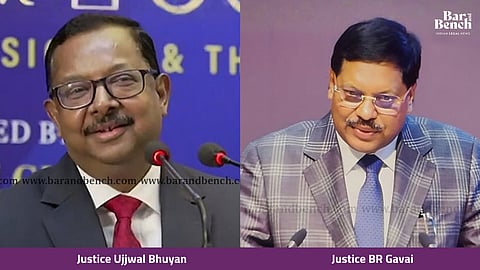
Recently, former Chief Justice of India BR Gavai criticised sitting Supreme Court Justice Ujjal Bhuyan for the latter's public remarks on the right to vote.
In a speech delivered on October 4, Justice Bhuyan had said that any process which disenfranchises millions of Indian citizens is intrinsically arbitrary and a negation of the constitutional order.
No "whataboutery" can justify the act of taking away voting rights of citizens, he said.
"If any process results in disenfranchising millions and millions of Indian citizens making them second class citizens in their own country in the sense of being citizens without voting rights, such a process is intrinsically arbitrary. No amount of whataboutery can justify it. It strikes at the very heart of the Constitution and I would go to the extent of saying that it is a negation of the constitutional order which we have adopted under the Constitution of India."
He added,
"Indian Constitution does not provide for two classes of citizens: citizens with voting rights and citizens without voting rights. Any process which leads to wholesale disenfranchisement of Indian citizens making them citizens without voting rights would be violative of Articles 326 and 14 of the Constitution of India."
He made it clear that no institution was exempt.
"No authority can do it; no court can condone it. No one is above the Constitution," he declared.
On the deletion of names from electoral rolls, Justice Bhuyan was categorical.
"Except in the case of a dead voter, the name of a voter once enlisted in the electoral roll cannot be deleted without notice and hearing. From the persona of an Indian citizen, the right to vote or right to be included in the voters list cannot be detached. It will be like taking out the soul from the body."
While he did not name any body or action specifically, it was widely interpreted as a criticism of the special intensive revision (SIR) of electoral rolls being undertaken by the Election Commission of India (ECI).
The Supreme Court had in May this year already upheld the Constitutional and legal validity of SIR, though it is continuing to hear various individual aspects as regards implementation of SIR in certain States.
Justice BR Gavai, it has to be understood, was taking objection to what he deemed to be a sitting judge commenting on a sub-judice matter before the apex court.
In this context, the question arises: Can sitting judges be proscribed from making remarks about legal issues that have already been decided?
In this present case, the legality of the SIR was already decided in May. Various individual aspects are still pending consideration before another bench, of which Justice Bhuyan is not a part. So, does that stop him from speaking about the subject? Does it go against judicial propriety?
To answer these questions, it would be worthwhile to examine how judges in India have approached the "judges speak only through their judgments" norm over the last few years.
Starting with Justice Gavai, it was his statement to a newspaper while serving as a sitting judge of the Bombay High Court in 2017 that was heavily relied upon by the Supreme Court to close a batch of petitions seeking a probe into the death of Judge Loya.
While Justice Gavai is fastidious about judicial propriety, the same did not deter him from giving a public statement through the media about an incident that many alleged back then warranted a thorough probe.
The fact that the issue was never investigated and never went to trial meant that Justice Gavai's statement escaped cross-examination; instead it was accepted as gospel truth by the Supreme Court in writ petitions before it.
Around the same time in 2018, four sitting judges of the Supreme Court though it fit to hold a press conference to flag the then CJI's exercise of powers as the master of roster.
This press conference was triggered by the same issue on which Justice Gavai had given an interview - the listing of the case on the death of Judge Loya.
The judges came under fire from various quarters for what many considered to be a breach of judicial propriety.

In February 2020, then Supreme Court Justice Arun Mishra described Prime Minister Narendra Modi as a "versatile genius, who thinks globally and acts locally."
Various bar associations took exception to a sitting judge making such remarks about the head of the government.
Such statements by a sitting judge for the Prime Minister of the country reflect poorly on the independence of the judiciary, SCBA said.
Justice GR Swaminathan, a sitting judge of the Madras High Court, has been steadfastly hearing the Deepam lighting case. He has been passing one order after another to ensure that Karthigai Deepam lamp (to mark the Hindu festival of lights) be lit on the Deepathoon (stone lamp pillar) atop the lower of two summits of the sacred Thirupparankundram hillock.
Many of those orders have been criticised on merits, but that is a discussion for another day.
What was noteworthy was his comment at a public event that the "day to light the lamp" will arrive soon, a reference to the hillock lamp lighting case which he had been hearing.
The comment seemed to echo his personal inclination as regards the contentious case which he himself was hearing.
Post COVID, judges, particularly Chief Justices, made it a habit of travelling around the country and delivering speeches on legal topics.
Many of them waxed eloquent about how the Indian judiciary saved India and Indians through those difficult times and how democracy is safely resting on the broad shoulders of the pillar of justice - Supreme Court of India.
These included former CJIs NV Ramana, DY Chandrachud and Justice Gavai himself.
Judicial propriety requires judges to maintain absolute silence - whether it is about praising the court or deriding it.
A traditional understanding of judicial propriety would then mandate that judges can speak only through judgments without blowing their own trumpets about it.
If it is considered proper for sitting judges to travel widely and parade what they consider achievements of the institution, they ought to also learn to digest criticism of the same institution, especially by one of their own.
If a sitting judge can speak about a case which he himself is hearing and also divulge his personal opinion on the issue, would it be correct in restraining a sitting judge from speaking about a legal issue or case which he has never heard/ is hearing?
What is good for the goose is good for the gander.
Disclaimer: The views and opinions expressed in this article are those of the author's and do not necessarily reflect the views of Bar & Bench.