
Subscribe
Subscribe
- Latest Legal News
- News
- Law Firms
- Columns
- Interviews
- Law School
- Legal Jobs
- हिंदी
- ಕನ್ನಡ
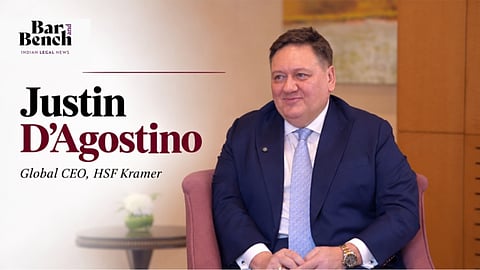
Justin D’Agostino landed in Mumbai straight from HSF Kramer’s first-ever global partner conference in Hong Kong.
18 months after the combination between Herbert Smith Freehills and Kramer Levin, the firm’s Global CEO chats with Bar & Bench's Pallavi Saluja about the firm's position post the combination with Kramer, fallout at Weil Gotshal & Manges, star partner pay, the firm's approach to AI and more.
[Watch Interview]
Edited excerpts follow.
Pallavi Saluja (PS): This is your first visit to India as Global CEO of Herbert Smith Freehills Kramer. What brings you to Mumbai?
Justin D’Agostino (JD): It is my first trip as CEO, but I’ve been coming to India for more than 20 years, since I was a junior lawyer. As an international arbitration partner, India was a big part of my practice. So it’s exciting to be back in this capacity. It was a trip down memory lane and a reminder of the amazing Indian talent we have in the firm, which I’m very proud of.
I’m here for two things: to see our clients and friends, and for the Earthshot Prize, which Mumbai is hosting this week. It's a fantastic annual event that the Prince of Wales hosts around the world every year and this year, it's India's turn to host. We are one of only a few global alliance members of the prize and the only law firm involved. The prize aims to help save our planet, which is quite a big objective, a big aspiration. It offers funding, mentoring and legal advice to businesses around the world that are building and scaling initiatives to that end. Over the years, we’ve given the finalists and winners thousands of hours of pro bono support.
The prize winners are often small companies or even groups of individuals. One year, it was a group of Indian women farmers with an idea for saving crops that would otherwise be destroyed. The prize helped them scale that idea across India and beyond. They all need legal advice, they need to raise finance and they need to enter into contracts. We’ve done that pro bono and we’re very proud of it.

PS: How would you describe the firm's current position 18 months after the Kramer combination?
JD: I landed in Mumbai at three o’clock this morning, straight from our first-ever global partner conference as Herbert Smith Freehills Kramer, in Hong Kong over the weekend. It was the first time since we combined that our whole global partnership was in one place: 650 people in the room. It felt amazing to be together.
We're really excited about where we're sitting in the market. Herbert Smith Freehills was, I think, the last top-tier international firm without scale in the United States. Our clients were telling us they wanted us there. At the same time, Kramer Levin’s leadership was having the same conversation about internationalising. We were fortunate to meet and together, we’ve created a global firm in all the major financial centres, with deep expertise in transactions and disputes.
We’re very happy with our progress, but there’s lots more to do. I’m hoping we will open in Texas in the first quarter of next year and we’re building our business in New York, Washington and on the West Coast. That matters for our Indian clients too. The India–US corridor is enormous and strengthening and we want to be very much part of it.
PS: What strategy did you set for the coming year at the partner conference?
JD: An event like that has two objectives. The first, and probably the most important, is getting everyone together to meet, make connections and collaborate, so people understand what this global firm is. Law firm partnerships are all about culture, the glue that holds you together. The time you spend on that is really important.
The second objective, of course, is to look at the horizon for our clients and our firm. We spent a huge amount of time on how AI will affect Big Law and our clients, and the opportunities it brings. We discussed geopolitics and megatrends. The world needs more energy. It is building more infrastructure, including digital infrastructure, and it is doing more mining for the critical minerals that drive everything. Our firm is one of the leading energy infrastructure and mining firms in the world. We really are in the leading pack of global law firms in those sectors, so we spent a lot of time on how those sectors are evolving.
We also looked at tech, at global disputes, where we’re very strong in international arbitration and litigation, and at transactions and projects.
PS: Cross-border law firm mergers have historically faced challenges around culture, compensation and integration. What were the biggest challenges in bringing the two firms together and how confident are you that the integration has worked as envisaged?
JD: We tested a lot before we combined and we realised early on that our cultures were aligned. We’re like-minded: very client-driven, very people-centric. From my early meetings with the Kramer leadership, I knew they were all about their people, developing their teams and partnership. That’s our firm too.
We took the first year to design a new partner remuneration scheme that delivers for the global firm and that was voted through earlier this year. So, the difficult things are done. Now it’s all about our clients and the synergies. We’ve been lucky with integration. I know some law firm mergers have had a more difficult path, but we had little overlap between our offices or our work. It was very complementary.
PS: Like you said, you were the last of the top international firms to do a transatlantic merger and we’ve since seen a wave of them. Is scale now a prerequisite to compete globally?
JD: I’d say our combination was both transatlantic and transpacific. Some mergers have focused only on the transatlantic, but HSF Kramer has an enormous Asia Pacific business. Our businesses in Australia and across Asia are critical to our global position, so the Asia-US corridors were just as important to us as the UK/Europe-US ones. That’s what makes our combination unique: our transpacific strength matches our transatlantic strength. We’re seeing huge investment between Japan, the Asian markets and the US, just as we are from the UK and Europe.
Scale is important. Our clients are global. They operate in all the major financial centres and markets, and they want their legal advisors there with them. If you want to be one of the world’s leading firms, you need to be in these markets. One of our slogans is that “we are a global legal powerhouse where our clients need us” – and we are in all those markets.
PS: What was your reaction to what happened at Weil? Why do you think it happened and could it happen to your firm?
JD: I think we were all saddened by the story around Weil. It’s been a big topic of conversation in our partnership; it came up in my meetings in Mumbai today. People are shaken and sad that a firm of such quality has ended up in this position. It has made our partners and our people reflect.
What it shows is what I talked about at the start: the importance of culture and glue, of strategy, of leading in your markets and being the platform people want to be on, and of building client relationships across teams. In our firm, clients aren’t held by one partner. They are serviced across offices, practice groups and regions, so many of our client relationships are very institutional. That’s a big part of our culture.
So my big reflection is that it’s a reminder to work hard on the culture of the firm and make it a place where people want to be. We’re trying to create a very inclusive environment. It doesn’t matter what your background is, the colour of your skin or your accent. If you work hard and you’re good, you can thrive in a firm like ours.
In the meetings I was in today, all but one of the HSF Kramer partners were lifers and the other joined us soon after qualifying. I think that says something. The same goes for our business services people. My EA joined the firm when she was 18 and she’s here with me. That takes work and attention, and it’s something I’ve been very focused on as leader of the firm.
PS: Reuters has reported star partner packages above $20 million. Is Big Law creating partners who are bigger than the firm itself?
JD: Every firm is different and every firm has its own way of remunerating and attracting the people it wants. That’s not the culture of our firm. We’ve built one of the world’s leading global law firms where we can pay our partners at market without creating a star culture, where one or two partners stand out from the rest. We’ve got dozens of people like that in our firm.
PS: US firms are competing hard on pay and lateral hires. How do you stay competitive on remuneration while protecting the culture and profitability of the firm?
JD: I think it’s straightforward. We are competitive on remuneration. But people want to be at a firm that leads in their area. If you want to be an international arbitration partner in London, you want to work for HSF Kramer. That’s what drives people. They want quality work; they want to act for the best clients in their market; they want an inclusive culture; they want to be developed, pushed and tested, and they want to be paid well. Pay is one element of the package. You’ve got to be competitive, but you’ve got to get everything else right.
PS: You mentioned AI in the beginning. International firms have been making big AI announcements. What is HSF Kramer doing?
JD: The legal sector is going to be transformed over this next period by technology and AI. The sector has operated in much the same way for 200 years. This technology is amazing. It’s learning very quickly and it can make us better lawyers. It can make our business services teams more success too, whether you’re in business development or HR. People who work in law firms, lawyers or not, are going to become super-users of this technology. They’re going to become legal engineers in their own right.
That’s quite exciting for young people, from my conversations on campus and with people joining the firm. Yes, we’re all a bit daunted by the change. But many are already tech-native and excited to learn these tools. If I were starting out, I’d be excited about what our profession will look like. It will look very different, and people will need different skill sets.
Today, we announced that we’re hiring a team of legal engineers from Norm AI, one of the AI-native law firms that have been set up. They’ll help us redesign workflows. Take an M&A deal: you can map every step from the client’s first phone call to completion and work out where technology can help at each step. That will change how we do M&A, how we run a dispute, how we do a financing.
AI is also going to affect how we price matters. Law firms are all looking at how to be more innovative. At our conference in Hong Kong, we had a panel of clients telling us they want more innovative pricing: fixed fees, capped fees. One described a matter where they’re saying, "Let’s price at the end. Let’s look at how well you’ve done and then work out what it should cost.” That’s very different from charging by the hour.
PS: How did your partners react to that?
JD: I could hear an audible gasp from the room. Of course, that’s not how we’re going to price everything. The point is that clients now want a conversation with us about how AI and technology will affect our business model. They know we’ve got to turn a profit and pay salaries. They want the best lawyers and they want to talk about pricing differently. We’re already looking at that quite deeply.
The picture I'm painting is a profession which could look very different over this period. I have no doubt AI is going to have a major impact. So we are investing heavily. We were one of the first law firms in the world that hired a Chief AI Officer 12 months ago, who's based in New York. She has a global role and she's building an AI native team around her, including the announcement today from Norm. But our firm has got a very strong DNA in this. We set up a technology-enabled business 15 years ago to run large-scale document production, document review, disclosure and discovery for major arbitration and litigation. That was all tech-enabled. So I'm not fearful of what AI is going to bring. We have built all the muscles around it and I am excited.
PS: There’s a lot of anxiety among junior associates. Does the traditional associate-to-partner career path need a fundamental rethink?
JD: There is anxiety. But when I talk to people about how this technology will be used, it’s quite exciting for that generation. What people are anxious about is whether it will do away with the ranks of lawyers. It won’t. Lawyers will be doing things differently.
Here’s a real example. When we opened the Belfast business 15 years ago, which focused on document review, people said, “That’s what our junior lawyers do. You’re going to put them out of a job.” That’s not what happened. Those junior lawyers did more high-end work, more interesting work, different work. That’s what will happen now. I can sense the anxiety, but I’m hopeful this will create more opportunities for people.
PS: You ran HSF Kramer’s global disputes practice and I'm sure you worked with India quite a bit. How do you think India has performed in arbitration?
JD: India is an enormous disputes market and an enormous arbitration market within that. India has worked hard to keep moving forward - its arbitration laws, how the courts support the arbitral process - with real effort from the top down, from government and from practitioners. And it shows. We’ve seen huge progress over the last decade or so and investment in arbitration talent here. We’ve also seen Indian arbitration’s relationships with Singapore, Dubai, London and Hong Kong grow, and the work increase.
PS: While we're talking about India, your new India co-heads are both Indian law graduates. Is that a statement about where the firm sees India's talent pipeline, or is it just a coincidence?
JD: It’s definitely not a coincidence. We’ve invested in our Indian talent pipeline for 20 years or more. One of our India co-heads tells the story that the very first Herbert Smith lawyer he met and had a beer with at his university in Jodhpur is now the CEO. I was very involved in that recruitment strategy. We decided early on that we wanted to tap into the enormous talent coming out of India. The universities are excellent. People are fluent English speakers with an international mindset. They want to travel and work in other markets. We saw a huge opportunity in that talent pool. It was a strategy and an investment, and I’m incredibly proud that our two new co-heads are from that investment.
PS: What are your expectations from this new leadership and what are you asking them to do when it comes to India?
JD: The first thing I’ve said is world domination. That’s what they’ve got to achieve over their term.
Beyond that, our India practice has always been both inbound and outbound. We’ve acted for the major Indian corporates for decades, including on many of their very early investments around the world, particularly in the UK. Those relationships are decades in the making. It's an amazing success story. Increasingly, we also advise international players investing in India or with Indian parties. So the new leaders are focused on strengthening both the inbound and the outbound sides.
We’re seeing much more private equity and huge investment in digital infrastructure and data centres. We’re seeing India investment along new corridors. India–Japan didn’t feature several years ago the way it does now. We’re doing lots of work on the India–China corridor, as well as the more traditional corridors. They have a strong brand and platform to build on; coupled with the commitment from the firm.
PS: Will we see HSF Kramer open an office in India any time soon?
JD: Well, never say never.