
Subscribe
Subscribe
- Latest Legal News
- News
- Law Firms
- Columns
- Interviews
- Law School
- Legal Jobs
- हिंदी
- ಕನ್ನಡ
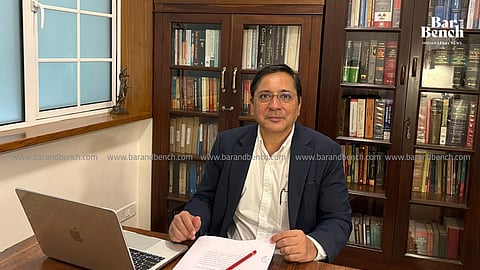
Long before he shaped judicial policy from the Bench, Justice Nitin Jamdar was in the Himalayas tracking bird speciation alongside a University of Chicago ecologist. That early commitment to scientific inquiry became the defining framework of his legal career.
Born into a family where public service was a way of life, his roots run deep: a freedom-fighter grandfather who was a Sanskrit scholar and advocate, a grandmother dedicated to women’s empowerment and a father who helped establish Solapur’s first law college before serving as a Bombay High Court judge.
Raised in Marathi-medium zilla parishad schools before moving to Mumbai, Justice Jamdar’s path uniquely connected rural Maharashtra with metropolitan legal practice. He spearheaded the Bombay High Court’s first e-court in 2013 and authored its Registry Handbook.
He views efficient court management as a pillar of judicial credibility. He insists that PILs should be used to repair failing statutory institutions, not replace them.
In this interview with Bar & Bench’s Neha Joshi, Justice Jamdar reflects on scientific rigour, structural court reform and the living social purpose of the law.
Edited excerpts follow.
Neha Joshi (NJ): What shaped your mind as a judge of the High Court?
Justice Nitin Jamdar: Growing up, law, public affairs and public duty were part of everyday life at home. Discussions on these topics were, therefore, quite natural at home, with an awareness that law was not merely a profession or a means of livelihood but had a larger social purpose.
Influences outside law also shaped how I approached legal questions. During my student years, I researched bird distribution in the Himalayas with a Professor at the University of Chicago and authored scientific papers. As my legal commitments increased, natural history gradually became a hobby. But the discipline of scientific inquiry in those formative years stayed with me: how to begin with a proposition, examine the evidence and guard against assumptions.
My education in schools across Maharashtra, colleges in Mumbai and extensive reading in my formative years further grounded my perspective. Later, during practice, the Bar served as a vital institution of learning.
As a judge, unlearning was perhaps more challenging than learning. I had to practice listening to understand both sides and deliberately guard against confirmation bias, premature conclusions and reasoning errors.
Closely tied to this is procedural justice. A judicial decision does not command respect merely because it has been made by a judge. Its legitimacy rests substantially upon the process by which it is reached. It is that both sides receive a fair opportunity, arguments are heard, relevant material is considered and the conclusion is supported by reasons.
NJ: Where do you see the greatest avoidable waste of judicial time?
Justice Nitin Jamdar: A court system cannot become efficient in isolation. Judicial time is lost to varied factors: from incomplete pleadings and unprepared advocates to transport disruptions and power outages. However, addressing pendency requires looking beyond simply increasing judges or reducing adjournments. We must examine how existing judicial time is lost to avoidable or mechanical work.
First, in cases that require repetitive data analysis (applying settled parameters to defined facts), carefully designed software tools for pre-decision steps can be used, keeping final decision-making intact with a judge.
Second, judgments frequently rewrite extensive factual histories merely to demonstrate application of mind. Where an appellate court agrees with a well-reasoned trial court judgment, rewriting facts can be reduced.
Third, judges spend several hours on non-judicial administrative tasks like building repairs, tenders, inspections and conferences. A dedicated administrative cadre for judicial infrastructure would free considerable judicial time. Hybrid meetings could eliminate unnecessary travel.
A system-wide time-and-work audit where there is a leakage of judicial time needs to be undertaken. There is also a larger point: disposal alone cannot measure efficiency. If the same category of disputes repeatedly comes before the courts, we must address the root cause. It could be: an unclear policy, a defective procedure, inconsistent administrative decisions, or failure to follow settled law.
NJ: How can government litigation be streamlined to curb unnecessary cases?
Justice Nitin Jamdar: The government must manage its litigation as an institutional system rather than thousands of isolated cases. Defensive litigation arises when officers file unnecessary appeals to avoid personal scrutiny. Departments should establish senior legal screening committees to make reasoned institutional decisions on appeals, shielding individual officers from personal risk.
Governments should also strictly enforce monetary thresholds. Spending ₹50,000 to challenge a ₹10,000 award simply because a legal remedy exists is counterproductive.
Moreover, recurring litigation should trigger policy reviews. When a High Court strikes down a policy or a government resolution, the State should promptly choose to either appeal or accept the ruling and correct the policy department-wide. Litigating settled issues repeatedly wastes enormous resources.
A responsive software-based system should be introduced so that government pleaders receive instructions within fixed, non-negotiable time windows.
NJ: What are your experiences in the process of digitisation of courts and how are digital tools and AI reshaping court functioning?
Justice Nitin Jamdar: The difficulties that litigants face arise primarily on the administrative side of the court: filing, scrutiny, payment of court fees, service of process, listing, movement of papers, obtaining information and securing copies of orders. These are precisely the areas where technology makes an immediate difference. The COVID-19 pandemic highlighted technology's role in preserving access to justice. Today, technology is no longer an isolated project driven by enthusiasts; a newer generation of judges and advocates naturally uses digital systems.
As an expert noted, there is an important distinction between digitisation and digital transformation. Digitisation involves technology, but transformation changes processes, habits, mindsets and institutional culture. Without understanding existing processes, we risk reproducing inefficient physical workflows in digital form.
Integration is equally vital. Filing, scrutiny, fees, service, listing, hearings and orders should form a single information flow, allowing electronic records to travel seamlessly from trial courts through the appellate hierarchy. Because courts are legacy institutions, the hardest shift is cultural. Many staff members were recruited for a non-digital era. Technology must be jargon-free, user-centric and participatory, involving the people performing the tasks in designing the systems.
Technology made many things possible that were previously unimaginable. However, merely because something is possible does not mean it should be automatically adopted. The ultimate test of digital transformation remains whether it genuinely improves the delivery of justice.
NJ: What are your views on live streaming of court proceedings?
Justice Nitin Jamdar: I doubt equating "open court" with live-streaming every proceeding to an unlimited audience. We must first define the objective: transparency, access, legal education, or accountability?
If the purpose is legal education, context becomes important. A 20-second extract from a two-hour argument on social media may convey precisely the opposite. A tentative observation by a judge, or a sentence from an advocate's argument, may acquire a very different meaning when separated from what came before and followed it.
Moreover, courtrooms are not broadcast stages. Judges test arguments through tentative observations. Being conscious that every observation may be extracted, could alter the natural process. There are better ways of ensuring accountability than broadcasting hearings live to every mobile device.
Privacy issues also arise and proceedings may be exploited for publicity or mischief.
Recordings raise questions about their evidentiary status; can a party rely upon it on appeal to establish that a particular submission was made? How long should recordings be preserved? Who should be permitted to reproduce or edit them? These questions require clear answers. Controlled virtual access may in appropriate cases achieve the object. Litigants, advocates, accredited journalists, researchers and others with a legitimate reason to observe proceedings may be granted access where the rules permit.
NJ: How did environmental litigation play out in Maharashtra versus in Kerala?
Justice Nitin Jamdar: Kerala lives with environmental law every day. As a narrow strip between the Western Ghats and the Arabian Sea, its dense habitation, forests, plantations, rivers, wetlands and coastline constantly intersect with agriculture, infrastructure, tourism and conservation. Rural issues immediately impact urban areas. Landholding also presents distinct dynamics.
While Maharashtra's environmental disputes largely involve public forest lands and state projects, Kerala's history of private plantations adjoining ecologically sensitive areas causes environmental protection to intersect directly with private property rights.
Kerala's paddy lands double as seasonal wetlands, involving complex questions of drainage, food security and land conversion. Immediate human-wildlife conflict, like elephant intrusion, further makes environmental protection very concrete.
Maharashtra has substantial litigation concerning central/eastern forests, mangroves, coastal regulation, urban development, pollution, tribal areas and water scarcity.
While civil society may understandably approach these issues emotively, the courtroom requires rigorous legal analysis.
Environmental enforcement extends beyond PILs. Underutilised statutory and criminal remedies exist such as magistrate powers under the Code of Criminal Procedure regarding public nuisances. One of the Supreme Court's early decisions on environmental pollution, the Ratlam Municipality case, arose from proceedings initiated by local residents before a magistrate under the Code of Criminal Procedure.
Legal aid programs should educate citizens on these remedies to complement or reduce reliance on PILs.
NJ: What do you think about the environmental impact when it comes to mangrove protection, especially in Mumbai?
Justice Nitin Jamdar: Mangroves are vital to coastal ecology, particularly in Mumbai. Public infrastructure projects frequently impact mangroves, but environment and development should not be viewed as an absolute binary. Public interest lies both in completing infrastructure projects and in preserving mangroves, preventing erosion and protecting coastal ecosystems.
The Bombay High Court has established strong safeguards for the protection of mangroves. Broadly, it has placed an embargo on destroying mangroves except for public projects, where project proponents must seek permission from the High Court. In many cases, the public importance of the project is not seriously disputed, but that finding should not automatically lead to permission to cut the proposed number of mangroves.
Judicial scrutiny of such applications must examine:
Does the project genuinely require destroying the proposed number of mangroves?
Have alternative alignments or designs been evaluated to minimise the impact?
Is there a feasible alternative that avoids permanent ecological loss, even if it involves additional expenditure at a reasonable price?
Is cutting mangroves merely a cost-reduction measure?
Are the compensatory and restorative measures adequate and enforceable?
While courts do not redesign projects or substitute technical opinion for engineering expertise, they must verify whether cutting mangroves is absolutely necessary. Courts can seek expert input or appoint an amicus curiae when applications are uncontested, often finding ways to save significant mangrove areas while allowing projects to proceed sustainably.
NJ: What key administrative reforms did you initiate during your tenure in the Bombay and Kerala High Courts?
Justice Nitin Jamdar: High Court administration is necessarily collective. In an administrative position, one can identify structural problems, bring relevant people together and initiate reforms. One was to focus on case classification and listing, because unless cases are properly categorised, pendency cannot be accurately tracked.
At the Bombay and Kerala High Courts, we found that matters that did not fit into an existing assignment remained under broad residual categories. Registry teams audited vague residual categories (such as "not assigned to any Bench") and undated cases in the case information system to ensure listing certainty. Fully pleaded matters were systematically prioritised on regular-hearing days to advance them toward adjudication. Internal practices that delayed cases were re-evaluated to ensure court procedures facilitate rather than obstruct justice.
Technology was another continuing reform area. When Maharashtra's first e-court was established in 2013, the surrounding digital ecosystem was still developing. By the time I served in Kerala, technological possibilities had advanced considerably. An important project in Kerala was transitioning a judicial district to completely paperless functioning. Digitising filing and scrutiny eliminated physical file movement and repeated visits by litigants. eFiling initiatives were also introduced through jails.
In Maharashtra, committees were constituted to identify infrastructure and security difficulties faced by women advocates, litigants and court staff. At the Maharashtra Judicial Academy, digital classrooms were introduced so judges could learn court technology using the exact systems they would operate.
We adopted a similar approach in Kerala to upgrade mediation centres for privacy and dignity. After gathering data from mediation centers across the State, the High Court administration, the legal services authority and government departments jointly created a mechanism to address mediation infrastructure continuously.
NJ: What are your plans post retirement?
Justice Nitin Jamdar: In my view, there is an important distinction between viewing judicial office as power versus regarding it as duty. If seen as a source of power, retirement may bring a sense of loss; if understood as a duty, then when the duty comes to an end, the feeling can instead be one of fulfilment and completion.
Arbitration offers an engaging new phase, allowing me to focus on complex substantive law, which I have always enjoyed. It permits deeper engagement with complex facts and law alongside a balanced schedule.
On the Bench, heavy boards left limited time for academic study. I now have the opportunity to read and reflect on foundational laws, legal philosophy and jurisprudence.
Furthermore, law has never been my only interest. My engagement with photography began in 1981, working first with film and later with digital cameras. Over the years, this has involved travel across India, with a particular interest to photograph people engaged in manual labour. This is part of a continuing project titled 'Documenting Work'.

I have also returned more actively to ornithological fieldwork in the Himalayas. Marathon running was another regular activity I plan to resume.