Government has been lackadaisical in addressing NCLT’s problems: Senior Advocate Sanjiv Sen

Sen calls for urgent action on vacancies, infrastructure and staffing, while warning against delays caused by frivolous litigation and judicial interference.
Senior Advocate Sanjiv Sen
Published on
7 min read
Listen to this article

Senior Advocate Sanjiv Sen has criticised the Central government for not being proactive in addressing institutional and infrastructural problems confronting the National Company Law Tribunals (NCLTs).
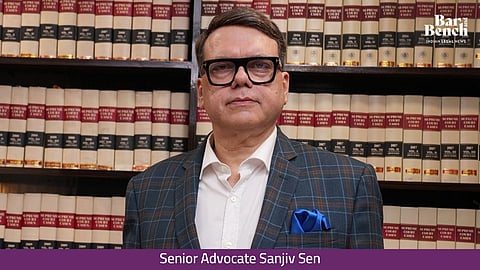
Sen has an extensive commercial law practice, with particular experience in company law, insolvency, taxation and arbitration. He regularly appears before the Supreme Court, High Courts, the NCLT and the National Company Law Appellate Tribunal (NCLAT). His insolvency practice has included significant matters involving Jaypee Infratech, Essar Steel and Bhushan Power and Steel.

In an interview with Bar & Bench's SN Thyagarajan on the occasion of the tenth anniversary of the Insolvency and Bankruptcy Code (IBC), Sen discussed the functioning of the NCLTs and the NCLAT, delays in insolvency proceedings and the treatment of operational creditors.

Edited excerpts follow.

SN Thyagarajan (SNT): It has been a decade since the NCLT and NCLAT came into being. How do you assess their performance? Have they created an effective tribunal system?

Sanjiv Sen (SS): Speaking personally, I feel that tribunalisation of justice is something I am against in an ideal situation. Ideally, High Courts should hear all matters, including commercial matters, tax matters and the other matters that have been assigned to tribunals. But the High Courts have their own problems. The combined pendency in the High Courts and subordinate courts is more than 5 crore cases. It has been assessed that at the current rate of disposal, it would take more than 3 centuries to clear the present backlog. We cannot remain in a Utopian world. Tribunalisation has, therefore, become necessary for the faster disposal of cases.

The NCLT began functioning in 2016 and assumed jurisdiction over company law matters. The IBC came soon thereafter and gave the NCLT its present form. However, after the advent of the IBC, greater emphasis has been placed on insolvency cases rather than pure company law matters. Pure company law cases have been put on the back burner. Those cases are accumulating and are not being disposed of properly.

Overall, consolidating these diverse jurisdictions in one tribunal has been a very good move. The NCLT is specialised and compact. It has the necessary wherewithal and gives much shorter dates than the High Courts traditionally did. It is certainly a good and welcome step to have one tribunal deciding all these matters.

NCLT and NCLAT
NCLT and NCLAT

SNT: Why are NCLT and NCLAT matters facing substantial delays?

The infrastructure is deeply unsatisfactory. The Principal Bench in Delhi is situated in a high-security area next to the Indo-Tibetan Border Police. Every lawyer must obtain an entry pass. Why should lawyers require passes to enter a tribunal?
Sanjiv Sen

SS: The infrastructure is deeply unsatisfactory. The Principal Bench in Delhi is situated in a high-security area next to the Indo-Tibetan Border Police. Every lawyer must obtain an entry pass. Why should lawyers require passes to enter a tribunal? The courtrooms are small and frequently overcrowded. Sometimes, the air-conditioning does not work. Leakages have also forced proceedings to stop. The NCLT must be housed at a proper venue with easier access, adequate courtrooms and the necessary infrastructure.

Although several vacancies have been filled this year, more than 15 remain. The NCLAT has been without a Chairperson since July 1, I believe. There is no reason why a successor should not be appointed immediately after the previous Chairperson demits office. More than 80 per cent of the NCLT’s staff is temporary and has no job security. There have also been instances where the Bombay NCLT staff went on strike because salaries were not paid on time.

Former promoters and unsuccessful resolution applicants are another source of delay. They flood the NCLT with unnecessary and frivolous litigation. Suspended directors are sometimes given too much indulgence, while unsuccessful applicants continue filing applications after losing a bid. The maximum outer limit for completing the resolution process is 330 days. In practice, cases often take 2-3 times longer because of continuous and vexatious litigation.

SNT: Has the government’s approach reduced the effectiveness of the IBC?

I would say government has been a little lackadaisical and rather than proactive. It must take a more proactive approach towards the infrastructural problems confronting the NCLT and the legislative changes required under the IBC and Companies Act.
Sanjiv Sen

SS: I would say government has been a little lackadaisical and rather than proactive. It must take a more proactive approach towards the infrastructural problems confronting the NCLT and the legislative changes required under the IBC and Companies Act.

The 4-year tenure prescribed for judicial members also requires reconsideration. Which practising lawyer will accept an assignment for 4 years knowing that, at the end of it, he or she must return to practice? 4 years may be adequate for a retired High Court or district court judge. But a longer tenure is required if the government wants to attract good practising lawyers.

The Principal Bench in Delhi is scattered across two buildings. Some courts are in one building and the others are elsewhere. Government ministries occupy parts of the premises, while sensitive establishments are located nearby. There should be a dedicated complex housing all the NCLT courtrooms, with proper access for lawyers, adequate courtrooms and a Bar room.

We also require more members and benches. Some members hold one court in the morning and another in the afternoon because there are insufficient members. That places enormous pressure on them.

The government rightly showcases the IBC as marquee legislation. Before the Code, recovery could take years or decades. Civil suits and winding-up petitions remained pending for years. The IBC has given the fear of God to companies. If you enter into a contract, you must fulfil it. If you do not, a creditor can initiate insolvency and the existing promoters may lose control.

The difference can be understood by imagining a company as a broken car. Under the earlier Sick Industrial Companies (Special Provisions) Act (SICA) and winding-up regimes, the broken car would be dismantled and its parts sold as scrap. Under the IBC, the objective is rehabilitation. A new driver can replace the old driver. A new engine and seats can be installed and the car can continue operating. Similarly, a company can continue under new promoters while preserving its employees, technology, land and other resources. This produces far greater value than dismantling the enterprise.

The IBC was revolutionary legislation. Better implementation would do wonders for India’s economy and ease of doing business.

SNT: An NCLT order in Pooja Ramesh Singh v. Jammu and Kashmir Bank was set aside for relying on AI-hallucinated judgments. What does this reflect?

SS: Artificial intelligence is both a boon and a bane. It drastically reduces preparation time by providing case law, suggesting legal points and condensing facts. But when used without verification, it produces precisely these kinds of results. Every judgment identified through AI must be checked and rechecked before it is used in a judgment or argument. Lawyers must confirm that a case exists and actually concerns the proposition for which it is being cited.

The unrestricted use of AI while writing a judgment cannot be condoned. Judicial and technical members must be trained in its use. AI is here to stay and is becoming increasingly sophisticated. But it remains artificial intelligence. Human intelligence must monitor and control it.

This incident should serve as a warning and red flag. No tribunal or court should rely on a judgment without verifying its existence and whether it contains the proposition attributed to it. Sometimes, AI may correctly identify an existing judgment but wrongly state that it decides a particular point. When the reported judgment is read, it may concern an entirely different issue.

The Bench must take responsibility for such a serious error finding its way into a judgment. Even if a law clerk incorporated the authorities, it remains the Bench’s responsibility, irrespective of its workload, to check every aspect of the judgment before pronouncing it.

SNT: Does the IBC provide sufficient protection to MSMEs and operational creditors?

SS: The Supreme Court is absolutely correct in saying that it does not. The IBC tilts heavily in favour of financial creditors. Operational creditors, including small businesses providing goods and services, do not even have a seat on the Committee of Creditors. They have no role in deciding how the insolvency process should be conducted. The amounts owed to financial creditors ordinarily exceed the liquidation value of the company. Consequently, operational creditors frequently receive nothing unless the resolution applicant voluntarily provides them with some amount.

In the ArcelorMittal and Essar Steel litigation, the NCLAT attempted to extend some protection to operational creditors. The Supreme Court reversed that relief because the Code did not provide for it. Courts must act according to the law. If the Code does not adequately protect operational creditors, it must be amended.

Operational creditors should, at the very least, have some representation on the CoC. Even without voting rights, they should have a voice and be able to observe the conduct of the process.

SNT: The IBC has been amended repeatedly, but the Supreme Court has frequently had to clarify it. Were amendments delayed?

SS: We had the benefit of Justice Rohinton Fali Nariman authoring several path-breaking judgments during the IBC’s early years. He made admission simple: once a debt and default are established, the corporate debtor ought to be admitted. However, the legislature could not have anticipated every situation. Homebuyers originally had no place on the CoC, even though their interests were paramount. The law was amended to recognise them as financial creditors and give them a voice. The government has, to be fair, introduced amendments at a relatively fast pace. The law is now reasonably well-settled.

The Supreme Court’s Vidarbha Industries decision created an exception by allowing other circumstances, including the debtor’s ability to repay, to be considered. Former promoters began misusing it by pointing to expected receivables despite an established debt and default. The Supreme Court subsequently clarified the position and reiterated the original rule: debt, default and admission.

The foundational questions are now reducing. The NCLT, NCLAT and other courts must apply the settled law instead of repeatedly creating exceptions.

SNT: Has the correct balance been struck between the CoC’s commercial wisdom and judicial scrutiny?

SS: The Supreme Court’s decision in K Sashidhar makes the law clear. A decision taken by the CoC in its commercial wisdom is not justiciable. Financial creditors must decide according to their commercial judgment and courts should not interfere. Unfortunately, courts and tribunals have interfered in several cases. Whether this reflects the genius of Indians in finding ways to tweak a system or excessive judicial indulgence, such interference should not be permitted.

When judicial intervention extends to commercial decisions, the entire resolution process suffers. Good or bad, right or wrong, Parliament has given primacy to the CoC. Courts cannot examine whether a commercial decision is good, bad or ugly. If the NCLT or NCLAT interferes despite the settled law, the resolution process will inevitably suffer.

Bar and Bench - Indian Legal news
www.barandbench.com