Not courage, it's indiscretion: Justice Indu Malhotra on Justice Bhuyan's remarks on arbitration in India

Justice Malhotra speaks to Bar & Bench on judicial delays, the arbitration landscape and where her own blueprint for reform went wrong.
Justice Indu Malhotra
Published on
11 min read
Listen to this article

Retired judges rarely turn their scrutiny on the very institutions they helped build, and rarer still on their own colleagues. Justice Indu Malhotra does both, in a conversation that ranges from a sitting Supreme Court judge's public conduct to the blueprint she herself once drafted for reform.

Justice Ujjal Bhuyan of the Supreme Court has, in recent public remarks, been sharply critical of the Court's own arbitration jurisprudence, including its curative intervention in the Delhi Metro Rail Corporation case. Justice Malhotra was asked how the legal community should read a sitting judge speaking this candidly about the Court's record.

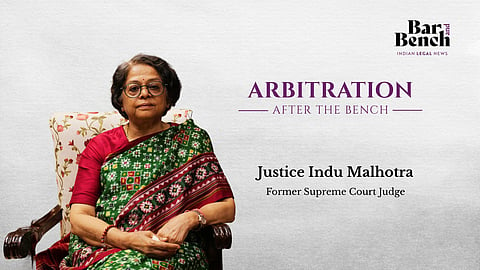
In this episode of After The Bench, Justice Malhotra, speaking with Bar & Bench's Debayan Roy, also revisits the Sri Krishna Committee blueprint she herself helped design, and finds fault with part of her own recommendation.

The conversation also covers judicial delays, the Gayatri Balasamy verdict on modification of awards and why retired judges should not head India's arbitration institutions.

[Watch Video]

Edited excerpts follow.

Debayan Roy: You spent close to 30 years practising at the Bar before you were directly elevated to the Supreme Court bench, a feat very few have achieved. How did it feel from the inside?

Justice Indu Malhotra: My practice was primarily and substantially in the Supreme Court, so I was very conversant with the procedures. I practised for almost 19 years as an advocate-on-record and was designated senior in 2007. I was elevated in 2018 and didn't find it a difficult transition at all.

DR: Is there more pressure being part of the top court of the country?

Justice Indu Malhotra: You have to be very vigilant that you don't make irrelevant remarks, because it is the last court and you don't want anything extraneous to become precedent in your judgment. You have to be very circumspect and cautious.

DR: Did you observe any difference in how lawyers addressed the bench once you were part of the bench?

Justice Indu Malhotra: No, never. I never found it, from the lawyers or from my brother judges.

DR: Were they very accommodating?

Justice Indu Malhotra: They were fine. They were collegial. I didn't find any kind of condescension.

DR: You walked back into arbitration immediately upon retirement in 2021. Did it feel like you were rejoining something you had left midway, or had arbitration moved ahead and you had to catch up?

Justice Indu Malhotra: Since 2015, there has been a sea change in the arbitration landscape. Section 29A was brought in to ensure arbitrators complete the award within 8-18 months and the amendment incorporated detailed provisions on conflict of interest and bias.

DR: Did you have to read up, or did you feel you needed to brace yourself for how much had changed?

Justice Indu Malhotra: Frankly, my contact with arbitration never broke. A year before I was elevated, I had gone to England for a course with the Chartered Institute of Arbitrators. I was working on the fourth edition of my book and I was on the arbitration roster.

DR: You have watched India's arbitration ecosystem as counsel, arbitrator and judge. Where is the system actually fragile?

Justice Indu Malhotra: Arbitrations have got streamlined at the arbitration stage itself. The clogging is happening at the Section 34 stage, when matters get stuck in the courts. Some lawyers recently went to the Chief Justice of the Delhi High Court and pointed out that not a single judgment had come under Section 34 because of the backlog.

DR: Is there something that could act as a redressal mechanism for this?

Justice Indu Malhotra: There should be a specialised bench for arbitration. Judicial delays in enforcement led to the White Industries case, where India had to pay about 4 million Australian dollars.

DR: Nearly a decade ago, you helped design the Justice Srikrishna Committee's framework for institutional arbitration in India. If you were grading that blueprint today, what survived contact with reality and what didn't?

Don't bring retired judges in, bring people in their 40s who are dynamic.

Justice Malhotra

Justice Indu Malhotra: We made two recommendations. One was that India needed a centralised institution, the India International Arbitration Centre, which was set up. The second was the Arbitration Council of India. I think that wasn't a good suggestion, the grading of institutions is something I think was wrong and that part should be scrapped. The India International Arbitration Centre was set up, but it's dysfunctional and these institutions have to be headed by someone familiar with arbitration, not retired judges. The Mumbai Centre, one of the most successful institutions, is not run by retired judges. Don't bring retired judges in, bring people in their 40s who are dynamic. Even the Mediation Act that was passed hasn't been notified, it's been three years.

DR: There was so much fanfare when it was being passed.

Justice Indu Malhotra: I really believe the Arbitration Council of India can be scrapped if the India International Arbitration Centre is energised instead.

DR: You said the India International Arbitration Centre is dysfunctional. Why do you think that happened?

Justice Indu Malhotra: They didn't have the requisite infrastructure and that became a big impediment. This was the centre we had identified - a five-acre plot in Vasant Kunj where the Lokpal's offices are also located. They were then shifted to the World Trade Centre. I'm told that two big floors have been given there, in a commercial centre. That's good, but I think they weren't able to operationalise it, the infrastructure didn't come in. Someone young and energetic has to take charge and the government should help. I know from the Mumbai Centre and from various foreign countries that once these centres are set up, state public sector entities can incorporate them as venues for conducting arbitrations. That's how work builds up in the beginning.

DR: When we think of Singapore, it's SIAC, Dubai, it's DIAC. What about India?

Justice Indu Malhotra: Mumbai matters go to the Mumbai Centre, Delhi has one, there's the Nani Palkhivala Centre in Chennai. If the India International Arbitration Centre becomes energised, it must have a panel of arbitrators and experts from various fields.

DR: You have been part of several complex construction arbitration disputes. Why has India not been able to match other foreign jurisdictions in this area?

Justice Indu Malhotra: Construction arbitration is complex and technical; it's not like general arbitration. There are various concepts peculiar to the construction industry, like the critical path, that we all need far more training on. We can have foreign experts come and train us since it's a very specialised field. Last September, I convened a conference organised at my request by Amarchand Mangaldas, where five leading experts from various jurisdictions came to give lectures on various aspects.

Frankly, it's the largest area of arbitration, the amounts involved run into hundreds of crores. It's high stakes and technical, so we certainly need specialised training.

DR: How do you view the role of experts, especially when an arbitrator isn't abreast of the technicalities?

Justice Indu Malhotra: You certainly need experts. Parties also appoint their own experts, but they tend to favour the party that nominated them. The tribunal has the power to appoint an independent expert.

DR: India keeps calling itself an aspiring global arbitration hub, but whenever the stakes get high, people think of London, Paris, Singapore. What does that tell you?

Justice Indu Malhotra: The bulk of the work in Singapore, I'm told, is also India-based. The enforcement procedure is very slow - that's what deters people from coming to India. We have rarely refused enforcement of foreign awards.

DR: Do you think a judicial check needs to exist over the arbitration process, or can it be done away with?

Justice Indu Malhotra: Honestly, there is no check by the judiciary. It is parties who keep making applications, filing applications or asking for adjournments at the last minute.

DR: Should that avenue stay open, or would closing the Article 227 route stop parties from making these applications?

Justice Indu Malhotra: That's actually very rarely invoked. It's parties who keep filing applications because they don't want to lose a chance.

DR: If a young lawyer asked you today whether arbitration is where the real opportunity lies, would you give the same answer as a decade ago?

Justice Indu Malhotra: It's a very good area of specialisation, more and more junior lawyers are taking it on fulltime. I've found this particularly true in Bombay. In Delhi, a full-time arbitration bar is yet to grow.

DR: Where does the delay in enforcement actually originate, the law, the courts, or somewhere else entirely?

Justice Indu Malhotra: It is the courts, it is at the Section 34 and 37 stage that the delays happen. One judge of a High Court told me they find it daunting to deal with so many cases because of the sheer volume of paper. The use of AI would be useful in collating material.

DR: As an arbitrator, have you ever taken recourse to AI yourself?

Justice Indu Malhotra: No, never. But I know some arbitrators are doing it, for collating material and learning.

DR: The Supreme Court's use of curative jurisdiction in the DMRC case became one of the most hotly debated topics in arbitration in India. As someone who has sat on both sides of the bench, how do you read what the Court did there?

Justice Indu Malhotra: On DMRC, first, it was a domestic award. In a domestic award, it can be set aside if the award is patently illegal. In my view, speaking of the merits and not the procedure, the curative order was correct. This was a case where a panel of three retired engineers were the arbitrators and when they wrote the award, they completely ignored the most crucial evidence and came to a wrong finding. At the Section 34 stage, the award was allowed to stand. But at the Section 37 stage, the Delhi High Court passed a detailed judgment, authored by Justice Sanjiv Khanna, finding that it was not a plausible award at all, that it was completely contrary to the statutory provisions on certification by a commissioner and that there were facts showing cracks in the metro rail, a public utility service.

He did not enforce the award and found it patently illegal, saying it didn't stand to reason. That was reversed in the SLP and then it came to the curative petition. This has never been done before, it is very rare. The amounts involved were huge - public money, for a public utility service, in the vicinity of ₹7,800 crore. In those extraordinary facts, I feel the curative judgment was correct on the facts of the case. I would not recommend curative jurisdiction become a precedent, but this was an extraordinary case, in the public interest, involving an award that had ignored the most vital and crucial evidence. So I think it was rightly set aside.

DR: Justice Ujjal Bhuyan of the Supreme Court has been unusually direct in his recent comments on the DMRC case and the Supreme Court's own arbitration jurisprudence. When a sitting judge speaks this candidly about the Court's own record, how should the legal community read it?

No, this is not courage. It is an act of indiscretion. The reputation of the court of which you are a member and national interest is supreme.

Justice Malhotra on Justice Bhuyan's remarks

Justice Indu Malhotra: Personally, I don't think any sitting judge should make such strong adverse comments against the judgments of the court. He is a member of the court, not outside it. It brings the reputation of the court down. To use a phrase like Gayatri Balasamy has opened a can of worms, I think that's unpardonable language. In customary international law, the state is not only the executive or the legislature; it is also the judiciary.

If any member holding public office makes adverse comments, it can be used by foreign investors in investment treaty arbitrations against the Republic of India, because these cases are filed against the Republic of India, which comprises all three organs. Great circumspection must be exercised by all persons holding public office when they make public statements.

DR: In the age of social media, such statements are sometimes viewed as an act of courage. Does institutional reputation and national interest come ahead, or does standing courageous come ahead?

Justice Indu Malhotra: No, this is not courage. It is an act of indiscretion. The reputation of the court of which you are a member and national interest is supreme. This is a false sense of bravado.

DR: In Gayatri Balasamy, the Constitution Bench gave courts a limited power to modify arbitral awards, not just set them aside. Does that strike you as the Court solving a real problem, or opening a door that arbitration was specifically designed to keep shut?

Justice Indu Malhotra: I concur with the view taken by Justice KV Viswanathan. The majority has really opened the door too wide by saying you can modify awards at the Section 34 and 37 stage. That's contrary to the words of the statute. If you can modify the award at every appellate stage, that undermines finality.

The one caveat is I would agree with the Constitution Bench on modification of interest alone, because we come across cases with highly unconscionable rates of interest and they can be ruinous. In one judgment, 36 per cent compounded interest was awarded, so the final amount was more than double the principal. The second thing I find commendable is that even at the post-award stage, parties can arrive at a settlement in supersession of the award, enforceable under Section 30.

DR: Are you also witnessing a spate of settlements taking place in arbitrations even after awards have been written?

Justice Indu Malhotra: Frankly, we try very hard, even midway through proceedings, once the evidence comes in and parties know where they stand. At least 30 per cent of matters get settled, but not post-award.

DR: Do you actively suggest settlement in between proceedings?

Justice Indu Malhotra: Very actively. Even if you get an award, it's not going to end there. It's much better to settle it out.

DR: Much of your own body of work leaned on the idea of party autonomy, that arbitration works only if courts largely stay out of the way. Does that principle still hold the weight you gave it?

Justice Indu Malhotra: There are a few issues where I feel there must be some limits to party autonomy. One is that party-nominated arbitrators tend to show loyalty to the party that nominated them. I find it universal, among foreign arbitrators and in India, though there are certainly exceptions. The second issue is procedural. Parties keep filing repetitive applications. In one recent construction dispute, one party filed 350 volumes running into a couple of lakh pages, right at the outset. I convened a meeting of all the arbitrators and said you can't inundate us with so much material.

DR: There is a criticism that India's arbitration ecosystem has narrowed down to a handful of retired judges. Is that criticism fair?

Justice Indu Malhotra: You are right that the majority are retired judges, but of late I find civil servants, young lawyers, chartered accountants and engineers also getting appointed. Judges know how to interpret contracts and write a reasoned award.

DR: Is it because people repose a lot of faith in the judiciary and go with retired judges believing fair treatment is more assured?

Justice Indu Malhotra: It's also that they are conversant with the law. You can't pass an award contrary to the substantive law of the country. But today, I am finding people from other professions getting appointed too.

DR: The government has grown visibly cautious about sending large public contract disputes to arbitration. What does it say about the ecosystem?

Justice Indu Malhotra: In construction contracts, there are milestones. The contractor treats every milestone as a separate cause of action, filing one arbitration, a second and a third with different tribunals. PSUs find it hard to bear this burden.

DR: What about the messaging it sends out internationally? Does it send a message that arbitration is the most effective dispute resolution mechanism in India?

Justice Indu Malhotra: Frankly, these are primarily domestic arbitrations. There is no law that bars filing one arbitration, a second and a third. The only way to address it is to bar it contractually. Most of these cases are tried by a body called SAROD.

DR: Have you also decided you would never join an institution to head it?

Justice Indu Malhotra: Yes, because I didn't have the time to head an institution and also do arbitration. I decided I would do arbitration full-time. I don't head any institution anymore.

DR: You were the first woman to be elevated directly to the Supreme Court. What do you want the system to give a young woman lawyer walking into this field now, that it didn't think to give you?

Justice Indu Malhotra: In arbitration today, there are many more women and the pool of women arbitrators is far greater. When I joined the Bar in 1983, far fewer women had taken to law as a full-time profession, the gestation period was too long before they became financially independent. It's taking time, but it's growing.

Bar and Bench - Indian Legal news
www.barandbench.com