
Subscribe
Subscribe
- Latest Legal News
- News
- Law Firms
- Columns
- Interviews
- Law School
- Legal Jobs
- हिंदी
- ಕನ್ನಡ
In 2025, Maharashtra amended its public trusts law to limit the number of lifetime trustees where a trust’s governing instrument does not specifically provide for their appointment, a change that has placed some of India’s largest business houses, whose controlling shareholders are public trusts in Maharashtra, under regulatory scrutiny.
A trust is a fiduciary arrangement whereby a settlor transfers property to a trustee to hold and manage for the benefit of beneficiaries. Private trusts, created for ascertainable individuals or classes, are governed by the Indian Trusts Act, 1882, and give the settlor considerable autonomy over trustee appointments, distribution of benefits and the trust’s operation. Public trusts, created for charitable or religious purposes benefiting the public, are regulated by state legislation and attract greater oversight. Even so, the settlor’s intentions, as expressed in the trust deed, remain paramount. The State’s role has traditionally been supervisory, ensuring the trust’s objects are honoured and preventing misfeasance, malfeasance and non-feasance rather than interventionist in the selection and composition of trustees.
The Maharashtra Public Trusts Act, 1950 (the “Act”) provides for the registration of public trusts, the duties and powers of trustees, and the role of the Charity Commissioner. For decades, it has balanced the State’s interest in proper administration of charitable trusts with the autonomy of trusts to operate according to their founding documents.
While Section 92 of the Civil Procedure Code, 1908 generally empowers civil courts to address disputes relating to public charitable trusts, Section 52 of the Act excludes Sections 92 and 93 for Maharashtra public trusts. Instead, the Charity Commissioner exercises both administrative powers (registration, supervision, inspection and direction) and adjudicatory powers over disputes concerning trust property, trustee appointments and accounts. This concentration of functions makes the Charity Commissioner a powerful authority over public trusts.
On September 1, 2025, the Governor of Maharashtra promulgated the Maharashtra Public Trusts (Amendment) Ordinance, 2025 (Mah. Ord. VII of 2025) (the “Ordinance”). The Ordinance was subsequently replaced by the Maharashtra Public Trusts (Second Amendment) Act, 2025 (Mah. Act No. LIII of 2025) (the “Amendment Act”). The Amendment Act introduces new definitions: a “perpetual trustee” is defined as “a trustee appointed for life or as a permanent trustee as per instrument of trust or as per the provisions of this Act,” while a “tenure trustee” means “a trustee appointed for a specific period of time.”
The Amendment Act introduces a new Section 30A into the Maharashtra Public Trusts Act, 1950, which fundamentally alters the governance structure of public trusts. Proviso to Section 30A(1) provides that if the instrument of trust is silent on tenure, trustees may be appointed unanimously for a period of up to five years at a time.
And Section 30A(2) provides: “If the instrument of trust does not contain any specific provision for appointment of trustee as perpetual trustee, then, notwithstanding anything contrary to the usage of the trust or any decision that the trustees may have taken, the number of perpetual trustees at any point of time in the trust shall not exceed one-fourth of the total number of trustees.”
The one-fourth cap on perpetual trustees under Section 30A(2) raises several fundamental concerns. Although it ostensibly applies only where the trust instrument is silent on perpetual trustees, it will affect all appointments of perpetual trustees, whether made by the settlor after formation or by the trustees themselves, forcing sweeping changes to the governing boards of many Maharashtra trusts.
There is no rational basis for prescribing “one-fourth” as the permissible proportion of perpetual trustees. Why one-fourth and not one-third or one-half? The arbitrary selection of this fraction suggests that the provision is not the product of reasoned policy-making but is designed to achieve a predetermined outcome namely, to force specific trusts that currently have a higher proportion of perpetual trustees to alter their board composition.
The initial resort to an Ordinance under Article 213 of the Constitution also raises questions about urgency. Trust governance had functioned under the existing framework for over seven decades, with no reported emergency, scandal or failure of existing mechanisms to justify bypassing the Legislature. The haste of the Ordinance and the subsequent Amendment Act suggests a determination to push the measure through without adequate deliberation.
The amendment’s constitutional validity is highly questionable. First, it is manifestly arbitrary under Article 14: the one-fourth cap has no rational nexus with its stated objective and is imposed without any demonstrated necessity or finding of maladministration against any trust.
Second, by mandating that perpetual trustees cannot exceed one-fourth of the total trustees overriding even the “usage of the trust” and “any decision that the trustees may have taken”, the amendment directly interferes with the autonomy of trusts to determine their own governance structure.
Third, the amendment fails the proportionality test laid down by the Supreme Court, which requires any restriction on fundamental rights to pursue a legitimate aim and be proportionate to it. Even assuming there are many pending governance disputes, a one-fourth cap on perpetual trustees bears no rational connection to resolving them. It does not improve accountability, transparency or administration; it simply overrides the settlor’s intentions without any finding of wrongdoing.
A foundational principle of trust law is the primacy of the settlor’s intentions. Having dedicated private property to charity, the settlor is entitled to determine who shall serve as trustees and how succession and governance will work; once the trust is created, the trustees stand in the settlor’s place in these matters. A public trust is not a democratic institution requiring periodic replacement of trustees, and there is no inherent harm in all trustees being perpetual. What matters is that trustees faithfully carry out the trust’s objects.
The State’s legitimate interest in public trusts is limited to ensuring that: (a) the trust operates in accordance with its charitable objects; (b) trust property is not misappropriated or wasted; and (c) the intended public benefit is realized. The amendment goes well beyond these interests and constitutes excessive State intervention in trust governance.
Many charitable trusts in India hold significant shareholdings in business enterprises and play an important role in their strategic direction. By forcing trusts to replace experienced, long-serving trustees, the amendment could destabilize corporate governance, create uncertainty for investors and markets, open the door to extraneous influences, and indirectly affect the management of private businesses, raising concerns under Article 19(1)(g). The chilling effect on philanthropy and private enterprise cannot be overstated.
Notably, the affected trusts, including the Tata Trusts, involve no public money. Their corpus was contributed entirely by private individuals who voluntarily dedicated it to charity and established governance mechanisms to perpetuate their vision. The State has contributed nothing to these trusts and has no legitimate claim to control their governance.
The timing and circumstances of the amendment suggest that it targets specific entities—the Tata Trusts and, by extension, the Tata Group, India’s largest and most respected business conglomerate. The Tata Trusts hold approximately 66% of the equity of Tata Sons Private Limited, the Group’s apex holding company, so control over the trusts is effectively control over one of India’s most valuable business empires.
The Tata Trusts have operated for over a century with an impeccable record in education, healthcare, rural development and other causes. Prior to the amendment, there had been no allegation, complaint or finding of maladministration against them. The absence of any demonstrated mischief strongly suggests a targeted measure rather than a general reform.
Immediately after the amendments, on April 18, 2026, a complaint was made by a private party that alleged that three out of six trustees of Sir Ratan Tata Trust, being permanent in nature, contravene Section 30A(2) of the Maharashtra Public Trusts Act, 1950 (as introduced by the 2025 Amendment).
The suspicion that the Amendment is designed to target the Tata Trusts has been borne out by subsequent events. On May 15, 2026, the Charity Commissioner, Maharashtra State, Mumbai, issued an ex parte direction to the Board of Trustees of Sir Ratan Tata Trust to defer a Board meeting scheduled for May 16, 2026.
The direction was issued without notice or hearing to the Trust, raising grave due process concerns and suggesting an exercise of power beyond legitimate regulatory oversight.
If the State can, through legislative fiat, impose mandatory caps that force the reconstitution of charitable trust boards and thereby destabilize the governance of major business enterprises, no private property or enterprise in India is safe from targeted interference. This represents not merely a threat to the Tata Group but a fundamental assault on the rule of law, the sanctity of private property, and the independence of civil society from State control. The amendment is likely to be challenged before the constitutional courts and ought to be struck down as violative of fundamental rights. Only then will the autonomy of charitable trusts, and the independence of private enterprise created by such trusts be preserved.
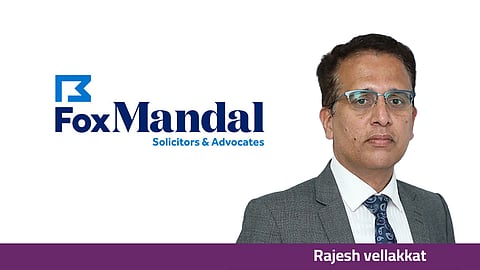
About the author: Rajesh Vellakkat is a Senior Partner at Fox Mandal & Associates.
Disclaimer: The opinions expressed in this article are those of the author(s). The opinions presented do not necessarily reflect the views of Bar & Bench.
If you would like your Deals, Columns, Press Releases to be published on Bar & Bench, please fill in the form available here.