
Subscribe
Subscribe
- Latest Legal News
- News
- Law Firms
- Columns
- Interviews
- Law School
- Legal Jobs
- हिंदी
- ಕನ್ನಡ
On July 2, 2026, the Supreme Court set aside orders of the NCLT and the NCLAT in Pooja Ramesh Singh v. Jammu and Kashmir Bank Ltd (2026 INSC 668). The Court examined six authorities relied on by the NCLT and referred to by the NCLAT, and found three non-existent citations, one existing citation attached to the wrong case, and two genuine citations carrying paragraphs that were not in those judgments. The bank filed an affidavit saying that its counsel had not cited those judgments, and that the Tribunal had obtained them through its own research. The Court said that a decision based on fake or hallucinated material is no decision in the eyes of law.
For a lawyer checking a draft, a false reference can carry a familiar case name, a year, a volume and a page number in all the right places, and the passage below it can read like something a court would say. A model can produce such text at length without checking any of it, so the appearance of the reference tells you nothing about whether the judgment exists.
When we put a citation in a court document, we are telling the court which case was decided, which court decided it, when it was decided, and where the passage we rely on can be found, and each of those things needs to be checked. A real case name beside the wrong reporter citation is still wrong, and a correct citation beside an invented paragraph leaves the court with a passage it cannot find.
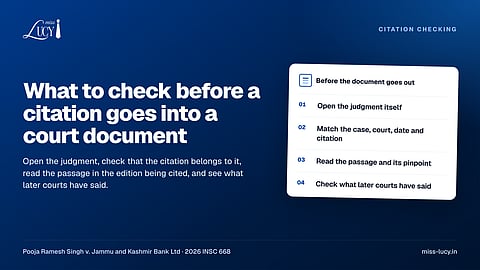
The first check is to open the judgment itself and establish that it exists, that the parties, court and date match, and that the citation belongs to that judgment. Searching for the case name alone is not enough because names repeat, abbreviations differ, and a party's name can be misspelled in a database. The same judgment may have SCC, AIR, SCR and neutral citations, and each one should take you to that judgment rather than merely to a familiar case name.
The passage itself needs to be read, because a headnote, a summary or a ratio generated by software can help you decide whether a judgment deserves your time, but they are not the court's own words. If a passage is presented as a quotation, it has to match the judgment, and the proposition in the draft has to follow from what the court actually said, including the qualifications before and after the quoted sentence. A sentence pulled out of its context can make a court appear to lay down a rule it did not lay down.
A paragraph number belongs to the edition in which it is printed, so the same judgment can have different numbering in different reports, and copying a number from one source and placing it beside another report's citation creates a reference the reader cannot follow. Old SCR volumes do not number their paragraphs at all, and the correct pinpoint there is a printed page and margin letter. If the passage has not been read in the report being cited, the pinpoint should be left out rather than filled in from somewhere else.
Even when everything matches, the case may no longer be good law. Later decisions may have distinguished it, doubted it, or overruled it, and a larger Bench may have changed the position. The check therefore includes what later courts have said about the judgment, not merely whether the original judgment can be found. This is the part of research that gets squeezed when a draft is due and everyone in the room recognises the case name.
None of this is new to a careful lawyer. It is the checking we expect when a junior puts a list of authorities in a brief, except that the list can now arrive from a machine and can contain mistakes that look unusually polished. The source of the list does not change the duty. The advocate who puts an authority before the court remains responsible for checking it.
We have tried to make this checking part of Miss Lucy's work rather than leave it to the end. When she researches a case, she reads the passage relied on and records it against that judgment. The formal citation is drawn from the knowledge base, not typed out from the model's memory, and for SCC, INSC and SCR the pinpoint comes from the paragraph numbering in the corresponding report or court copy. Separate checks look for citations that were not retrieved, citations attached to the wrong case, and paragraph references that do not match the copy being cited, so a failed check can be corrected before the document goes out.
Even with these checks, the lawyer still needs to read the judgment. A tool can retrieve the text and compare the reference, but the lawyer has to decide whether the case supports the argument being made and how later decisions affect it. That judgment belongs to the advocate, and useful software should show its sources and make that work easier to do.
The Supreme Court said that citing such judgments without verification is misconduct by an advocate, and that it is a serious lapse for a judge to rely on them. Courts trust the authorities placed before them, and when fake material enters the reasoning, the damage reaches the decision itself. The Court directed the Bar Council of India to set up a committee to examine the issue and prescribe guiding principles and disciplinary consequences for advocates who rely on such material.
The working rule for each of us is to open the judgment, check that the citation belongs to it, read the passage in the edition being cited, and see what later courts have said. If those things have not been done, the reference is not ready for a court document, whether it came from a junior, a database, an AI tool, or our own memory.
About the author: Aniruddha Sen is the co-founder of Miss Lucy.