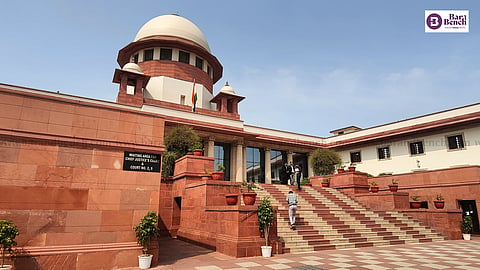
The Supreme Court on Wednesday acquitted two Gujarat government employees in a corruption case lodged in 1996 over alleged demand of a bribe of ₹20 [Rafikmiya Ahmedmiya Malek v. State of Gujarat]. .A Bench of Justices Ujjal Bhuyan and Atul S Chandurkar set aside the conviction of a Talati-cum-Mantri (a village-level revenue official) and a peon working under him. The Court held that the mere recovery of ₹20 from the peon could not sustain their conviction since the foundational requirement of proving a demand had not been met..The case arose from a complaint by a student who had approached the Bechri Gram panchayat office in February 1996 for an income certificate which was required to avail certain educational concessions. According to the prosecution, the Talati-cum-Mantri demanded ₹120 for issuing the certificate, ₹100 for himself and ₹20 for the peon.The student then approached the Anti-Corruption Bureau, which laid a trap. The student was instructed to carry the full ₹120 in marked currency notes, treated with a chemical powder to help detect them later. A raiding party accompanied him to the office to collect the income certificate. Once he received the certificate, he handed the peon a ₹20 note, which was found in his pocket. On a pre-arranged signal, the raiding party stepped in and caught the peon with the marked note. A formal seizure record was drawn up on the spot. The remaining ₹100 was never recovered from the Talati-cum-Mantri..The trial court convicted both employees in 1999 under Sections 7 and 13(1)(d) of the Prevention of Corruption Act, and the Gujarat High Court upheld the conviction in 2015. Before the Supreme Court, the accused argued that the demand itself was never established and that the peon had never asked the student for any money..The top court found several inconsistencies in the prosecution’s case. It noted that the student had given a different account of the alleged demand in a separate case he had file. In that case, he had said the Talati-cum-Mantri initially demanded ₹200, and that ₹120 was later agreed upon as a settlement. This version did not appear in his testimony before the trial court.The Court also noted that the Anti-Corruption Bureau had instructed the student to hand over the full ₹120 once demanded, but he gave the peon only ₹20 instead, and the peon, standing close to the Talati-cum-Mantri at the time, never questioned why.“This again raises a doubt as regards demand of ₹120/- by A1 (the Talati-cum-Mantri) in the backdrop of the complainant giving ₹20/- to A2 (the peon) despite being instructed to give the entire amount of ₹120/- whenever the demand was made,” the Court observed.The Court also noted that in his cross-examination before the trial court, the student admitted that the peon had never actually demanded any money from him. The ₹20 was handed over only after the certificate had already been prepared and given to him, the Court noted. Taken together, the Court found these facts raised serious doubt about the prosecution’s version..The Court then considered whether the recovery of ₹20 could, on its own, trigger the statutory presumption of guilt under Section 20 of the Prevention of Corruption Act. “If the initial demand itself is not proved, mere recovery of the amount of ₹20/- from A2 would not resurrect the case of the prosecution to enable the Court to hold that the charge was proved,” the Court said.It also said that peon’s defence that the ₹20 was handed to him only because Eid was to be celebrated the next day, could be probable.Separately, the Court found that the sanction to prosecute the Talati-cum-Mantri was invalid, having been granted by an officer not competent to do so..Therefore, the Court set aside the conviction and acquitted both men after three decades of litigation. .[Read Judgment]