
Subscribe
Subscribe
- Latest Legal News
- News
- Law Firms
- Columns
- Interviews
- Law School
- Legal Jobs
- हिंदी
- ಕನ್ನಡ
Court is dictating order now
Senior Advocate CU Singh: In our country, we have always cherished the doctrine of proportionality. There is no concept of anticipatory stoppage of movement of citizens as a whole. The police are there to maintain law and order.
CJI Surya Kant: We have already addressed that concern.
Singh: I am going one step further. I am saying that the complete stoppage of trains itself is impermissible. The police can maintain law and order.
CJI Surya Kant: That is precisely what we were saying. Complete stoppage and regulation have different connotations. Regulation is understandable because law enforcement agencies are responsible for maintaining law and order. They can regulate movement. But complete stoppage is what we have expressed concern about.
Justice Bagchi: Those who choose to participate are a different category. The organisers and their supporters are not before us today. We are not saying that we do not respect an individual's right to join or organise a protest. But that is not the issue we are addressing at present.
Counsel: That's right. I am not addressing who goes to the protest and who does not.
CJI Kant: We are concerned with access to public facilities and freedom of movement. We will pass an order on that issue.
Advocate Vrinda Grover: I have an important point concerning the conduct of police officers. There is enough material in the public domain showing police personnel entering paying guest accommodations, hostels and other premises, telling young people not to step out and discouraging them from participating in protests. Does that not create an atmosphere of fear?
Senior Advocate Gopal Sankaranarayanan: The police have no business telling citizens not to protest. Whether I choose to participate in a protest is my decision. That is my right as a citizen.
Counsel: The police are not approaching these people in their capacity as ordinary citizens. They are acting as police officers.
CJI Surya Kant: We will come to you. At present, we are examining access to common facilities for citizens who do not choose to participate in the protest.
CJI Surya Kant: Advance announcements can also address some of these concerns. If people cannot travel safely during particular hours, they should be informed beforehand. Instead of allowing people to reach stations, stand in queues and face uncertainty, advance information can help them make alternative arrangements. Such precautions can be taken.
Solicitor General Tushar Mehta: My worry, as an officer of the Court and a law officer, is that if I give an assurance, I bind the authorities without knowing what the situation will be. Therefore, in principle, I bow down to the Court's concerns. But some leeway must be given to law enforcement agencies depending on how the situation develops.
Solicitor General Tushar Mehta: The Court is right. But sometimes, if the situation so demands, even complete stoppage for a particular number of hours can be a proportionate measure. I am unable to give an assurance because I cannot foresee what the situation will be tomorrow. That decision will have to be left to the authorities on the ground.
Justice Bagchi: It depends on the number of hours and the overall circumstances. Suppose you say that services will remain open from 2 a.m. to 4 a.m., but will be closed from 4 a.m. to 9 p.m. For all practical purposes, that becomes a ban.
Solicitor General Tushar Mehta: I understand. But sometimes we have to act according to the circumstances.
Justice Bagchi: We are taking cognisance of the railway notice as well as the metro notice.
SG: That cannot be. We do not know what the situation may require.
Justice Bagchi: The word "closure" in the metro notice appears to sit uncomfortably with the expression "frequency reduced." Reduction of frequency is regulation. Closure is prohibition. There is a contradiction in the notice which needs to be revisited. It first speaks of reducing frequency and then provides for closure.
CJI Kant: Closure amounts to closure.
Counsel: And the closure is stated to continue until further orders.
CJI Surya Kant: Many of these problems, at least as I understand them, arise because of the geographical location of the protest site.
If some other open space can be identified where permission can be granted, people can still exercise their democratic right to protest. Facilities must also be provided. Somebody participating in a protest may develop health problems. There may be children and others requiring special protection. Perhaps a larger space can be provided where people can participate. In the event of an unfortunate incident, emergency services must be able to reach them.
Sibal: Ramlila Maidan has been taken away. Ramlila Maidan was another site designated by the police themselves as an alternative protest venue. If permission for Jantar Mantar was being refused, the police could have said that permission would be granted at Ramlila Maidan. But they will not do that.
Counsel: Please consider the photographs of the women police officers who were brutally harassed while performing their duties. Unfortunately, a very false narrative is being created.
Senior Advocate N Hariharan: What about election rallies? Are such restrictions imposed during election rallies, when people come out in large numbers? Are these measures taken during other protests? I really cannot understand what is being said. Political rallies bring hundreds and thousands of people into this city, but nobody seems bothered about that.
CJI Surya Kant: Mr. Sibal has already pointed out that they are not representing the protesters. They represent citizens whose concerns are confined to the restrictions imposed in Delhi.
Solicitor General Tushar Mehta: I understand. We know whom they represent. But keeping the previous experience in mind, measures have to be taken to ensure the safety of Delhi residents and other citizens.
Since the Court has expressed concerns regarding railway services and metro stations, I assure the Court that I will go back to the government and proportionate measures will be taken. I would not risk the life, safety or property of any citizen of this country. Calls are being given asking people, wherever they are, to march towards Delhi. The police will necessarily have to make arrangements.
Solicitor General Tushar Mehta: Absolutely. But thereafter, the protesters tried to reach Parliament. I am making this submission with a sense of responsibility. Parliament is not merely a political building. It is a symbol of the sovereignty of this nation. Nobody can enter Parliament without permission. Thereafter, the Court is aware of what happened. I do not wish to reopen wounds which may or may not have healed.
But more than 200 police personnel were injured. Some private individuals were also injured. While protecting the rights of protesters is our responsibility, we also have a responsibility towards the rest of the population.
The impression being created today is that the entire city has been paralysed and internet services have been shut down everywhere. I have taken instructions. The internet restrictions are confined to the area around Rashtrapati Bhavan, Raisina Road, and a radius of approximately four kilometres. These restrictions are reviewed, relaxed or imposed depending on the situation. These are proportionate measures recognised by judgments of this Court.
I would request the Court to examine some of the video clips from the events of the day before yesterday. We will place them on record. Women police officers were molested, attacked and injured. The Court may examine any video of its choice to see the exemplary restraint shown by the police. They were subjected to abuses involving their mothers and sisters, but they did not retaliate. Keeping all these circumstances in mind, the earlier protest was unlawful because permission had not been granted for its continuation. The present protest is also not permitted.
Solicitor General Tushar Mehta: May I now make my submission?
I have to take responsibility for what I say. I represent an institution that is answerable and responsible to this Court. I am making this statement in deference to the concerns expressed by the Court. But there is a background to it.
On June 20, the organisers of the present protest sought permission from the police. Permission was granted that very day. I will place that permission on record. The organiser also gave a written undertaking that the protest site would be vacated after the permitted period. Permission was granted for only one day, from 10 a.m. to around 4 or 5 p.m. But the protest continued for 17 days. During this period, there were several violations of the conditions and guidelines. I am not going into those details. They also started a protest march in a restricted area near the Parliament building.
CJI Surya Kant: For how many days was permission granted?
Solicitor General Tushar Mehta: Only one day. But the protest continued for 17 days.
CJI Surya Kant: In the farmers' protest case also, we passed orders that a protest site cannot be occupied permanently. Other protesters have rights too. Trade unions have a right to protest. Students have a right. Traders have a right. Other citizens also have a right to use the roads.
Senior Advocate Gopal Sankaranarayanan: The microphones are not working. Can the microphones please be switched on? Why are they off?
Counsel: Even young women have been taken off trains at night on the suspicion that they were travelling to participate in the protest.
CJI Surya Kant: If you believe all these matters require the Supreme Court's intervention, please file petitions.
Counsel: We will file our petitions.
CJI Surya Kant: You can file them by tomorrow and ensure that they are brought for listing. We can list these matters together. There is no difficulty.
Senior Advocate N Hariharan: There is a reason for my anguish. When the protest took place two days ago, there was a Full Court function concerning the elevation of a judge. As President of the Bar, I was supposed to attend it, but I was stuck in traffic for three hours and could not reach the venue.
Senior counsel: Delhi Police have been going from mosque to mosque since yesterday. We have stated this on oath. There is also a photograph on page 13 and a video. They cannot intimidate citizens like this. If a citizen participates in a demonstration and violates the law, the law can take its course.
Solicitor General Tushar Mehta: This is more of an instigation than seeking justice.
Senior Advocate Gopal Sankaranarayanan: I thought you were not interrupting.
CJI Surya Kant: We cannot comment on these allegations unless the matter comes before us and we call upon the authorities to respond. We would like to hear them as well. Without hearing them, it is difficult for us to comment on why they went there and whether they should have gone there. There may be justifiable reasons.
Senior Advocate Kapil Sibal: We will come back to the Court on this.
CJI Kant: We appreciate that. But citizens should not be unduly harassed. That is all we want. If protesters need to be regulated, or if there is a danger to public order, appropriate measures can be taken.
CJI Surya Kant: Closure of roads also needs to be revisited. See which areas need to be regulated and which areas need not be regulated. There should be a free flow of traffic.
CJI Surya Kant: One very important principle that we follow for every citizen is the principle of proportionality.
Solicitor General Tushar Mehta: Absolutely.
CJI Surya Kant: You have to prevent certain things. Take measures only to the extent necessary to prevent them. But that does not mean you should use a hammer to kill a fly. That principle must be kept in mind.
Solicitor General Tushar Mehta: That is what the Court has said by way of an example. It should not be reported that the Chief Justice of India said the government is using a hammer to kill a fly.
CJI Surya Kant: Exercise caution. Exercise an abundance of caution. There is nothing wrong with that. You are responsible for maintaining law and order. But that responsibility is not merely about protecting State property. It is about protecting people. That is your sovereign duty.
There are our daughters, young children, senior citizens, very elderly people and patients who travel through these places. They also need to be protected. There is absolutely no difficulty with taking appropriate measures. But make sure that everything is not brought to a halt.
Senior Advocate N Hariharan: Our concern is also this. The Court mentioned that lawyers may not face difficulties because they have cars. But where are the roads on which we can drive? Roads have been barricaded. We are being prevented from moving from one part of the city to another. How are we supposed to overcome this? There is complete barricading.
Solicitor General Tushar Mehta: That can also be addressed.
Solicitor General Tushar Mehta: I will immediately follow the Court's suggestions. But I would like to respond after all the counsel have individually expressed their concerns.
CJI Surya Kant: That's right.
Solicitor General Tushar Mehta: After they have expressed their concerns, I will make my submissions.
Senior Advocate Kapil Sibal: "It is anticipated that there will be road traffic congestion in the areas around New Delhi Railway Station and Hazrat Nizamuddin Railway Station on October 10. Therefore, all Mail and Express trains scheduled to reach these stations during the specified hours are to be cancelled at source."
This means that a train coming from Kerala cannot reach Delhi if its scheduled arrival falls within those hours. Most trains from Kerala arrive between 11 a.m. and 1:30 p.m.
Solicitor General Tushar Mehta: Coming from the Court, I immediately bow down. I will consult the government. The restrictions can be regulated and periodically reviewed depending on how the situation develops.
CJI Surya Kant: Let me give you an illustration. Suppose tomorrow there is court work. Most lawyers have private cars, so they may not face any difficulty. But what about the clerks working here? What about the staff? What about those working in the canteen, mitti cafés and other establishments? We would like you to do something about this immediately.
If you apprehend unruly movement, or the involvement of antisocial or anti-national elements, you are entitled to take appropriate preventive measures. You have CCTV cameras at railway stations and metro stations. There are other security measures available to the government. You are entitled to adopt those measures. But ordinary citizens are also entitled to access these stations and use public transport.
Solicitor General Tushar Mehta: The frequency of metro trains passing through the following metro stations may be reduced. It does not talk about complete closure.
CJI Surya Kant: The next line is more important.
Solicitor General Tushar Mehta: I am reading it. Entry and exit at these stations will be closed from 9 a.m. until the situation normalises.
Justice Bagchi: That will be difficult for us to accept. On the one hand, you say that the frequency of metro trains may be reduced. Then you say that from 9 a.m., the stations will be closed until further notice. How?
CJI Surya Kant: We are mainly concerned about the complete closure of these metro station entries. We have serious concerns about this.
Our concern is not with respect to any protesters or any individual. Our concern is about the hundreds and thousands of commuters who come from Gurugram, Greater Noida, East Delhi and South Delhi to Delhi for their livelihood. They are students, employees and senior citizens who travel by public transport.
We are speaking on behalf of the common citizens of this city. The law enforcement authorities are certainly entitled to take regulatory measures. There is no doubt about that. If you want to restrict unruly movement, you can do so. But that does not mean you can bring everything to a halt and leave people without any transport facility.
Everybody does not have a car. Everybody does not have access to private transport. People depend on public transport. This cannot be done.
Solicitor General Tushar Mehta: I do not know what has been placed before us because nothing was given to me earlier.
Advocate Vrinda Grover: This is an order. It is in the public domain. May I hand over these orders?
Another counsel submits: Please see how far apart the metro stations are. Rohini, Azadpur, North Delhi, South Delhi, East Delhi, West Delhi, Central Delhi. All of them.
Hearing starts
Advocate: There is an order directing the closure of 57 metro stations now. This violates the doctrine of proportionality laid down in Anuradha Bhasin. It also violates the principle of minimal invasiveness and the constitutional standards governing orders restricting fundamental rights.
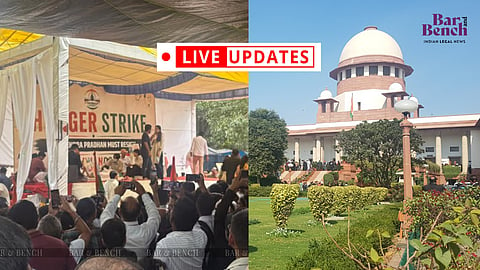
The Supreme Court is currently hearing a batch of petitions against the closure of Delhi metro stations and cancellation of long-distance trains to Delhi ahead of the October 10 protests demanding removal of Chief Election Commissioner (CEC) Gyanesh Kumar.
The protests have been called by various opposition parties and youth organisations including the Cockroach Janta Party (CJP) and other youth wings of various political parties.
A bench of the Chief Justice of India (CJI) Surya Kant and Justices Joymalya Bagchi and V Mohana is hearing the case after an urgent mentioning.
