
Subscribe
Subscribe
- Latest Legal News
- News
- Law Firms
- Columns
- Interviews
- Law School
- Legal Jobs
- हिंदी
- ಕನ್ನಡ
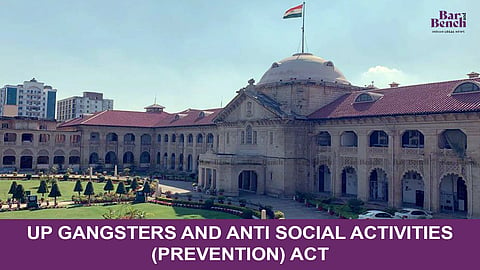
The Allahabad High Court on Thursday cautioned Uttar Pradesh authorities against treating company officers and employees as gang members under the Uttar Pradesh Gangsters and Anti Social Activities (Prevention) Act for offences arising out of the conduct of business [Pranay Aneja v. State of UP and 4 Others].
A Bench of Justices Chandra Dhari Singh and Tarun Saxena observed that such economic offences are now addressed by Section 111 of the Bharatiya Nyaya Sanhita (BNS), which defines and penalises organised crime.
"They are also addressed by specific statutes such as the excise laws and the Prevention of Money Laundering Act, 2002. That is itself a reason for restraint before the officers and employees of a business, prosecuted for the manner in which the business was run, are treated as members of a gang," the Court said.

Employees who act within a hierarchy, on the instructions of their superiors and in the course of a company’s business, do not become a gang merely because that business is alleged to have been run unlawfully.
Allahabad High Court
The Court made these observations while dealing with a petition challenging an FIR registered in 2025 against under UP Gangsters Act over alleged evasion of excise duty by Co-operative Company Limited, a licencee for the manufacturer of country liquor in Saharanpur.
It was alleged that the licenced distillery in collusion with a transporter, wholesale licensees and some excise officials, removed liquor twice on one pass by using duplicate bar codes to evade duty.
The Court found that the gang chart was prepared against 27 persons including company employees, transporters, liquor licensees and four excise officials on the basis of a single FIR registered in 2021 related to the evasion of duty.
Concluding that no act of violence, threat, show of violence, intimidation or coercion was attributed to any of the petitioner to justify invocation of the Gangsters Act, the Court quashed the FIR against accused Pranay Aneja, Ashwani Upadhyay, Upendra Govind Rao and Ravindra Kishor and the gang chart on which it was founded.
It observed that employees who act within a hierarchy, on the instructions of their superiors and in the course of a company’s business, do not become a gang merely because that business is alleged to have been run unlawfully.
The Court also rejected the State's argument that a single offence was sufficient to invoke provisions of the Gangster Act.
"At face value, the allegations disclose offences which are already being prosecuted in the base case. They do not disclose the activity of a gang within Section 2(b) read with Rule 3. Nor does the record furnish any basis for invoking the Act nearly five years after the solitary incident," the Court ruled.
It stressed that a law carrying graver consequences than the ordinary penal law should be invoked only after a recorded determination of why the ordinary process is inadequate in the particular case.
"The gravity of the base offence alone cannot supply that determination, because the general law already deals with grave offences," the Bench said.
It also observed that when the predicate offence is already being prosecuted and the accused are on bail without breach, the invocation of the Gangsters Act only adds to bail restrictions, extended period of remand and exposure to a minimum sentence before a special court.
"Consequences of that weight for liberty should follow only from reasons that are specific, contemporaneous and verifiable," it emphasized.
The Court went on to issue 12 binding directions for future cases under the Gangsters Act. It said that before a gang chart is prepared, the authorities shall record certain particulars for each person and the material to support their claim.
"Satisfaction at every stage shall be individual to each person. It shall state why that person is a member, leader or organiser of a gang, as distinct from a co-accused in the predicate offence. A collective satisfaction, or an identical entry against every person, shall be treated as no satisfaction."
The Court also said that when non-compliance of its directions is found, a copy of the judgment will be sent to the Chief Secretary and the Additional Chief Secretary (Home) for necessary action against those responsible.
Meanwhile, the Court also observed that the Supreme Court in Shiv Pratap Singh v. State of UP had expressly refrained from deciding the constitutionality of the Gangsters Act when it observed that the enactment creates no offence since it only provides a definition of a 'gang'.
"Since the constitutionality of the Act has not been decided, the Act remains on the statute book and carries the presumption of constitutionality," the Bench said.
Senior Advocate Purnendu Chakravarty with advocate Rishabh Chauhan represented the petitioners.
[Read Judgment]