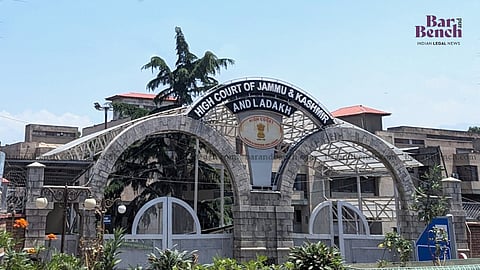
The High Court of Jammu and Kashmir and Ladakh on Friday observed that courts cannot deny bail to a person accused of a crime only to “teach him a lesson” or to satisfy the conscience of society [Nisar Ahmed Joo v. UT of J&K]..Justice Sanjay Dhar explained that such an approach would amount to pre-trial punishment, which is impermissible in law. The Court made the observation while granting bail to a man accused of raping a girl aged around 16-17 years old in 2024. The Court granted him bail after noting that the allegations against him appeared to be highly doubtful. "Merely because the petitioner is facing trial for heinous offences which entail punishment extending upto life imprisonment, is not a good enough reason to deny concession of bail to him when his, prima facie, involvement in the alleged crime is highly doubtful. The concession of bail to the petitioner, in these circumstances, cannot be denied just to teach him a lesson or to satisfy the conscience of the society as it would amount to inflicting pre-trial punishment upon them, which is impermissible in law," the Court said..The Court also noted that since the all the material witnesses cited by the prosecution had already been examined by a trial court, there was little chance of the accused influencing any witness or tampering with evidence..The bail plea was filed by one Nissar Ahmad Joo, who is facing trial in a case registered under Sections 137(2) (kidnapping) and 64 (rape) of the Bharatiya Nyaya Sanhita (BNS) and Sections 3 (penetrative sexual assault) and 4 (punishment) of the Protection of Children from Sexual Offences Act, 2012 (POCSO Act)..The case is tied to a complaint filed by a teenage girl's father, who reported her missing on November 11, 2024. The girl was found on November 17, 2024. In an initial statement given to a judicial magistrate, she alleged that she had been sexually assaulted by four different persons at different locations over several days after leaving home with friends.Based on the girl's statement, police arrested three accused, namely Mohammad Ashraf Sheikh, Chaman Lal and Basharat Ahmad Shora, on November 29, 2024. Later, the police arrested a fourth person, Nisar Ahmad, in May 2025. However, at the stage of trial, the victim/ prosecutrix is said to have disowned her earlier allegations and said that she did not want to pursue the case against the accused men. .Three of the accused - Sheikh, Lal and Shora - were granted bail February 2025 by the High Court. Nisar Ahmad also moved a bail plea following his May 2025 arrest. A trial court, however, rejected his plea, holding that the prosecutrix had supported the prosecution's case against him. Ahmad (petitioner) challenged this order before the High Court, maintaining that there were material contradictions in the prosecutrix's statements and that she had significantly changed her version of events during her deposition before the trial court. Ahmad's counsel submitted that while the victim had initially implicated the petitioner, she later stated before the trial court that she did not want any action against anybody, that she wanted the case to be dismissed.It was further argued that the scientific evidence did not support the allegation of sexual assault by the petitioner..The Court found merit in these arguments. The Court acknowledged that once charges were framed against the petitioner under the POCSO Act, there was statutory presumption that he is guilty unless shown otherwise under Section 29. However, the Court emphasised that this presumption is rebuttable. An accused can rely on material emerging during trial to demonstrate that the foundational facts for the presumption are not established. In the present case, the Court held that the victim's inconsistent statements, coupled with medical evidence that supported the petitioner's claims of innocence, were sufficient to conclude that the petitioner had, prima facie, rebutted the statutory presumption. .The High Court also noted that the petitioner had remained in jail for about one year. It proceeded to grant him bail on various conditions. He was ordered to appear before the trial court on every date of hearing, not leave the Union Territory of Jammu and Kashmir without prior permission, and not influence or intimidate prosecution witnesses..Advocates Danish Majeed, Monisa Manzoor and Mehjabeena Gulzar appeared for the petitioner.Senior Additional Advocate General (AAG) Mohsin Qadri, assisted by Assisting Counsel Mohammad Younis, represented the Union Territory of Jammu and Kashmir..[Read Order]