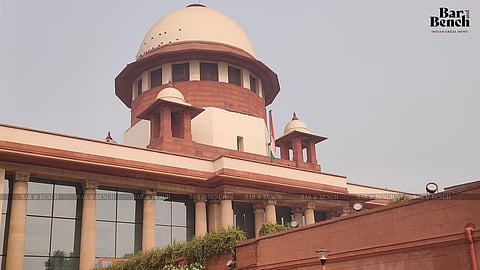
The Supreme Court has doubted the correctness of its own ruling upholding arbitration clauses that require only contractors to deposit a percentage of their claim before invoking arbitration [Santosh Associate v. HSIIDC]. .A Bench of Justices Manoj Misra and Manmohan asked the Chief Justice of India to consider referring the issue to a larger bench..Accordingly, the Bench requested the Chief Justice of India to consider referring a set of questions to a larger bench. These include: • Whether a clause requiring only the contractor to make a pre-deposit before arbitration violates Section 18 of the Arbitration Act, which mandates equal treatment of both parties at every stage of arbitration.• Whether pre-deposit conditions discourage parties from turning to arbitration in the first place, defeating its purpose of easing the burden on courts.• Whether such a condition is arbitrary and violates the right to sue, Article 14 of the Constitution and Section 28 of the Indian Contract Act, 1872.• Whether requiring a pre-deposit has any real connection to the goal of weeding out frivolous claims, given that frivolous claims can already be addressed through costs at the end of arbitration under Section 31(8) of the Arbitration Act.• Whether a pre-deposit clause is valid if the deposit is refundable once arbitration concludes.• Whether SK Jain continues to be a valid, binding precedent at all..The Court was hearing an appeal by a party whose claim was dismissed after it refused to deposit 10% of its claim amount, a requirement under its contract with the Haryana State Industrial and Infrastructure Development Corporation. The dispute arose from a drainage works contract awarded to Santosh Associate Private Limited in 2017. The contract contained a clause requiring the contractor, if it wished to raise a claim exceeding ₹1 lakh, to deposit 10% of the claim amount as security before the dispute could go to arbitration. When the contractor sought arbitration over payment disputes after the contract’s scope was later reduced, the Corporation objected, citing the contractor’s failure to make this deposit. The arbitrator upheld the objection and dismissed the claim in its entirety when the contractor refused to pay. A commercial court in Gurugram later upheld this dismissal, relying on the Supreme Court’s 2009 ruling in SK Jain v. State of Haryana, which had upheld a similar clause..Before the Supreme Court, the contractor argued that such clauses are unconstitutional, since they discriminate against contractors alone, while the state faces no equivalent requirement. It relied on more recent rulings, including ICOMM Tele Ltd. v. Punjab State Water Supply (2019) - where the Court had struck down a similar clause as being arbitrary - and the three-judge bench ruling in Lombardi Engineering Ltd. v. Uttarakhand Jal Vidyut Nigam (2024), which held that contractual party autonomy cannot be stretched to override fundamental rights. The contractor argued that SK Jain was decided “sub silentio,” without the Article 14 challenge actually being argued before the Court and should no longer be treated as binding.The Corporation countered that SK Jain remains good law and that the clause in this case, like the one in that judgment, only required a refundable deposit rather than one that could be forfeited outright, unlike the clause struck down in ICOMM Tele Ltd..The Court noted that this apparent conflict in precedent could not simply be resolved by a two-judge bench.“This Court, mindful of the bounds of judicial discipline and the enduring authority of precedents, is constrained to observe that ICOMM Tele Ltd. (supra), being a decision of a two Judge Bench, could not override the principle of law enunciated by the three Judge Bench in S.K. Jain (supra), even though this Court is prima facie in agreement with the reasoning advanced in ICOMM Tele Ltd. (supra)."The Bench also flagged a broader concern with pre-deposit clauses that had not been addressed in earlier rulings. It noted that the right to sue is available to every individual, unless expressly barred by law.“This Court is of the considered view that an arbitration clause cannot impose pre-deposit conditions so onerous as to render the right to sue, at the very threshold, illusory or nugatory,” the Court held..The petitioner was represented by Advocates Shreeyash U Lalit, Rishi Kapoor, Arun Choken, Azad Bansala, Shailendra Singh, Inderjeet Dagar, Prakriti Rastogi, Mitul Sehrawat, Naveen Tanwar, Nadeem Arman and Angad Pahel. HSIIDC was represented by Senior Additional Advocate General Alok Sangwan, along with Advocates Samar Vijay Singh, Sumit Kumar Sharma, Rajat Sangwan, Vaibhav Yadav, Harsh Mehla, Sabarni Som, Aman Dev Sharma, Gaj Singh and Keshav Mittal..[Read Order]