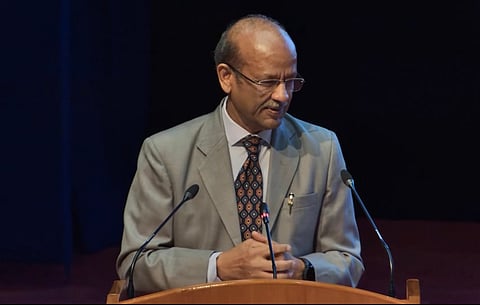
Courts must decide cases based on the evidence before them rather than public opinion or narratives circulating on social media or newspapers, former Supreme Court Justice Rajesh Bindal recently said..Justice Bindal stressed the need for a gender-neutral criminal justice system and also said that courts must focus on the material before them rather than public perceptions or allegations of bias.“We have to do justice by seeing what is there on that court before us. It is not that what is said in the social media or what is said in the newspaper or what is said outside the board by anyone. That is not our job because we do not consider anything of that,” he said..We have to do justice by seeing what is there on that court before us. It is not that what is said in the social media or what is said in the newspaper.He was delivering the inaugural address at the Ekam Nyaay Dialogue, held at the Atma Ram Law Auditorium in Chandigarh on August 30.In his speech, Justice Bindal observed that courts are often accused of being biased depending on which side their decision favours, even though judges are required to decide cases on the basis of the evidence placed before them.“General perception is, suppose the court decides in favour of men, they say the courts are generally biassed. If they decide in favour of women, they say they are biassed. But the fact is that we cannot, as a court, believe any person blindly,” remarked Justice Bindal..On gender-neutral criminal justice system, Justice Bindal said it was rooted in the constitutional guarantee of equality before the law and equal protection of the laws. He rejected the suggestion that legislation itself was inherently discriminatory, saying the purpose of every enactment was to address an identified social problem.“All enactments are in fact enacted by either the Parliament or maybe state legislature for a positive note to solve a problem. There is no biasness inbuilt in any statute,” he noted..According to Justice Bindal, the real challenge arises when legal provisions are misused. Referring to criminal laws dealing with offences against women and children, he said statutes also contain provisions enabling prosecution in cases of false accusations and compensation for persons wrongfully arrested or implicated. However, he held that these remedies remain significantly under-utilised. Drawing from his experience on the Bench, Justice Bindal referred to several matrimonial and criminal cases where allegations were ultimately found to be unsupported by evidence. He observed that courts frequently encounter disputes in which entire families are implicated or consensual relationships subsequently result in allegations of rape on the ground of a false promise of marriage..Justice Bindal also referred to the increasing burden of matrimonial litigation. He urged greater acceptance of mediation as an alternative to prolonged courtroom battles. He recalled his experience with pre-litigation mediation initiatives, and noted that a substantial number of matrimonial disputes were resolved through dialogue rather than adversarial proceedings.He added that parties often approach courts believing judicial adjudication is the only remedy, whereas mediation can help resolve disputes without determining which spouse was right or wrong..Speaking about disputes over child custody, he observed that such conflicts often lose sight of the child's welfare.“The child is taken as a commodity and on that the couple starts fighting, not seeing the welfare of the child, of the future of the child,” he said..Additionally, he highlighted emerging technological challenges before the justice system. Justice Bindal particularly talked about the possibility of fabricated photographs, videos and electronic communications being created using artificial intelligence and presented as evidence in litigation. According to him, such developments would require courts to exercise even greater caution while assessing the authenticity of digital material. .Justice Bindal concluded by reiterating that a balanced justice system must protect genuine victims while simultaneously recognising the rights of those subjected to false prosecution. He said the objective should not be to immediately send someone to jail at the first instance of every dispute, but to encourage a change in mindset among litigants, lawyers, police and other stakeholders. "The attitude has to be to resolve the problem, not to aggravate it," held Justice Bindal.