
Subscribe
Subscribe
- Latest Legal News
- News
- Law Firms
- Columns
- Interviews
- Law School
- Legal Jobs
- हिंदी
- ಕನ್ನಡ
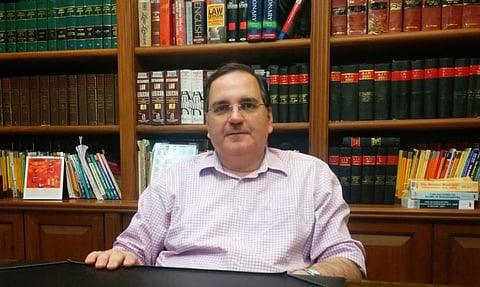
Senior Advocate Darius Khambata has decided not to seek reappointment as a trustee of Tata Trusts, warning that the governance model established by the Tata Group's founders is under threat amid differences over the proposed public listing of Tata Sons and the conduct of its board.
In a four-page letter dated November 2 addressed to Tata Trusts Chairman Noel Tata and Chief Executive Officer Siddharth Sharma, Khambata said that the Tata model represented a unique relationship between business and philanthropy that could not be dismantled without undermining the institution itself.
"The Tata model is a living manifestation of Mahatma Gandhiji's trusteeship doctrine: India's most iconic industrial and philanthropic combine, a national treasure in which neither limb is meaningful without the other," he said.
He also strongly criticised the events surrounding the Tata Sons board meeting on September 17, 2026, describing the day as one that would "live in infamy".
"The sad events of 17 September 2026, a day that will live in infamy, have sullied Tata Sons' reputation and have imperilled the image of corporate India. No spin doctoring can mask what happened," he said.
Khambata questioned whether the board would have acted in the same manner had the late Ratan Tata been alive.
"Would the board of Tata Sons have acted as it did on 17 September, had Ratan Tata still been alive? Of course not. But duties are owed to institutions, not to individuals. And as Ratan Tata used to say, the institution is always bigger than the individual."
Khambata's term as a trustee of Sir Dorabji Tata Trust (SDTT) is scheduled to end on November 9.
Explaining his decision not to seek reappointment, he said that he had accepted both trusteeships at Ratan Tata's invitation and had always sought to preserve his independence. He acknowledged that his positions had sometimes differed from those of other trustees, including Noel Tata.
"That independence comes at a cost. My stand and approach has at times differed from others', including Noel's; I appreciate Noel's democratic acceptance of this. That is the old Tata way," he said.
However, Khambata pointed out that reappointment required the agreement of all other trustees.
"That is a consent that it is not in my character to seek as it would compromise my independence to do so," he said.
A substantial portion of the letter was devoted to the proposed listing of Tata Sons, which Khambata argued would threaten the ownership and governance structure of the Tata Group.
He said that he was the first to caution against a potential listing at a meeting on May 28, 2025, describing it as an existential issue for the Trusts.
Khambata subsequently drafted a resolution opposing the listing, which was unanimously adopted on July 28, 2025. However, he clarified that opposition to the listing did not mean denying liquidity to existing shareholders. He said that he had consistently supported providing the Shapoorji Pallonji Group liquidity through the sale of some or all of its shares.
Khambata also criticised Tata Sons' engagement with the Reserve Bank of India (RBI) over its regulatory status.
"Unfortunately, I do not believe that the engagement with the RBI has been meaningful, much less successful, in showing how Tata Sons could fully adopt a listed company's transparency and reporting mechanisms even if it was deregistered as a CIC or could restructure to avoid the nuclear option of listing," he said.
The letter also revisited the September 11, 2025 decision by four trustees, including Khambata, not to renew Vijay Singh's tenure as a Tata Sons nominee director. Khambata said that the decision was intended to strengthen opposition to the listing and was not motivated by personal considerations. He alleged that the trustees subsequently faced a sustained media campaign intended to discredit them.
He further criticised Singh and Venu Srinivasan for publicly supporting Tata Sons' listing in April 2026 despite having been parties to earlier unanimous resolutions opposing the proposal. Referring to the Supreme Court's judgment in Tata v. Mistry, Khambata argued that nominee directors appointed by public charitable trusts owed special duties to those trusts.
"It is now untenable to say that a nominee Director of a public charitable trust, particularly a sitting Trustee, may act against the Trust's interests merely because he also owes a duty to the Company; he sits on that board precisely to protect the Trusts," he said.
Khambata maintained that trustees serving as nominee directors could not be treated differently from other trustees when it came to their fiduciary obligations.
"There cannot be two classes of trustees – those who are nominee Directors and those who are not. All Trustees owe an equal fiduciary duty to the Trust."
He also expressed disappointment over the growing differences between Noel Tata and Tata Sons Chairman N Chandrasekaran. He recalled having seconded Noel Tata's appointment as chairman in October 2024 despite pressure to defer the decision.
Emphasising the importance of institutional values, Khambata said,
"Leadership is not about power or position but about dharma, wisdom and temperance. A position must be won by consensus and respect and not by stratagem."
Khambata concluded by questioning whether those entrusted with preserving the Tata model would rise above personal interests.
"I leave it to the judgment of history as to whether those to whom Ratan Tata entrusted the Tata model have the statesmanship to rise above personal interest and to preserve, rather than diminish, the model," he said.