

A Delhi court recently granted bail to two law students, Prabal Pratap Singh and Chanderbhan, in a case involving use of expletives against the Chief Justice of India (CJI) inside the Supreme Court, assault of a security staff member and disruption of judicial proceedings.
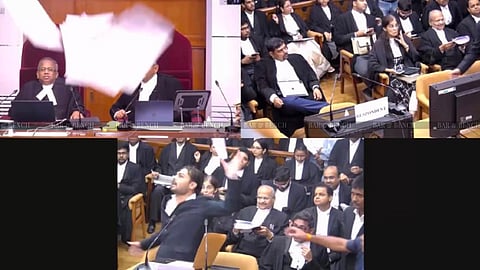
Singh and Chanderbhan, third-year and second-year law students respectively at Lucknow University, were arrested on July 11 after an incident on July 10 in court No. 13 of the Supreme Court, where both were appearing as petitioners-in-person in a case.
According to the complaint filed by a Supreme Court security official, Prabal Pratap, in a fit of anger, threw papers in the courtroom and directed unparliamentary and abusive language at the Chief Justice of India.
When a security official tried to restrain him, he allegedly pushed and used criminal force against the official, obstructing him from performing his duty. Chanderbhan was accused of supporting and abetting his co-accused's conduct.
In the bail order passed on July 27, Judicial Magistrate First Class (JMFC) Ravi of the Patiala House Court sharply criticised the duo's conduct, observing that no litigant, however aggrieved by the outcome of a case or however unrepresented, has the licence to throw papers in open court or use abusive language against the presiding judge, much less the office of the Chief Justice of India.
He underscored that such behaviour could not be condoned, as allowing it to pass without comment risked creating the impression that it was acceptable.
However, the Court said that the Supreme Court, the institution whose dignity was allegedly affronted, had itself responded with considerable restraint.
"An institution of the stature and permanence of the Supreme Court of India is not diminished by the intemperate conduct of a single agitated, unrepresented litigant. It is only appropriate that subordinate courts, in assessing the consequences that ought to flow from such conduct at the stage of bail, be guided by the same institutional restraint and equanimity that the highest court itself has demonstrated," the Court said.
It added that the gravity of the language used cannot by itself convert offences that are otherwise non- heinous in nature into grounds for indefinite pre-trial incarceration, particularly once the investigation stands substantially complete.
"Accordingly, while recording its unequivocal disapproval of the conduct attributed to the accused persons for the reasons discussed above, and making it clear that the observations herein are confined to the question of bail and shall have no bearing on the merits of the trial, this Court is of the view that the continued detention of the accused is not warranted in law," the Court concluded.
It then released them on bail.
[Read Order]