

Statutory recognition of emergency arbitration and a dedicated Gujarat High Court bench at GIFT City will significantly streamline Indian dispute resolution, Delhi High Court Justice Tejas Karia remarked on Friday.
Justice Karia noted that despite immense progress in arbitration since the 2015 amendments, procedural bottlenecks under Sections 9, 11, 34, and 37 of the Arbitration Act continue to clog courts.
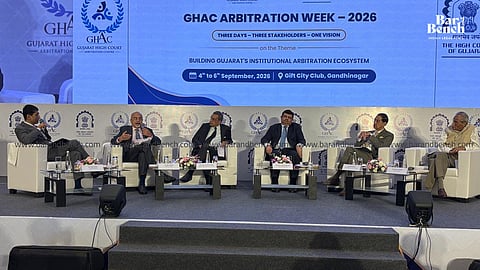
The judge was speaking at a panel discussion organised by the Gujarat High Court Arbitration Centre (GHAC) as part of its Arbitration Week 2026 event held at GIFT City in Gandhinagar.
The panelists included former Supreme Court Justice MR Shah, Gujarat Advocate General Kamal Trivedi, and Senior Advocates Mihir Thakore and Janak Dwarkadas. Senior Advocate Shalin Mehta moderated the session.
The panel focused on two themes:
- The Post-2015 Amendment Era: Where have we progressed?
- The New International Bar Association (IBA) Guidelines 2024: Conflicts, Disclosure & Arbitration Independence.
Justice Karia emphasised the need to formally integrate emergency arbitration into the statute through proposed Section 9A.
"With the emergency arbitration concept, the only way it can be implemented is that it has to be institutional arbitration," Justice Karia stated.
This statutory framework would enable parties to secure interim relief in under 14 days without clogging court dockets.
On GIFT City’s potential as an arbitration hub, Justice Karia suggested establishing a dedicated High Court bench.
"My suggestion is to start with, we can have a dedicated bench of Gujarat High Court having a seat in GIFT City," Justice Karia urged.
He noted that default jurisdiction otherwise falls onto the Gandhinagar district court.
He proposed a long-term vision which envisages establishing a full-fledged international commercial court modeled on the Dubai International Financial Centre (DIFC) or Singapore International Commercial Court (SICC).
The panel debated on whether judicial review under Section 34 should remain light-touch or expand to cure flawed awards.
Justice Karia advocated for specialised arbitration benches, capacity building, and arbitrator re-training.
"They should unlearn and learn again how to do arbitration when they sit as an arbitrator," Justice Karia remarked.
Dwarkadas highlighted systemic delay stems from poor judge-to-population ratios.
He suggested amending the definition of "court" under the Arbitration Act to limit it to specialised arbitral tribunals or dedicated judicial divisions.
Trivedi called for an end to ad-hoc arbitrations.
"Ad-hoc arbitration must go as a matter of rule," he said, adding that 85 percent of ad-hoc awards lack quality.
Dwarkadas cited statistics from the Delhi High Court.
"49.80 percent is a number of times that awards have been fully upheld. Which means 50 percent of the time awards have failed. These are ad hoc arbitration awards. Any product or service which fails 50 percent of the time, would you call it a successful brand?” he asked.
Justice Shah observed that timeline extension applications under Section 29A have become routine. However, due to Supreme Court rulings, extension applications now go before trial and district courts. He urged judicial academies to provide specialised arbitration training to trial court judges.
He added that monetary security deposits fail to protect claimants whose businesses collapse during years of litigation.
Trivedi proposed strict statutory deadlines, including a 6-month cap for Section 34 petitions and a 3-month cap for Section 37 appeals. He also noted that vague statutory terms like "public policy" compel continuous judicial interpretation.
Thakore highlighted execution delays under Order 21 of the Code of Civil Procedure. He suggested transferring execution powers directly to Section 34 courts or adopting Schedule Two of the Income Tax Act for faster recovery.
Justice Shah reiterated that Supreme Court intervention must remain minimal and should be restricted to ironing out creases.
"You cannot rewrite the Arbitration Act by interpreting and adding something which is not there," Justice Shah stated.
On arbitrator neutrality under the revised IBA Guidelines 2024, Justice Shah noted that statutory declarations under Section 12 have become mechanical.
Thakore advised arbitrators to err on the side of caution.
"Disclosure is better than non-disclosure," Thakore said.
Dwarkadas concluded by citing data showing that tribunal composition accounts for 74.28 percent of the awards set-aside by courts.
Upfront disclosure is vital to protecting award enforceability, he underscored.