
Subscribe
Subscribe
- Latest Legal News
- News
- Law Firms
- Columns
- Interviews
- Law School
- Legal Jobs
- हिंदी
- ಕನ್ನಡ
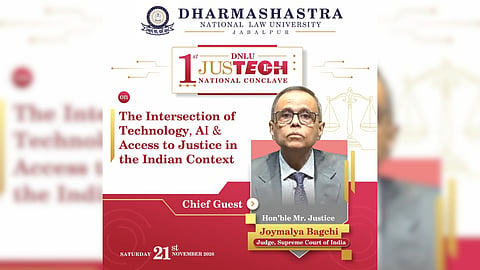
As the Indian judiciary stands at the cusp of a profound digital metamorphosis, Dharmashastra National Law University (DNLU), Jabalpur is poised to catalyse a much-needed national dialogue. The premier legal institution is all set to host its maiden ‘JUSTECH’ National Conclave on Saturday, November 21, 2026 at PDPM IIITDM Jabalpur, Dumna Airport Road, Khamaria, Jabalpur, on the theme “The Intersection of Technology, AI & Access to Justice in the Indian Context,” the event promises to be a seminal gathering of legal luminaries, tech innovators, and policy architects.
For those unable to attend in person, the conclave will also be livestreamed on YouTube, enabling participants, legal professionals, academicians, students, and other interested stakeholders from across the country to be part of this important national dialogue virtually.
The gravity of the issues at hand is reflected in the calibre of the speakers. The conclave will be headlined by Mr. Justice Joymalya Bagchi, (Judge, Supreme Court of India) who will be presiding as the Chief Guest for the morning pre-lunch session. Justice Bagchi will address the critical challenges of implementing AI in the judicial decision-making process, a topic fraught with constitutional complexities.
Joining him will be Mr. Justice Alpesh Y. Kogje, Chief Justice of the Madhya Pradesh High Court, as the Presiding Guest. Chief Justice Kogje’s participation is significant as the MP High Court has been at the forefront of integrating technology into its administrative and judicial functions. Together, they will set the tone for a day of rigorous debate on how to maintain human oversight and due process while leveraging technology.
The rapid infusion of Artificial Intelligence into the legal ecosystem is no longer a futuristic conjecture; it is an unfolding reality. From AI-driven legal research and predictive analytics to automated case management and e-filing systems, technology is fundamentally reshaping the administration of justice. However, this digital leap raises a labyrinth of complex questions. Can algorithms be trusted to remain impartial? How do we safeguard against the entrenchment of existing societal biases within machine-learning models? Most critically, in a nation as diverse and unequal as India, does the digitalization of courts risk widening the chasm of access to justice for the marginalized, or can it be the great equalizer that democratizes legal aid?
It is precisely these pressing dilemmas that the inaugural ‘JUSTECH’ National Conclave seeks to address. By convening stakeholders from across the legal and technological spectrum, DNLU aims to move beyond theoretical debate and towards actionable frameworks that ensure the digital transformation of the Judiciary is both ethical and inclusive.
Session I: Algorithmic Justice on the Driver’s Seat: Reincarnating the Judiciary through Al & Technology
The morning session, titled “Algorithmic Justice on the Driver’s Seat: Reincarnating the Judiciary through AI & Technology,” promises to be a deep dive into the ethical minefield of legal tech. The discussion will shift to the more contentious applications, such as risk assessment and facial recognition technology, which is currently deployed in over 170 systems across India.
This session will also feature Mr. Justice Anand Pathak Judge, MP High Court, with the judicial perspectives complemented by the insights of leading legal practitioners, including Senior Advocates Mr. G.K.K. Subramaniam, Mr. Rajshekhar Rao, & Mr. Siddharth R. Gupta, Advocate, Supreme Court of India, who will bring their extensive courtroom experience to bear on how these technologies are actually impacting litigation and client representation.

Session II: Bridging the Justice Gap - Democratisation of Legal System through Tech tools
If the morning session tackles the how of technology, the afternoon session, “Bridging the Justice Gap: Democratisation of the Legal System through Tech Tools,” tackles the who, what & why of technology. As the Indian judicial system struggles with a backlog of over 1.7 lakh cases older than 30 years, the promise of LegalTech in expanding access to justice is immense. However, the risk of creating a two Indias with one judiciary, where the digitally literate benefit while the poor are sidelined is equally severe.
This session will explore the transformative potential of Generative AI in affordable legal aid and Alternative Dispute Resolution (ADR). The panel will scrutinize the efficacy of Online Dispute Resolution (ODR) and the NITI Aayog ODR Policy Plan (2021), questioning how to standardize these mechanisms across jurisdictions and give smart contracts full legal force. Additionally, the conversation will spotlight language barriers, evaluating how AI translation committees are working to make judgments accessible to non-English speakers.
Leading this discussion will be Mr. Justice Sanjeev S. Kalgaonkar, Judge, MP High Court, along with Mr. Justice Tejas Karia, Judge, Delhi High Court. They will be joined by Senior Advocates Mr. Ritin Rai to deliberate on how LegalTech can truly reach the last mile of the Indian legal system.
Organized by DNLU’s BRIDGE (Centre for Industry Engagement and Advocacy) under the guidance & mentorship of Vice-Chancellor, Prof. Manoj K. Sinha, the conclave aims to bridge the divide between academia, industry, and the judiciary.
As India hurtles towards a fully digitized judicial infrastructure, the ‘JUSTECH’ National Conclave at DNLU Jabalpur is a timely intervention. It seeks to ensure that the pursuit of technological efficiency does not come at the cost of constitutional morality and equitable access to justice. In bringing together the guardians of the law and the architects of technology, the university is providing a vital platform to ensure that the future of Indian Jurisprudence is both smart and just.