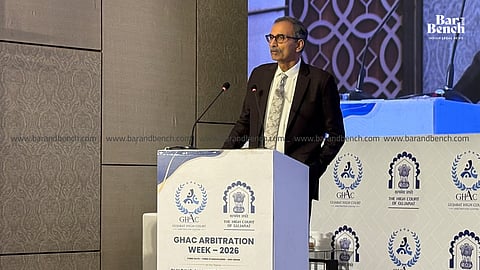
India must first address delays, court interference and the lack of confidence in its domestic arbitration system before seeking to become a global arbitration hub, former Supreme Court judge Justice L Nageswara Rao said on Saturday..Justice Rao was speaking at GHAC Arbitration Week 2026, organised by the Gujarat High Court and the Gujarat High Court Arbitration Centre at GIFT City, Gandhinagar.“Unless we improve domestic arbitration, there is no point in thinking about international arbitration,” he said. .Justice Rao said India had fertile ground for disputes, with hundreds of thousands of arbitrations taking place in the country. However, there was no reliable data even on the number of pending ad hoc arbitrations.He noted that arbitration practitioners from London, Singapore and Dubai regularly came to India because of the volume of disputes available here. At the same time, Indian parties were choosing foreign seats to secure more efficient resolution. He said“What does this indicate? This indicates that people who are going out do not have confidence in our system.”.Justice Rao said reducing the number of courts involved in arbitration proceedings would help restore confidence. He proposed that challenges to domestic arbitral awards under Section 34 of the Arbitration and Conciliation Act, 1996 should be heard by specialised High Court benches instead of district courts.“Have at least a High Court having a specialised bench to take up Section 34 petitions.”.Such benches would develop expertise in commercial law and dispose of challenges faster, he said. Justice Rao also stressed that commercial disputes must receive adequate attention from constitutional courts.He further called for faster disposal of applications under Section 11 of the Arbitration Act for the appointment of arbitrators. Such applications have remained pending before some High Courts for several years, he noted.Justice Rao referred to a case in which a Section 11 application was pending before the Telangana High Court for six years. Since courts now primarily examine the existence of an arbitration agreement at this stage, these applications should not be kept pending for long, he said..Courts should impose exemplary costs when meritless Section 34 petitions are dismissed, Justice Rao suggested. Lawyers and parties should first assess whether a challenge has any realistic chance of success..Justice Rao also disagreed with Justice Rohinton Nariman’s suggestion the previous day that parties should be given one full-fledged appeal on facts and law. He said, “I am not very sure adding an appeal would really help. On the other hand, I am of the opinion that this appeal would only add another three-four years of delay in finalisation of these awards. I think it is better that it is avoided.”.On arbitral appointments, Justice Rao defended the suitability of retired judges.“You cannot say that judges are not suited to be arbitrators. They are.”However, he said arbitral appointments should not be confined to former judges.“I agree that it should not be only judges who should be appointed as arbitrators.”.Justice Rao added that Indian arbitral institutions suffered from a deficit of trust. Institutions must engage with law firms and general counsel to understand why contracts continue to prefer foreign institutions such as the SIAC, ICC and LCIA, he said.India must plan its arbitration ecosystem for the next 20 to 30 years by building institutions and developing full-time arbitrators and arbitration counsel, Justice Rao concluded.