

Levy of court fees at ad valorem rates in cases before civil courts is harsh, the Allahabad High Court recently said while asking the government to consider easing the same [Laxmikant Aggarwal v State of UP and Others]
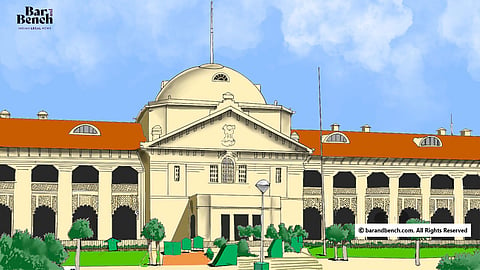
A Bench of Justice JJ Munir and Justice Indrajeet Shukla made the observation while hearing a 70-year-old man’s petition alleging encroachment of his property, a paper mill in Kanpur Dehat's Visayakpur Raniya village.
Ad valorem court fee is a percentage or proportion of the monetary value involved in a case.
The petitioner Laxmikant Aggarwal’s argument against approaching a civil court was that the process is time-consuming and that he cannot pay court fees at the ad valorem rate.
The Court remarked that while his apprehensions are not entirely ill-founded, the law is what it is.
However, the Court also observed that the government should reconsider the payment of court fees at ad valorem rates.
“At the same time, we would recommend to the Government to consider ameliorating the hardship caused by taxing civil justice at ad valorem rates. It does not seem to fit into the constitutional scheme. We do no say that Court fee should not be charged, but to tax justice at ad valorem rates is, indeed, harsh.”
Aggarwal earlier told the Court that he had moved an application before the District Magistrate of Kanpur Dehat for restoration of his property, alleged to be encroached by a person with criminal antecedents, but no action was taken.
The Court noted that Aggarwal had filed a writ petition earlier. The first plea was declined and he was asked to go to a civil court.
However, the Court noted that the present petition too was filed for similar relief but with a different prayer – a direction to the District Magistrate to hold an inquiry into this matter by invoking provisions of Rules 21 and 22 of the Uttar Pradesh Maintenance and Welfare of Parents and Senior Citizens Rules, 2014, for protection of life and property.
Considering the petitioner’s argument that a civil court is not a place for senior citizens, the Court acknowledged the problems faced by people in civil courts, including on account of their own actions.
“Some of their powers have been grossly curtailed by statutes, excluding their jurisdiction. But none of this would deprive the Civil Court of the jurisdiction, which it rightfully possesses to decide all questions that are civil in nature and grant relief, unless and until, the jurisdiction is expressly, or by necessary implication, barred,” the Court added.
The Court noted that the petitioner ultimately seeks to recover possession of title from a trespasser. He has to seek his remedies before a civil court and cannot ask the High Court to convert the Collector into a judge trying civil actions for senior citizens, the Bench said.
It thus declined to grant him any relief in the writ petition.
“Given the totality of circumstances, we regret that we are unable to extend any assistance to the petitioner and must require him to approach the Civil Court of competent jurisdiction for the relief that he seeks,” the Bench said.
Advocates Devbratt Yadav, Phool Singh Yadav and Ram Pratap Yadav represented the petitioner.
Additional Chief Standing Counsel Girijesh Kumar Tripathi represented the State.
[Read Order]