
Subscribe
Subscribe
- Latest Legal News
- News
- Law Firms
- Columns
- Interviews
- Law School
- Legal Jobs
- हिंदी
- ಕನ್ನಡ
Former Supreme Court judge Justice RV Raveendran on Sunday disagreed with Justice Rohinton Fali Nariman’s recent suggestion for a full-fledged first appeal against domestic arbitral awards on facts and law, saying such a remedy would defeat the very purpose of arbitration.
Justice Raveendran said he was “shocked” by the suggestion, though he acknowledged that it reflected the frustration caused by the present state of challenges to arbitral awards.
“Imagine, out of desperation, Justice Nariman said, let us have a first one appeal, full appeal and be done with it. I was shocked. But see, that is the amount of desperation.”
He added,
“If you have a first appeal, then why have an arbitration? The entire purpose of arbitration is to have finality.”

Justice Raveendran said that if courts were given wider appellate powers, including the ability to extensively reconsider or modify awards, the distinction between arbitration and ordinary litigation would begin to disappear.
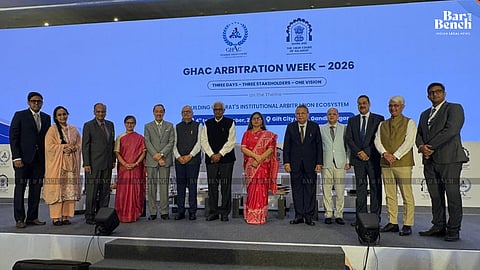
He was speaking at a panel discussion titled “A Judge’s wish list of what the law ought to be” on the concluding day of GHAC Arbitration Week 2026 in Gandhinagar.
The three-day conference, held from September 4 to 6 at GIFT City Club, was organised by the Gujarat High Court in collaboration with the Gujarat High Court Arbitration Centre. The theme of the event was “Building Gujarat’s Institutional Arbitration Ecosystem.”
The panel comprised Gujarat High Court Chief Justice Sunita Agarwal, Justice Raveendran and former Delhi High Court Chief Justice AP Shah. Senior Advocate Saurabh Soparkar moderated the discussion.
Justice Raveendran also raised concerns over inconsistent Supreme Court rulings on arbitration. He said
“We have 37 judges. We have 17 benches. We do not have one single Supreme Court. We have 17 Supreme Courts.”
He said outcomes could depend on the Bench before which a case was placed, adding that changes in legal position by different Benches were causing problems.
Justice Raveendran particularly flagged the widening use of “patent illegality” as a ground to interfere with arbitral awards. He said that under a strict approach, interference should arise only in exceptional situations.
However, Supreme Court was repeatedly changing the limits of permissible intervention in arbitral awards. This affected lower courts, arbitral tribunals and every party who has entered into an arbitration agreement, Justice Raveendran said.
"It causes chaos and confusion and uncertainty" he remarked.
At the same time, he said courts alone could not be blamed for judicial interference. Arbitrators too had to improve the quality of their awards.
“If we want courts to exercise restraint, we must also ask the arbitral tribunals to act with more responsibility.”
He said tribunals must follow contractual terms, consider material evidence, address important submissions and give proper reasons.
Chief Justice Sunita Agarwal said a judge’s wish list for arbitration was essentially the same as that of its users: clearer law, disciplined procedure, greater institutional trust and finality.
She summed it up in three words: transparency, accountability and predictability.
Chief Justice Agarwal also suggested that courts should no longer appoint arbitrators under Section 11 of the Arbitration and Conciliation Act, 1996. Instead, arbitral institutions should become the default appointing authorities. She further suggested replacing the present two-stage challenge structure under Sections 34 and 37 with a single level before the High Court.
Justice AP Shah, meanwhile, agreed that uncertainty in Supreme Court jurisprudence was a serious concern.
“What I find is, you said back and forth. That is a very mild description of the phenomenon which is happening in the Supreme Court.”
Justice Shah said such shifts had contributed to pendency in arbitration matters and called for greater finality and judicial discipline. He also advocated specialised arbitration benches in select High Courts and a stronger shift from ad hoc to institutional arbitration.