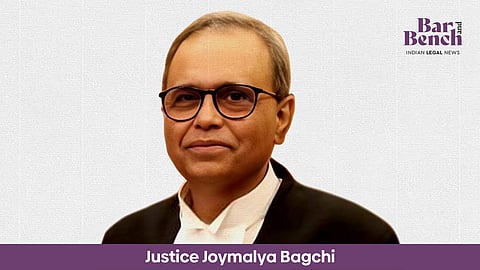
A legal victory for free speech inside court does not guarantee that such freedom will survive outside the courtroom, Supreme Court Justice Joymalya Bagchi said on Saturday..In this regard, recalled his own experience defending author Taslima Nasrin against the government's ban on her book.He said that it "was fought, and fortunately won" inside the Court but the courtroom outcome did not settle the matter."If the lamp of justice dies in the hearts of the people, no court can save it," he said.Owing to the public disorder that followed, Nasrin's visa was ultimately restricted and she had to leave India."What happened outside the courtroom is another testament to the reality that, even if you win in a court of law, you may still not enjoy the freedom, because rule of law can be subverted by the rule of the mob," the judge said.Justice Bagchi was in conversation with law students at a session organised by the CAN Foundation as part of the 5th Justice HR Khanna Memorial National Symposium.The discussion was on the theme "From Classrooms to Courtrooms: Syllogisms, Stories & Lessons of Life from the Bench.".If the lamp of justice dies in the hearts of the people, no court can save it.Justice Joymalya Bagchi.Asked how constitutional jurisprudence should evolve to balance the State's interest in curbing fake news with the risk of a chilling effect on speech, Justice Bagchi turned to the Nasrin case, noting,"Whenever expression touches raw nerves, the State takes the safe route. It does not preserve expression; it regulates expression and, thereby, preserves outrage."He added that this tendency was not unique to India,"It has always been, and perhaps remains, the most consistent approach not only of the Indian State but of governments everywhere, that they tend to lean more towards maintaining order than enlarging rights.".Even if you win in a court of law, you may still not enjoy the freedom because rule of law can be subverted by the rule of the mob.Justice Joymalya Bagchi.On judicial security, a subject he addressed later in the conversation, Justice Bagchi drew a distinction between security and status."In the Indian context, security is often mistaken for status. But from the perspective of judicial independence, security means ensuring that a judge is free from fear and has the confidence to deliver, perhaps, an unpopular verdict," he opined.He flagged that a judge's digital presence now needs safeguarding alongside physical security, and said threat assessments must be calibrated to the seriousness of the cases a judge handles.Justice Bagchi also spoke about the gap between law as declared and law as lived, explaining why the Supreme Court repeatedly reiterates settled requirements such as communicating grounds of arrest."The reason is that the law exists in a normative state, whereas it is experienced in a kinetic state, in litigation and in real-life situations," he said..That gap, he said, cannot be bridged by standard operating procedures alone, but will require young lawyers willing to carry justice "to every household and every individual, including those standing at the end of the line."He closed with a reminder that the Supreme Court's judges "can declare justice" but cannot deliver it to every Indian. .[Read Live Coverage]