

Over-reliance on artificial intelligence (AI) in legal practice carries severe risks for lawyers who substitute technology for core critical thinking, Senior Advocate and King's Counsel Nakul Dewan said during a panel discussion at the GHAC Arbitration Week 2026.
The senior lawyer warned that counsel who rely entirely on AI risk failing during high-stakes cross-examinations when unexpected issues arise. He termed the reliance as ‘cognitive off-loading’. Dewan emphasised the importance of lawyers knowing their case files thoroughly.
"When you use AI, if you substitute it for your own brainwork, then you have a problem...You should certainly use AI, but you use AI to harness your own critical thinking."
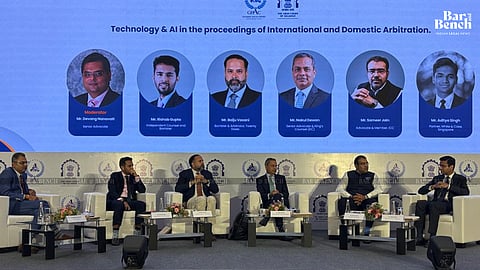
Dewan was part of a panel discussing Technology & AI in the proceedings of International and Domestic Arbitration.
The session was moderated by Senior Advocate Devang Nanavati. The co-panelists were Twenty Essex Barrister Baiju Vasani, ICC Indian Chair Sameer Jain, Barrister Rishabh Gupta and White & Case Partner Aditya Singh.
The panelists echoed the view that generative tools must remain secondary to human intellect. Gupta highlighted that AI primarily serves as an efficiency aid for tasks such as searching through massive volumes of document.
"I personally look at it always as a productivity tool, in much the same way as Microsoft Word would have been a productivity tool 20 years ago,” he said.
The debate also focused on transparency standards and procedural integrity. Singh argued that clear boundaries must exist between counsel usage and tribunal reliance.
"Disclosure in my view becomes imperative when AI is being used by the arbitrators,” Singh stated.
Vasani elaborated that parties select individual arbitrators based on a specific expertise for their personal input.
“They understand you will do that with AI, not simply by AI. They don't want you to simply delegate your function away,” Vasani said.
He reiterated that technological adoption is inevitable, but personal responsibility remains non-negotiable.
“AI is a tool and not a replacement,” he said.
Jain warned against treating AI as a primary source of law.
He explained, "It's very difficult for AI to say 'No.' It's very difficult for AI to say that, 'I do not know this.'"