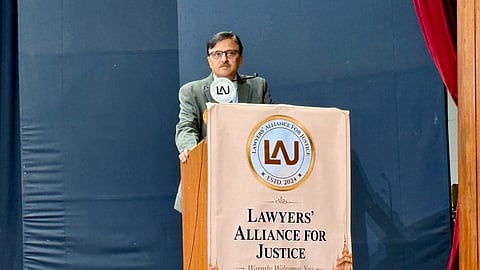
Former Supreme Court Justice Abhay S Oka warned that India risks losing democracy if the State continues to criminalise dissent. .The retired judge urged constitutional courts to quash such prosecutions and stop regulating or stifling free speech.Pertinently, he said that courts cannot sit in judgment over the content of speech of protestors/ dissenters when fundamental rights are at stake“The court may not like what the petitioners have said or expressed, but still it is the duty of the court to protect the freedom of speech and expression. It is not the function of the court to preach or teach the petitioner what he should say and what he should not have said,” he said.He was delivering the inaugural Advocate Haroon Solkar Memorial Lecture on August 1 at KC College auditorium in Mumbai. The programme, organised by Lawyers’ Alliance for Justice, also felicitated Senior Advocate Rafique Dada with the “Juridical Excellence Award 2026”..In his speech, Justice Oka cited Constituent Assembly debates to state how the framers of the Constitution never envisaged a situation where citizens’ demands would simply be ignored. "So here comes the right of making peaceful protests, peaceful protests within constitutional means. And if we do not allow people to express displeasure by making peaceful protests, there won't be any democracy," he emphasised..He criticised the use of prohibitory orders to block protests, recalling a case from Karnataka where Section 144 CrPC was invoked to stop an anti-CAA demonstration at Bengaluru’s Freedom Park. "Somebody wants to have a peaceful protest without committing any offence, police have to permit it. The protest may be on any ground, so long as it is a lawful protest within the constitutional framework, it is the duty of the courts to permit it," he said..It is not the function of the court to preach or teach the petitioner what he should say and what he should not have said.Justice AS Oka.Citizens who approach constitutional courts after they are booked for their comments or social media posts ought to be granted relief, he said."All that court has to see: whether an offence is made out, and whether there is a violation of fundamental right of freedom of speech and expression. And if the court is satisfied that there is a violation, the court has to grant relief. It is the bounded duty of the courts to ensure that the Constitution and ideals of the Constitution are not trampled upon. The reason is that if courts are not going to protect these freedoms, these fundamental rights, who else is going to protect? Which institution is going to protect the fundamental rights of the citizens?" he questioned..When a law student sought advice on the right under Article 19 and its connection with protests, Justice Oka said the “simplest advice” to the younger generation was to read and understand the Constitution. He reiterated that everybody has a right to protest in a peaceful manner and that this right is recognised by our Constitution.Quoting Irish writer Sir Thomas More, he added that citizens are not expected to say only those things which are liked by the rulers. "If democracy is to survive, we must guard and protect our freedoms under Article 19(1)(a) and Article 21 of the Constitution of India, even if we have to pay a huge cost for protecting these fundamental rights,” he concluded.