
Subscribe
Subscribe
- Latest Legal News
- News
- Law Firms
- Columns
- Interviews
- Law School
- Legal Jobs
- हिंदी
- ಕನ್ನಡ
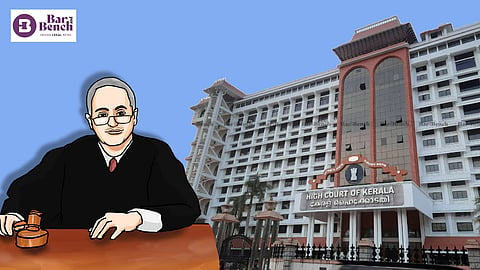
The Kerala High Court has held that a judicial officer facing disciplinary proceedings cannot insist on engaging a lawyer to defend himself, when he is capable of presenting his case with the assistance of another judicial officer.
Justice Gopinath P made the observation while dismissing a petition filed by a serving Additional District and Sessions judge (petitioner) who challenged the refusal to allow him to engage a lawyer to represent him during a disciplinary enquiry.
The Court observed that although the charges against the petitioner were serious, they were not complicated and could be defended by taking the assistance of another judicial officer of the District Judge rank.
"I find that the petitioner cannot insist that he must be permitted to engage a legal practitioner to defend him in the proceedings before the Inquiring Authority." the Court concluded.

The plea before the Court was filed by a serving sessions judge, who challenged certain decisions taken by an Inquiring Authority during disciplinary proceedings pending against him.
The petitioner submitted that the Inquiry Authority, a High Court judge, had initially permitted him to engage a lawyer in August 2025.
However, the permission was subsequently withdrawn following an objection by the presenting officer - a District judge-rank judicial officer appointed to present the disciplinary case against the petitioner.
The petitioner challenged this denial of permission. He argued that he should be allowed legal representation, particularly because the enquiry was being conducted by a High Court judge. He also challenged the modification of certain charges against him. He pointed out that the modification was carried out after several witnesses, including the complainant, had already been examined.
The High Court administration opposed the plea, arguing that Rule 15(6) of the Kerala Civil Services (Classification, Control and Appeal) Rules, 1960 (1960 Rules) restricted the right to engage a lawyer during disciplinary proceedings.
While examining the issue, the Court referred to the Supreme Court's decisions where it was emphasised that denying legal assistance to an employee facing disciplinary enquiry could be unfair when the person conducting the enquiry or presenting the allegations was legally trained.
However, after examining the Supreme Court's decision in Dinesh Chandra Pandey v. High Court of Madhya Pradesh and another, the Court found that the petitioner's request could not be allowed in the present case.
In Dinesh Chandra, a similar challenge was raised by a judicial officer who was denied permission to engage a lawyer during disciplinary proceedings.
The top court clarified that permission to engage a lawyer was not mandatory in every disciplinary enquiry.
In this case, the Court noted that the petitioner had already chosen another judicial officer to assist him in defending the charges. It concluded that there was no reason for the judicial officer to insist on engaging a lawyer.
The Court further noted that the petitioner had continued participating in the disciplinary proceedings with the assistance of the judicial officer after his request for legal representation was rejected as well.
It proceeded to rejected the petitioner's plea.
Senior counsel S Sreekumar, instructed by advocate P Martin Jose, along with advocates P Prijith, Thomas P Kuruvilla, Ajay Ben Jose, Manjunath Menon, Harikrishnan S, Anavadya Sanil Kumar, Anjali Krishna, Adarsh V Manoj and Abhinav PS appeared for the petitioner.
Standing counsel Shajna M represented the High Court administration.
[Read Judgment]