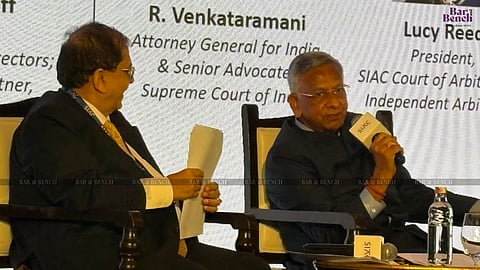
India’s arbitration law requires a fundamental relook to address concerns over fairness, consistency and public accountability, Attorney General (AG) for India R Venkataramani said on Saturday..Venkataramani said that changes may be required not only in India but across jurisdictions..He was speaking during a fireside chat on law, policy and business at the Singapore International Arbitration Centre (SIAC) Annual India Conference 2026 in New Delhi.The other panellists were President of the SIAC Court of Arbitration and independent arbitrator Lucy Reed and Managing Director of Indian Metals & Ferro Alloys Limited (IMFA) and past president of the Federation of Indian Chambers of Commerce and Industry (FICCI) Subhrakant Panda.The discussion was moderated by Cyril Shroff, member of the SIAC Board of Directors and Managing Partner of Cyril Amarchand Mangaldas..The Attorney General said that disputes involving the government and public-sector undertakings raised challenges that did not ordinarily arise in private commercial disputes.Government decisions are subject to scrutiny by auditors, including the Comptroller and Auditor General of India, he pointed out. This makes civil servants wary of accepting adverse awards, foregoing appeals or approving settlements.Venkataramani said that even where he had advised the government against filing an appeal, officials had questioned how the acceptance of an adverse award would be viewed during an audit.“Every civil servant is concerned about that.”.He also flagged concerns over fairness and the absence of a discernible pattern across arbitral awards. Merely continuing to litigate after an award would not resolve the underlying problem, he added.Venkataramani said that the government’s decision to move away from arbitration towards mediation was a knee-jerk reaction.“I think that was again a knee-jerk reaction. We should not have knee-jerk reactions.”Arbitration should not be abandoned altogether, he clarified. Instead, India should consider a framework that draws principles and ideas from different dispute-resolution systems..The comments assume significance in light of guidelines issued by the Union Ministry of Finance in June 2024. They recommended that arbitration should not routinely be included in domestic public-procurement contracts, particularly large contracts..The conference subsequently hosted a panel titled The Costs of Arbitration: What GCs are No Longer Willing to Pay For?.The discussion was moderated by AZB & Partners Senior Partner Vijayendra Pratap Singh. It featured Essar Group Managing Director and Group General Counsel Sanjeev Gemawat, Akasa Air Chief of Governance and Strategic Acquisitions Priya Mehra, Axis Max Life Insurance Senior Vice President and Head Legal Urvashi Pathak, Rajah & Tann Singapore Deputy Managing Partner Kelvin Poon SC and S&R Associates Partner Abhishek Tewari..The conference also featured a mock emergency-arbitration hearing under the SIAC Rules 2025. The session featured Ankit Goyal, Ila Kapoor, Dipen Sabharwal, Mahesh Rai, Nish Shetty, Jafar Alam and Dr Rishab Gupta.The mock hearing focused on the newly introduced Protective Preliminary Order mechanism. It permits a party to seek urgent relief without prior notice to the opposite party when giving notice could frustrate the purpose of the requested interim measure..Delivering the closing address, Delhi High Court Justice Tejas Karia said that India was no longer merely using international arbitration, but was also helping shape its development.He pointed to the continued presence of Indian parties among SIAC’s leading foreign users, the frequent use of Indian law in SIAC-administered cases and the appointment of Indian arbitrators.Justice Karia said that the opening of SIAC’s Delhi liaison office was more than a geographical expansion. It would deepen the institution’s engagement with practitioners, businesses and institutions while improving its understanding of Indian commercial realities.He added that users now expected arbitration to be proportionate, efficient, technologically enabled and commercially sensible.