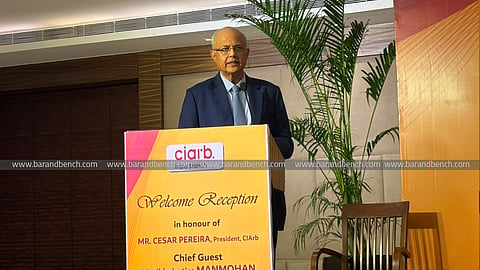
Supreme Court Justice Manmohan on Thursday described arbitration and mediation as “sunrise areas” with tremendous potential, particularly as courts struggle with mounting dockets and new forms of commercial disputes emerge..“The courts, as you know, are full of cases. It is just exploding with dockets. I, in fact, consider these two areas as the sunrise areas. And I think there is tremendous scope in these two areas in the immediate future,” he said..Justice Manmohan was speaking as the chief guest at a dinner reception organised by the India Branch of the Chartered Institute of Arbitrators (Ciarb) in honour of its President Cesar Pereira.Delhi High Court Justice Tejas Karia attended as the guest of honour. Ciarb India Chairman Nusrat Hassan and Chairman Emeritus Lalit Bhasin were also present..Justice Manmohan said that arbitration in India was no longer confined to conventional domestic disputes and now encompassed international commercial arbitration, investor-State disputes arising from bilateral investment treaties and hybrid processes combining mediation with arbitration.“The new genres which are appearing on the horizon will have to be dealt with, in private settings, through the arbitration and mediation process.”He emphasised the importance of strengthening institutional arbitration and also called for the creation of a larger pool of trained arbitrators and mediators conversant with international practices. He said“The Bar has to keep pace with the developments that are taking place internationally.”.Justice Karia said India’s ambition to become a preferred seat for international arbitration could not rest on legislation and judicial support alone.The country must ensure that businesses and counsel across the world associate India with fairness, efficiency, neutrality and excellence, he said.Justice Karia added that the reputation of an arbitral seat was built through everyday professional conduct, including the manner in which hearings were conducted, the courtesy shown by counsel, discipline in following procedural directions and clarity of awards.“The finest arbitrators inspire confidence through integrity, impartiality, restraint and professionalism.”.Pereira said Ciarb treated arbitrators, mediators and adjudicators as professionals and subjected its members to enforceable ethical standards even when they were not acting in a particular proceeding.“Our code of conduct is not merely aspirational, but it’s for real.”Pereira said the institute maintained a disciplinary mechanism to deal with breaches of professional conduct. Its membership process also required candidates to demonstrate a prescribed level of knowledge rather than merely pay a membership fee, he added.He also called for greater collaboration among Ciarb’s branches and increased participation by Indian professionals..Hassan said capacity-building was critical if India wanted to become an international arbitration hub. Training, particularly in drafting arbitral awards, could substantially improve the quality and acceptability of awards, he said..Bhasin said the difference between arbitrariness and arbitration was the arbitrator. While arbitrariness involved decisions based on whim or discretion, arbitration required parties to repose confidence in a neutral decision-maker who would decide disputes on facts and law.He clarified that Ciarb was not competing with arbitral institutions. Its role was to train and accredit arbitrators who could serve on the panels of such institutions.