Law practice not only way to gain courtroom experience: Supreme Court in judges' recruitment verdict

"We believe that practical exposure and judicial training may be acquired through a combination of professional and institutional experience," the Court said.
Supreme Court Lawyers
Published on
3 min read
Listen to this article

The Supreme Court on Friday observed that legal practice is not the sole factor for a meaningful courtroom experience required by a person seeking entry into the judicial service [Bhumika Trust v Union of India and Others]
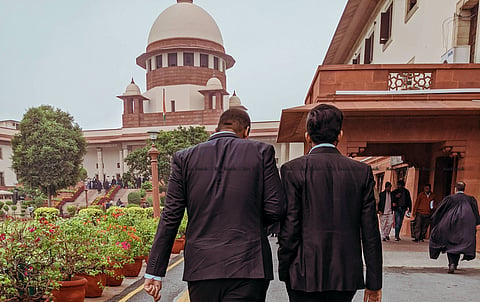
The Court made the observation in its judgment on petitions seeking review of its May 2025 verdict in which it had imposed three-year law practice requirement for being eligible for judicial service.

Today's judgment was delivered by a bench of Chief Justice of India (CJI) Surya Kant and Justices Augustine George Masih and K Vinod Chandran. While CJI Kant and Justice Masih modified the May 2025 verdict and reduced the practice requirement from 3 years to 1 year, Justice Chandran dissented from the majority view and upheld the 2025 verdict.

CJI Surya Kant, Justice Augustine George Masih and Justice K Vinod Chandran

On 3-year law practice rule

The Court today ruled that effective from April 2027, candidates will need only one year of law practice to apply for civil judge posts and, upon qualifying the examination, will have undergo one year of intensive training at the State judicial academy, followed by six months of clerkship each at the district court and the High Court.

The majority judgment said that the minimum period of practical exposure before assuming judicial office is neither unreasonable nor inconsistent with the object of securing a competent and independent subordinate judiciary.

However, it also said that the experience at bar may not be only the way to create capable judges in the district courts.

"The passage of time at the Bar, while a meaningful component, may not be the sole factor behind the meaningful courtroom experience. The quality of practice may depend upon the nature of the chamber, the court in which the advocate practises, the opportunities for appearance, the availability of a mentor and, in many cases, the financial circumstances of the candidate," the Court said.

The Court added that practical experience and judicial competence continue to develop even after a person joins the judicial service.

"We believe that practical exposure and judicial training may be acquired through a combination of professional and institutional experience," the judges said.

Difficulties faced by lawyers

It said that three-year practice requirement had unevenly disturbed the careers of certain groups of young law graduates who want to enter the judiciary.

It gave the example of young advocates, particularly those without established professional networks or financial support. It said they may find it difficult to sustain themselves when initial years of practice provide little or no assured remuneration.

The Court also said that that women candidates may face additional social and familial constraints during the period in which they are expected to establish themselves at the bar.

"Similarly, persons with disabilities may face difficulties in obtaining meaningful opportunities for practice at the Bar," it added.

In this backdrop, the Court opined that if the entry requirements become so burdensome that a significant segment of talented candidates are discouraged from even competing, the judiciary may lose precisely the pool of candidates for whom the requirement was intended to improve.

"A judicial service which demands adequate maturity and practical exposure must also remain sufficiently attractive to the most capable young lawyers," the Court said.

Why judicial training and law clerkship?

As alternatives to 3-year legal practice, the Court today prescribed judicial training and law clerkship to train the future judges.

The Court said judicial academies now exist across the country and provide an opportunity to impart, in a structured and supervised manner, the very skills which a young advocate may otherwise acquire unevenly at the bar.

The Court further said that a law clerkship under the direct supervision of judges can expose a candidate to the manner in which court proceedings are to be held. It will help them learn the decorum and attitude to be maintained towards members of the bar and litigants, the Court added.

"Simultaneously it will assist in preparation and analysis of cases, the evaluation of submissions, the application of procedural law and the discipline involved in preparing judicial orders," the order further said.

The Court said the changes ordered by it today are necessary to minimise the hardship caused to fresh and recent law graduates by the sudden restoration of the legal practice requirement.

It also said that its aim is to provide a structured and workable mechanism through which the requirement can be implemented without uncertainty or artificial exclusion.

Further, the Court said it has to ensure that judicial service continues to attract meritorious young persons who may otherwise be lost to other branches of the legal profession or public service.

[Read Judgment]

Attachment
PDF
Bhumika Trust v Union of India and Others
Preview
Bar and Bench - Indian Legal news
www.barandbench.com