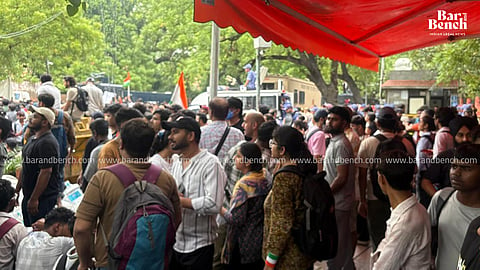
The Delhi Police has told the Supreme Court that its personnel used "maximum restraint but minimum required force" against the Cockroach Janta Party (CJP) protestors at Jantar Mantar..The affidavit sworn by Deputy Commissioner of Police (New Delhi District) Sachin Sharma said that the crowd turned violent and breached multiple layers of barricades in an attempt to march on parliament..The case before the Court stemmed from protests that began at Jantar Mantar on June 6, against alleged irregularities in the NEET-UG and CBSE examinations. The protestors demanded the resignation of Union Education Minister Dharmendra Pradhan. The Supreme Court, while hearing a batch of pleas alleging police excesses, had earlier indicated that it was considering setting up a committee to examine the use of force by security personnel. It had given the Central government and the Delhi Police an opportunity to place their version on record. The present affidavit is the Delhi Police' response to that notice..The Delhi Police clarified that it was not dealing with the petitions para-wise or individually on merits and that its silence should not be read as an admission. It said that its case would be laid out in full only before the committee since the allegations of use of force would be a subject matter of examination by the said committee in greater detail..On the sequence of events, the affidavit states that although permission for a dharna was granted only for June 20, post 5 PM, the protesters did not vacate the venue. The police states that the agitation escalated after a call was given for a march towards the parliament on July 20, the opening day of the monsoon session.The police maintained that "permission was neither sought nor granted for any 'Chalo Sansad' march," and that prohibitory orders under Section 163 BNSS had been in force in New Delhi District since June 21.The affidavit gives a graphic account of the violence, alleging that protesters "started attacking the police and other security forces stationed at the barricades"."...digital record available that shows disturbing visuals of big groups of protestors targeting lone police officials with stones, sticks, beating them up without any provocation almost in a mob lynching fashion."It further alleges that a group vandalised the building of the Registrar of Cooperative Societies on Sansad Marg and "started using those bricks to attack the officers.".According to the police, over 30,000 protesters, "including rioters and miscreants," were present against a deployment of around 5,000 uniformed personnel, along with CAPF, CRPF and RAF companies and over 3,600 barricades. It states that more than 240 police personnel/uniformed officers sustained multiple injuries, while "around 200 members of the public/protestors also underwent medico-legal examination," and that the injuries to the "218 protestors...may not be qualified on account of use of any excess force."On the contentious use of a lathis with nail embedded in them, the police called it "only a solitary video," asserting the object was "actually a stick" with a national flag attached, "possibly carried by some protestor," and that no medico-legal certificate recorded nail injuries to any protester..On facial recognition technology, the subject of a separate petition, the affidavit says that the system does not automatically capture, create, generate or maintain profiles of peaceful protesters. It only flags persons with prior criminal antecedents for field verification, the affidavit states.It discloses that between July 20 and 26, 2,873 persons with matching criminal records were identified, of whom 92 had "involvement in more than 10 cases" and 47 were history-sheeters, with offences ranging from murder and rape to offences under the POCSO and NDPS Acts. It clarified that any investigation into the protests would be confined to these 2,873 persons and not extended to other protesters.The affidavit also details that more than 4,600 women police personnel were deployed cumulatively across the 6 days of the protest to ensure the safety and dignity of female participants. It states that lathis used by officers were "an acceptable and permissible helping gear," with protective gear issued to personnel "accounted for and well documented."