
Subscribe
Subscribe
- Latest Legal News
- News
- Law Firms
- Columns
- Interviews
- Law School
- Legal Jobs
- हिंदी
- ಕನ್ನಡ
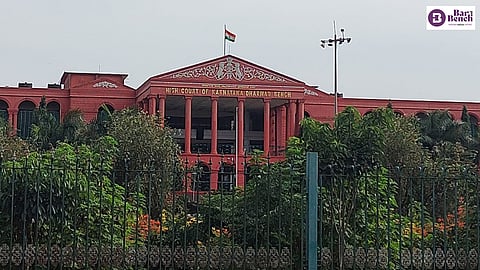
The Karnataka High Court recently held that administrative and statutory authorities cannot pass executive orders blindly, relying solely the legal opinion of their panel advocates.
Justice T M Nadaf held that legal opinions given by panel advocates are only advisory in nature and cannot replace the independent decision-making process of the competent authority.
The Court added that an authority that merely copies or approves a legal opinion without examining the relevant facts and law abdicates its statutory power and acts under dictation.
“If an authority blindly copies or signs off the order only on the legal opinion, without examining the facts and relevant law by itself, it amounts to an abdication of statutory power and acting under dictation. Such orders require to be held as arbitrary, invalid and lacking jurisdiction,” the Court said. .

The Court passed the order on a petition filed by a woman named Sangamma, who challenged an endorsement issued by the Executive Officer of the Kushtagi Taluk Panchayat on June 6, 2023.
The endorsement had been issued after an earlier High Court direction to consider her representation.
The petitioner had also filed a contempt of court petition against the local authority for not examining her representation despite a court directive. These contempt proceedings were dropped after the officer claimed that he had complied with the Court's order. The petitioner, however, was granted liberty to challenge the endorsement issued by the officer on her representation.
She eventually filed the present petition challenging the Panchayat official's endorsement. The Court found that the officer had failed to independently apply his mind to the petitioner's grievance in accordance with the Karnataka Gram Swaraj and Panchayat Raj Act, 1993.
“It appears, the order came to be passed in a haste, only to absolve themselves from the contempt proceedings and to save their skin. These kinds of endorsements amount to aggravated form of contempt,” the Court observed.
The Court further pointed out that the Panchayat official had issued the endorsement entirely based on an opinion furnished by the Taluk Panchayat's panel counsel.
The High Court stressed that the discretion vested in a statutory authority must be exercised personally and objectively by the authority concerned, and not merely echo legal opinions given by panel counsel.
“The opinions expressed by the panel counsel/advocate are just advisory in nature and a mean to guide the authority and cannot be a basis or the only reason for the decision. In other words, it cannot replace the decision-making process of the competent officer,” the Court observed.
The Court also stressed the importance of recording reasons while passing administrative and quasi-judicial orders.
“The reasons are the heartbeat and soul of the order. In the absence of reasons, the order is just a bunch of dead words, without having any meaning in law,” the Court remarked.
The Court proceeded to quash the endorsement and remand the matter for fresh consideration in a time-bound manner. It also directed the concerned Zilla Panchayat to assign the petitioner's representation to an officer other than the one who had passed the endorsement under challenge.
The Court made clear that the fresh decision must be taken independently and in accordance with law, and not merely on the advice of the panel counsel.
“It is made clear that the order shall be passed in accordance with the law and not on the advice of the panel counsel/advocate. The opinions are advisory in nature and cannot be the basis for passing the order,” the Court stated.
The Registry was also directed to forward a copy of the Court's order to the Principal Secretary of the Rural Development and Panchayat Raj Department and the Chief Secretary of Karnataka for issuing guidelines to officials to ensure that they apply their mind while passing orders, and not merely rely in legal opinions by panel counsel.
Advocate V S Kalasurmath appeared for the petitioner.
Additional Government Advocate Sharad V Magadum and advocate Vijaykumar Balagerimath appeared for the respondents.
[Read Judgment]