

The Supreme Court on Thursday said that the Bar Council of India (BCI) lacks the jurisdiction or statutory competence to look into the conduct of law students before their enrollment as an advocate [Mihira Sood and another v. Bar Council of India and others]
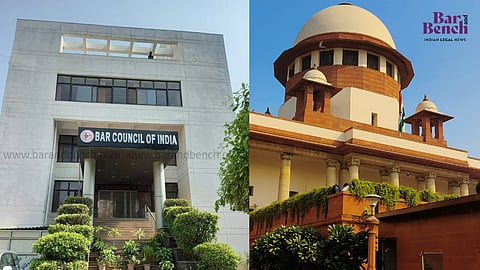
A Bench of Chief Justice of India (CJI) Surya Kant, Justice Joymalya Bagchi and Justice V Mohana made the observation while dealing with a petition concerning BCI's now-withdrawn decision to bar enrollment of NALSAR Hyderabad's 2026 batch students over their campaign against the CJI.
The Court said that the Advocates Act, 1961, under which the Bar Council of India has been constituted, does not confer any express or implied power upon it to take disciplinary action against students pursuing legal education.
"Such power is vested in the university or educational institution in which the students are enrolled. The Bar Council of India may prescribe and enforce standards of legal education in accordance with the statutory provisions and applicable regulations. It cannot, however, take disciplinary action against a law student," the Court ruled.
CJI Kant remarked that BCI can exercise its powers over a law graduate only after he has enrolled with the statutory body.
"As far as the conduct of law students is concerned, the Bar Council of India has neither jurisdiction nor statutory competence. That falls exclusively within the domain of the educational institution or university. There cannot be any dispute about that. After a student graduates and registers himself or herself as an advocate, the Bar Council comes into the picture. It is then the statutory authority responsible for regulating advocates. But none of these students had enrolled as advocates," he observed.
Similarly, Justice Bagchi said that a university may even allow a law student to continue his education despite his involvement in an act involving moral turpitude.
"The Bar Council can certainly examine, at the stage of enrolment, whether the conditions precedent for enrolment have been satisfied. But whether the student should be permitted to continue pursuing legal education is for the university to decide. The Bar Council cannot impose a caveat in advance that the student will not be enrolled as an advocate upon graduation," the judge said.
Considering that the BCI has already withdrawn the circular against the students of the 2026 NALSAR batch, the Court today closed the matter. It ruled that the BCI decision was without authority.
"Having regard to what we have declared above, the communication dated August 13, 2026, and all subsequent modified communications are declared to have been issued without jurisdiction," it said.
CJI Kant had earlier also taken an exception to the BCI circular, stating that the statutory body had no role in the matter.
"Naturally, this is absolutely uncalled for. It’s a dialogue between students and me. Who are they to raise an issue? This is totally uncalled for. In my student days I have been actively involved in student activities. Assuming, even if they are wrong, they have a right to protest. BCI doesn’t have any business," remarked CJI Kant.
The top court had also ordered that no punitive action should be taken against NALSAR or any of its students or faculty or any other national law university by the BCI. The direction was made absolute today.
The controversy stems from a letter written by NALSAR students to the University protesting the invitation of CJI Kant as chief guest for their convocation, over his alleged inaction on police brutalities during the recent protests at Jantar Mantar.
The students said that it did not sit right to receive their degrees from a dignitary whose recent public conduct appeared dismissive of serious allegations of police brutality against protesting citizens.
The letter referred to a mention made on July 22 by a lawyer before a Bench led by the CJI, seeking an urgent hearing on the issue. The CJI, at the time, told the counsel,
"Don't waste our time, and don't waste your time."
The representation said that when counsel offered to show video evidence of the alleged police action, the CJI reportedly said,
"We are not interested in videos; we don't have time to watch."
The representation was signed by around 70 students of the outgoing 2026 batch. Two days later, about 380 more students from the 2027 to 2031 batches extended their support.
In response to this, the BCI issued a circular barring the entire 2026 batch of NALSAR from being enrolled as advocates due to their opposition to have CJI as the chief guest for their convocation. The circular stated,
"As per some reliable sources, there exists groupism and dirty politics among some of the academic staff and they have played very active role in misleading, instigating and misguiding the students. This is a very serious matter. The teachers, instead of involving themselves in their teaching job, are doing nasty politics in the campus. Bar Council of India, being the regulator of Legal Education cannot be a mute spectator of such a serious situation."
The second circular, passed within hours of the first, reversed the decision on halting enrolment, but retained the decision for an inquiry into the persons instrumental in initiating, organising, or mobilising the campaign to protest the invitation of the CJI. In this regard, the BCI also sought an inquiry report from the University.
After the second circular, NALSAR Vice-Chancellor Prof Srikrishna Deva Rao issued a press release stating that the University would first examine whether such an inquiry is permitted under its governance regulations. Following an outrage over its actions, the BCI closed the proceedings and told NALSAR that no further action was required.
The circulars were subsequently challenged before the top court.
Today, Senior Advocate K Parameshwar, representing the petitioners, urged the Court to examine the circumstances in which the circulars were issued.
He questioned whether any meetings had been held before the circulars were issued.
"This is a question of freedom of speech and expression in a university. It is not about just one student. It is about banning freedom of speech and expression across an entire university," the senior counsel said.
Parameshwar also urged the Court to ascertain who had authorised the decision and under which provision of law it had been taken.
"They must be held accountable in some fashion," he submitted.
BCI Chairman and Senior Advocate Manan Kumar Mishra responded that the decision already stands withdrawn.
"The question here is that everything has already been closed. The Council, in its meeting, has said that there is nothing further and that everything has been resolved. The letter was immediately withdrawn," Mishra said.
CJI Kant remarked that the withdrawal of the circulars amounted to an acceptance of mistake by the BCI.
"We expect everyone to act responsibly. There is no doubt that the orders were withdrawn. That means there must have been some realisation that a mistake, if not a blunder, had been committed, and it was accordingly rectified," the CJI said.
Parameshwar then urged the Court to clarify that BCI has no power to regulate the conduct of students.
"We only request a clarification that the Bar Council of India has no statutory power to regulate the conduct of students. That jurisdiction falls exclusively within the domain of the educational institution. That will suffice," the senior counsel said.
CJI Kant agreed to issue the clarification, while making it clear that students do not have unbridled freedom.
"Of course, students have freedom, but it cannot be unbridled freedom," CJI Kant said.