
Subscribe
Subscribe
- Latest Legal News
- News
- Law Firms
- Columns
- Interviews
- Law School
- Legal Jobs
- हिंदी
- ಕನ್ನಡ
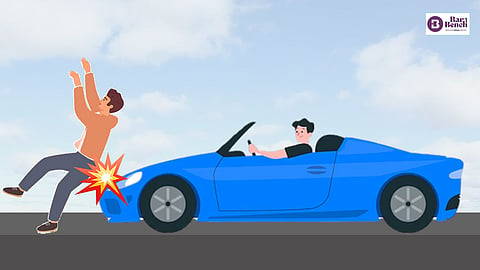
The Karnataka High Court recently refused to quash a criminal charge of culpable homicide not amounting to murder against a man whose 14-year-old son allegedly drove a car that killed three members of a family [Nadeem Ur Rehman Vs State of Karnataka].
Justice M Nagaprasanna observed that a parent who knowingly allows a minor to drive cannot automatically escape criminal liability when the act ends in tragedy.
The Court held that the prosecution must be allowed to proceed against accused man, Nadeem Ur Rehman, as the chargesheet contained prima facie material indicating that he had handed over the car keys to his minor son and permitted him to drive.
"A parent who knowingly places the steering wheel in the hands of a child cannot always retreat behind the minority of that child, when the adventure ends in catastrophe. Parenthood carries not merely affection and authority, but responsibility. Roads are shared public spaces, not training grounds for unlawful indulgence," the Court held.

The case arose from an accident that took place on December 10, 2020, when the Rehman's 14-year-old son allegedly drove a Volkswagen Vento on the Mysuru–Bengaluru road and collided with a two-wheeler. Three members of a family died in the accident, while another person was injured.
The police initially registered a case for the offences of rash driving and causing death by negligence. Section 304 Part II of the Indian Penal Code (IPC), which deals with culpable homicide not amounting to murder, was subsequently added.
The father was named the second accused in the case. After a sessions court rejected his discharge application, he approached the High Court seeking to quash the culpable homicide charge.
The Court made it clear that it was not holding every parent criminally liable whenever a minor child caused an accident. However, it added that where the prosecution alleged a conscious act of a parent entrusting a vehicle to a child, coupled with circumstances indicating that the parent had the requisite knowledge of the danger involved, the charge could not be quashed without a trial.
The Court also cautioned against determining the gravity of a criminal offence solely by the tragic consequences of an accident.
“The magnitude of that tragedy, by itself, cannot constitute Section 304 Part-II; criminal culpability cannot be measured by counting the dead,” it said.
The Bench emphasised that the prosecution's case went beyond the fact that three people had died. It alleged that the father had repeatedly permitted his 14-year-old son to drive and had himself handed over the car keys on the day of the accident.
The father, however, denied authorising the drive and contended that his son had taken the vehicle without his knowledge or consent.
“A discharge proceeding cannot be converted into a miniature trial for choosing between these competing versions,” the Court held.
It said the question of whether the father possessed the knowledge necessary to attract Section 304 Part II of the Indian Penal Code had to be decided on the basis of evidence at trial.
“The charge must face the test of evidence rather than suffer a premature burial at the threshold,” the Court observed.
The Bench also expressed concerns over road accidents involving minors and the dangers of allowing children who are legally ineligible to drive to operate motor vehicles on public roads.
The judgment referred to figures indicating that Karnataka recorded 751 accidents involving minors during 2025–26, out of an all-India total of 11,890.
The Court clarified that statistics could not substitute for proof of criminal liability, but said that courts could not ignore the wider social context in which such incidents occurred.
“The steering wheel of a motor vehicle cannot become a plaything in the hands of a child, nor can a public road become the playground for such indulgence,” the Court observed.
Advocate Pallava R appeared for the petitioner.
Special Public Prosecutor B N Jagadeesha represented the State.
[Read Judgment]