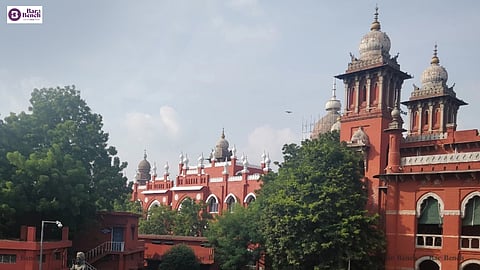
The Madras High Court has ruled that a lawyer cannot invoke the writ jurisdiction of a High Court to recover disputed professional fees from a public sector bank [Sunit Kumar Agarwal Vs AGM, PNB]..A Bench of Chief Justice Sushrut Arvind Dharmadhikari and Justice G Arul Murugan said that writ jurisdiction was not an alternative mechanism for recovering money arising from commercial or professional contracts.“A writ is an extraordinary public law remedy. It is designed to correct glaring constitutional overreaches, failures of public duty, and arbitrary abuses of State power. It is not intended to serve as an alternate recovery mechanism for commercial or professional contracts,” the Court observed..The ruling came in an appeal filed by advocate Sunit Kumar Agarwal, a former empanelled counsel for Punjab National Bank (PNB).Agarwal had approached the High Court seeking payment of outstanding professional fees and expenses. His claim was initially quantified at ₹6.80 lakh and was later increased to ₹10 lakh during the appeal proceedings on account of what he described as newly discovered bills.A single judge had dismissed his writ petition in April 2024 after declining to exercise writ jurisdiction in a dispute concerning unpaid professional fees.In appeal, Agarwal argued that the dues were undisputed and that he had satisfactorily rendered legal services to the bank for several years. He alleged that certain bank officials had demanded a 40 per cent commission to release the dues.PNB responded that while some undisputed bills had been settled, the remaining claims were contested. It also alleged deficiencies in the legal services rendered by Agarwal..The Division Bench said that a contractual dispute could be examined under Article 226 (writ jurisdiction of a High Court) of the Constitution only when there was an absolute and unambiguous admission of liability, coupled with shocking arbitrariness violating Article 14 (right to equality and against discrimination or arbitrariness).“When the respondent/bank raises questions regarding the performance of a service, the matter loses its public law character and enters the domain of private civil obligations,” the Court said..It noted that PNB had expressly disputed the claims and alleged deficiencies in service, while Agarwal had made serious allegations of bribery and corruption against bank officials. Such contested questions could not be resolved in writ proceedings, it concluded.“The appellant has knocked on the wrong judicial door,” the Court remarked.The Bench dismissed the appeal but granted Agarwal liberty to approach a competent civil court or an appropriate forum. "The proper course of action is to approach a competent civil court, where both parties can file detailed pleadings, produce documents, cross-examine witnesses and establish the truth through a regular trial," the Court said.It also directed that the time spent pursuing the writ petition and appeal be excluded while computing the limitation if he files a civil suit..Agarwal appeared in person.Advocate P Raghunath of TS Gopalan & Co represented PNB and its officials..[Read Judgment]