
Subscribe
Subscribe
- Latest Legal News
- News
- Law Firms
- Columns
- Interviews
- Law School
- Legal Jobs
- हिंदी
- ಕನ್ನಡ
The Supreme Court on Wednesday questioned why the Election Commission of India (ECI) did not deny the Shiv Sena’s bow-and-arrow symbol to both rival factions, in the absence of clear parameters.
A Bench of Chief Justice of India Surya Kant and Justices Joymalya Bagchi and V Mohana was hearing challenges arising from the split in the Shiv Sena, including the ECI’s decision to recognise the Eknath Shinde faction as the official party and the Maharashtra Speaker’s refusal to disqualify its MLAs for switching sides.

The Court posed the question while Senior Advocate Neeraj Kishan Kaul, appearing for the Shinde camp, defended the ECI’s reliance on legislative majority.
“If all the tests stood vitiated, there was always the option available to them not to give an advantage to either of these groups. Let them select their own symbols and fight on their own strength, not on Balasaheb’s,” Justice Bagchi remarked.
The judge also stressed that proceedings under the Tenth Schedule concern the conduct of individual legislators, while a dispute over a reserved symbol concerns the political party.
“The symbol test is of the political party, whereas disqualification is qua the act of a legislator in the legislative assembly. The symbol is not being tested for the legislative party. It is of the political party,” Justice Bagchi observed.
Kaul argued that the ECI examined the Shiv Sena’s constitution, its organisational structure and the support enjoyed by the rival groups before finding legislative majority to be the only workable test in the peculiar circumstances.
He submitted that the organisational structure was dominated by nominated members, did not reliably reflect the will of the party cadre and vested unbridled authority in the paksha pramukh (party chief). Counting support among the wider cadre was also impracticable, while the elected representatives were divided, he said.
Kaul maintained that the Supreme Court's verdict in Subhash Desai did not prohibit the ECI from considering legislative strength under paragraph 15 of the Symbols Order. He added that disqualification of a legislator does not annul the election, votes polled or the vote share secured by the party.
The hearing is continuing after Senior Advocate Kapil Sibal concluded submissions for the Uddhav Thackeray faction. Sibal had argued that a majority within the legislative wing could not appropriate the identity of the political party or be rewarded with its name and symbol.
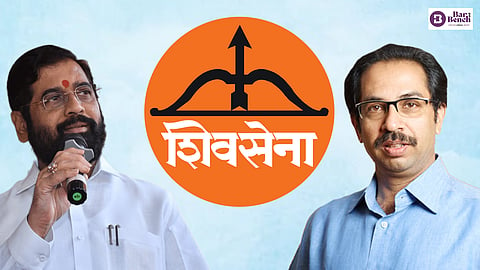
The Shiv Sena split into two factions in 2022, one led by Thackeray and the other by Shinde. The latter then petitioned the ECI staking a claim to the 'Shiv Sena' name and the bow and arrow symbol.
The ECI relied on the strength of the legislative wing of the party to arrive at its decision rather than on the test of its organisational wing. It explained that although it had attempted to apply the test of the organisational wing, it could not come to any satisfactory conclusion because the latest constitution of the party was not on record. The claims of numerical majority in the organisational wing of the party by both factions were not satisfactory, the ECI opined. Thus, it proceeded to rely on the test of who had the majority in the legislative wing.
The Shinde faction was noted to have 40 Members of Legislative Assembly (MLAs) as against the Thackeray faction's 15 MLAs. Likewise, in the Lok Sabha, out of 18 Members of Parliament (MPs), 13 MPs supported the Shinde faction, while only 5 supported the Thackeray faction, the ECI found.
Hence, it ruled in favour of the Shinde faction and allowed it to retain Shiv Sena name and the bow and arrow symbol.
[Read Live Thread]