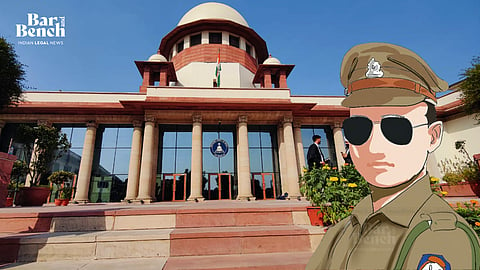
Plea in Supreme Court alleges Odisha trying to bypass law on DGP appointment

The plea alleged that Odisha had withdrawn its earlier panel and was attempting to include an ADGP in a fresh list in violation of the apex court's directions on DGP appointments.
Police Officer with Supreme Court
Published on
3 min read
Listen to this article

The Supreme Court on Tuesday agreed to urgently hear a public interest litigation (PIL) petition alleging that the Odisha government was attempting to circumvent the top court's judgment on the appointment of the State's Director General of Police (DGP) by including ineligible officers in the selection panel.

A Bench of Chief Justice of India (CJI) Surya Kant, Justice Joymalya Bagchi and Justice V Mohana agreed to list the matter on Wednesday.

Senior Advocate P Chidambaram, appearing for the petitioner, mentioned the matter.

He alleged that the State withdrew a panel of officers sent to the Union Public Service Commission (UPSC) and was now preparing a fresh list.

He further contended that the State was attempting to promote an Additional Director General of Police (ADGP) to the rank of DGP and then include the officer in the fresh panel sent to the UPSC.

Taking note of the submissions, CJI Kant said,

“They (UPSC) are well aware of who is eligible and who can be considered. If a panel of ineligible officers is being sent, we expect the UPSC to act in accordance with our directions."

Chief Justice of India Surya Kant and Justices Joymalya Bagchi and V Mohana

The Apex Court in February 2026 had reiterated that States must follow the procedure laid down in the judgment in Prakash Singh v Union of India for appointing their DGPs. The Court had directed that eligible officers be considered through a panel prepared by the UPSC, with the State then required to appoint the DGP from among the officers empanelled by the Commission.

Under the framework governing DGP appointments, the post of DGP in the apex level 17 is to be filled by selection from among officers holding DGP-level posts in level 16. The Supreme Court had previously too held that Prakash Singh directions do not permit States to bypass the prescribed eligibility requirements merely because fewer eligible officers are available.

In February, the Supreme Court had further directed States facing similar disputes to follow the procedure it had laid down for DGP appointments. It required the UPSC to make its final recommendations within the prescribed timeframe after receiving a revised proposal from the State.

In Odisha, the process is underway ahead of the retirement of incumbent DGP YB Khurania on August 31.

The State had initially sent three names before forwarding a wider panel of 11 senior IPS officers to the UPSC. The Commission was scheduled to meet on August 7 to shortlist three officers for the post.

Today, Chidambaram submitted that the State's move was in breach of the Supreme Court's directions in the Prakash Singh case.

He said the State had sent a panel to the UPSC in April, but later withdrew it. In May, another panel comprising three DGPs and eight ADGPs was sent to the UPSC.

According to Chidambaram, the UPSC had on August 7 indicated that it would consider only officers at the DGP level.

"On August 7, the UPSC demurred and said, 'We will only consider the DGP level.' Then, on the meeting day, or the previous day, or during the meeting, they purported to withdraw the list. They are now frantically trying to prepare another list and send it," he contented.

He further submitted that the Supreme Court had earlier permitted the UPSC to approach it if States failed to send a panel of eligible officers.

CJI Kant noted that the UPSC was aware of which officers were eligible for consideration and expected it to follow the Court's directions.

“We expect the UPSC to adhere to our judgment,” said CJI Kant.

Hence, it agreed to list the case on August 12, Wednesday.

[Read Live Coverage]

Bar and Bench - Indian Legal news
www.barandbench.com