

The Supreme Court on Monday refused to interfere with the Election Commission's decision to use the 2002 electoral roll as the baseline for the ongoing Special Intensive Revision (SIR) of electoral rolls in Sikkim.
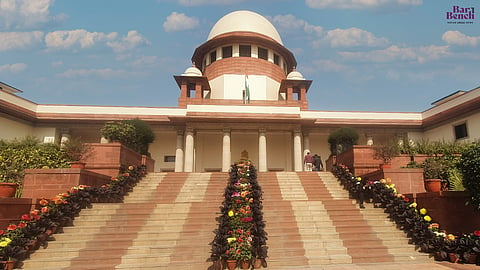
The Court was hearing a petition questioning whether the choice of 2002 as the cutoff year was appropriate for Sikkim given the State’s distinct demographic and constitutional position.
A Bench comprising Chief Justice of India (CJI) Surya Kant , Justice Joymalya Bagchi and Justice V Mohana held that the exercise was being carried out on a uniform basis across States.
CJI Kant questioned why a different baseline should now be adopted for Sikkim when the SIR was being conducted on a uniform basis.
“How can now we claim a different date for your State? SIR is specifically on uniform basis in 2002,” he said.
The Election Commission ordered SIR in 16 States and three Union Territories in May 2026. In Sikkim, the house-to-house enumeration exercise began on May 30 and the draft roll was published on July 5.
The State's electoral authorities have specifically identified the 2002 SIR roll as the last SIR roll for the exercise. The official electoral-roll database also lists the final 2002 SIR roll, dated January 5, 2002.
The current schedule had set the deadline for claims and objections till August 4, with the final electoral roll scheduled to be published on September 6.
Today, the petitioners argued that Sikkim's distinct demographic and constitutional position warranted a closer examination of the decision to use the same baseline of 2002 as other States.
They also pointed to an alleged mismatch between the State's demographic data and the growth in its electoral rolls. They referred to an increase in the number of local voters between 1999 and 2019 which, according to them, was disproportionate to Sikkim's fertility rate of 1.1%.
Sikkim became India's 22nd State in 1975 through the Constitution (Thirty-Sixth Amendment) Act, which also inserted Article 371F, containing special provisions for Sikkim. Article 371F, among other things, provides for special arrangements concerning the State's Legislative Assembly and protection of the interests of different sections of its population.
The petitioners' argued that the uniform application of a 2002 baseline may not adequately account for Sikkim's particular historical trajectory, including its merger with India in 1975, distinctive community composition and border-state status.
Additionally, the counsel for the petitioners clarified that they were not seeking the adoption of any particular year as the cut-off, but wanted to know why 2002 had been chosen.
The Election Commission (EC) said that the 2002 electoral roll was the last SIR roll prepared in Sikkim. The EC counsel said the 1993 electoral roll had undergone further modifications and adjustments before being adopted in 2002 and therefore, the Commission was using the last SIR roll as the baseline.
The EC also opposed the plea on the ground that it has been filed at a belated stage.
They contented that the claims and objections period has already ended, notices were being issued and objections were being heard and disposed of. The final electoral roll is scheduled to be published on September 6.
The EC submitted that changing the baseline at this stage would require the entire revision exercise to begin afresh.
The petitioners contended that there was no immediate electoral urgency, as the next general elections were still three years away.
However, CJI Kant, at this point questioned whether political parties or other stakeholders in Sikkim had opposed the exercise.
“Have any political parties come forward? You know, those who are involved in the governance have come forward? It is acceptable to everyone. Why you people sitting in Delhi should be heard on this issue?” he asked.
Responding to this, the petitioner's counsel submitted that the petitioner-organisation was based in Sikkim. He also argued that political parties were unlikely to raise the issue because voter numbers were a sensitive matter in the small State.
The Court ultimately declined to interfere after noting that SIR had already been conducted in Sikkim in 2002 and that the adoption of that year as the cut-off was a policy decision.
It also noted that no political party or other stakeholder from Sikkim had come forward to oppose the exercise and that the EC has already taken necessary steps based on the 2002 cut-off.
“We are not inclined to entertain the plea at this stage,” said the Court.
[Read Live Coverage]