
Subscribe
Subscribe
- Latest Legal News
- News
- Law Firms
- Columns
- Interviews
- Law School
- Legal Jobs
- हिंदी
- ಕನ್ನಡ
Students cannot be threatened with punitive action for expressing a different point of view or asking questions, Supreme Court Justice Ujjal Bhuyan said on Sunday.
Right to question is an essential part of citizenship, liberty and constitutional responsibility, Justice Bhuyan underscored.
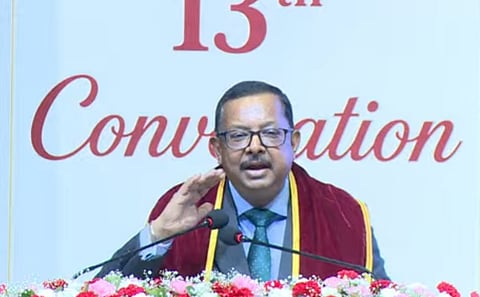
He was delivering the convocation address at the 13th convocation of National Law University Delhi for its postgraduate programmes.
In his address, he spoke on the importance of dissent, tolerance and independent thought in a constitutional democracy, particularly within universities.
“In a democracy, the right to question is not an act of defiance. It is an essential expression of citizenship, liberty and constitutional responsibility. So when students express a different point of view, when students ask questions, they cannot be threatened. They cannot be threatened with punitive action. That is unconstitutional. That is misuse of power and office,” he stated.
The judge said that the Constitution does not seek uniformity of thought, but creates a framework within which people holding different beliefs, opinions and convictions can live with equal dignity and participate in democratic life.
He emphasised that tolerance of disagreement is essential to democracy.
“A democratic society cannot be built on the edifice that everyone will think alike. It is built on the understanding that differences will exist and that those differences must be accommodated within the broader constitutional framework,” he said.
Justice Bhuyan added that constitutional democracy requires the State to listen to citizens, citizens to listen to one another, institutions to remain accountable and society not to treat every dissenting voice as a threat.
Justice Bhuyan recalled Justice Chinnappa Reddy’s judgment in Bijoe Emmanuel v. State of Kerala.
“Our tradition teaches tolerance, our philosophy preaches tolerance, our Constitution practises tolerance. Let us not dilute it.”
The words, delivered four decades ago in 1986, are even more relevant today, Justice Bhuyan said.
“Tolerance is not merely a matter of personal courtesy. It is a constitutional value. A democracy becomes meaningful not when everyone speaks the same language of thought but when different voices can coexist, be heard and be treated with dignity,” he said.
The maturity of a democracy is reflected not merely in how it treats popular opinions having majoritarian mandate, but in how it responds to opinions that are “difficult, unpopular or sometimes very inconvenient”.
“An intolerant mind, by its very nature, is at odds with the spirit of the Constitution. It is a manifestation of another form of violence. The ability to live with disagreement is therefore not merely a social virtue. It is the very essence of a liberal constitutional democracy,” he said.
Justice Bhuyan also underscored the role of universities in fostering such a culture.
“A university, in my view, should be one of the first places where the habit of thinking freely begins,” he said.
Universities should be spaces where ideas are not accepted merely because they are familiar and students do not hesitate to ask difficult questions simply because the answers may be uncomfortable, he opined.