Supreme Court proposes ladies' Bar rooms across courts, financial support for young lawyers

On funding, it suggested a law providing for structured donations by successful senior lawyers, along with contributions from court fees and a portion of costs imposed in judicial proceedings.
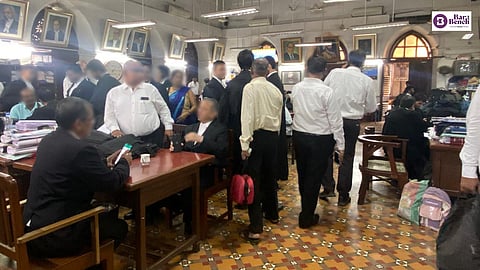
Advocates bar room, Bombay High Court
Published on
3 min read
Listen to this article

The Supreme Court has taken note of the absence of adequately equipped ladies' Bar rooms across courts in the country and proposed setting up a fund to financially support young advocates during their early years of practice.
A Bench of CJI Surya Kant and Justice V Mohana was hearing a plea filed by a group of women advocates practising across courts in the country, raising concerns about the accessibility, inclusiveness and long-term sustainability of women lawyers in the legal profession.

CJI Surya Kant and Justice V Mohana

The petitioners had pointed to the lack of adequately equipped Bar rooms for women lawyers and other essential facilities in most courts, tribunals and commissions. Flagging financial difficulties faced by young lawyers, they proposed a Young Advocates Corpus Fund to be controlled by State Bar Councils to give fixed monthly stipends to new entrants to the profession.

In support, the petitioners had relied on a survey conducted through a questionnaire titled "Form for Basic Provisions and Amenities," circulated among women advocates and backed by physical visits to several court complexes. The data showed that most court complexes either had no dedicated ladies' Bar room or provided facilities that were grossly inadequate, lacking basics such as proper seating, clean washrooms, changing rooms and nursing facilities.

The Court observed that this grievance could not be brushed aside as a matter of mere convenience. It noted that while women had increasingly entered the legal profession over the decades, their entry alone was not sufficient cause for celebration, since meaningful participation required conditions that allowed them to discharge their duties effectively, safely and on equal terms.

It held that the provision of such facilities prima facie bore a direct nexus with the right to live and work with dignity under Article 21 of the Constitution, noting that the word "life" in Article 21 had consistently been read expansively to include conditions necessary for a dignified existence.

Turning to the second issue, the Court said that financial hardships faced by young advocates was gender-neutral and merited equally serious consideration. It observed that a first-generation lawyer entering the Bar does not immediately inherit an office, a library, a stable clientele or a predictable income and that many junior advocates remain dependent on modest stipends from seniors that are often insufficient for basic living expenses.

The Court noted that this period of financial turmoil often compels capable young lawyers to abandon practice altogether, leading to a professional "brain drain" that diminishes the Bar's ability to attract and retain talent, a problem that is particularly acute for first-generation lawyers and those from disadvantaged backgrounds.

The Court suggested the creation of a Young Lawyers' Professional Assistance Fund, to be established under the exclusive control of the jurisdictional High Courts or an autonomous body constituted by the Union and state governments. On funding, it suggested a law providing for structured donations by successful senior lawyers, along with contributions from court fees and a portion of costs imposed in judicial proceedings.

The Court mooted incentives such as tax exemptions or national awards to encourage such donations. It proposed that the fund be used to give monthly stipends to first-generation or economically disadvantaged young advocates, who would simultaneously be attached to senior lawyers as associates rendering services in lieu of the stipend.

The Court said that the assistance must be sufficient to cover basic sustenance for the first 3 years of practice, reducing proportionately thereafter and ending after 6 to 7 years, by which point a lawyer would typically attain self-sufficiency. It further suggested examining a mechanism for beneficiaries to repay the fund in phased monthly instalments, creating a self-sustaining corpus for future generations.

It clarified that these observations were tentative and illustrative, not meant to limit the alternatives available to stakeholders.

The Court issued notice to all respondents and requested the Attorney General for India, along with the Advocates General of States and Standing Counsel for Union Territories, to remain present and assist in the matter.

[Read Order]

Attachment
PDF
Sarita Tyagi vs Union
Preview
Bar and Bench - Indian Legal news
www.barandbench.com