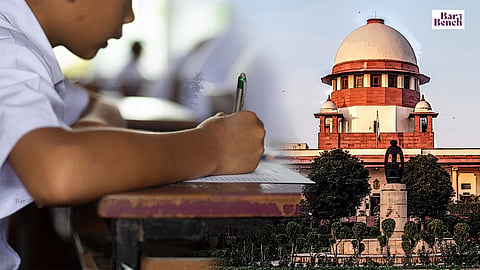
Supreme Court seeks CBSE, NCERT response on challenge to mandatory three-language policy for classes 6 to 9

The Court sought responses while flagging logistical concerns over the implementation of the policy.
Supreme Court, Exams
Published on
3 min read
Listen to this article

The Supreme Court on Tuesday sought responses from the Union Government, Central Board of Secondary Education (CBSE) and the National Council of Educational Research and Training (NCERT) on a petition challenging a CBSE circular mandating the study of three languages including two regional languages from class 6 to class 9 [Yashica Bhandari Jain & Ors. v Union of India & Ors.]

A Bench comprising of Chief Justice of India (CJI) Surya Kant and Justice Joymalya Bagchi while issuing notice, noted that the logistical concerns arising from the implementation of the policy would require closer examination.

“Let us have a comprehensive reply. We can hear on June 15. There will be logistical issues,” observed CJI Kant.

CJI Surya Kant and Justice Joymalya Bagchi

The plea challenges a May 15 CBSE circular aligning its scheme of studies with the National Education Policy 2020 and the National Curriculum Framework for School Education 2023. Under the revised framework, students entering Classes 6-9 from July 2026 must study three languages, with at least two being Indian languages.

Petitioners, including parents and teachers from multiple cities, have argued that the sudden implementation imposes an additional academic burden mid-session. They also contended that this disrupts preparation for Class 10 board examinations, and lacks adequate infrastructure such as trained teachers and textbooks.

They also flagged concerns about unequal regional impact and the absence of clarity on evaluation patterns for the additional language.

Senior Advocate Mukul Rohatgi, appearing for the petitioning parents and teachers, argued that the mandate would disrupt existing language combinations across the country.

He pointed out that students who are already studying subjects such as Tamil, English and French would now be required to take up an additional Indian language. He also submitted that the policy requires students to pass the additional language for their final certification.

Senior Advocate Mukul Rohatgi

Senior Advocate Kapil Sibal raised constitutional concerns, submitting,

“There are Constitutional issues of federalism and of choices... language is a matter of choice.”

Justice Bagchi, however, clarified the Court’s immediate focus would not be on the Constitutional issue of federalism.

“We are not on the federal issue. This is increasing the number of regional languages. There are issues of teachers, books etc.”

Senior Advocate Kapil Sibal at his Hailey road residence

Appearing for the CBSE, Additional Solicitor General (ASG) Aishwarya Bhati said the education body was ready to respond.

“I am ready today. There is no urgency for June 15. Only classes will start. Everything will be subject to orders of this court,” she said.

Taking note of the concerns, Justice Bagchi suggested that a status report be filed on logistical preparedness.

CJI Kant observed that learning multiple languages contributes to strengthening the federal structure.

“In the opening week we will just hear this case first on one day and decide it. When you learn more languages, it strengthens federal structure and another thing is also there,” he said.

ASG Bhati said that there is no question of making life harder for students.

“No question of making it hard for the students.”

Aishwarya Bhati, Additional Solicitor General

The Court ultimately sought CBSE's response and asked that the petition be handed over to ASG Bhati.

The matter will be heard next on July 15 or 16 after the Court's summer vacation.

Also Read
Petition in Supreme Court against CBSE’s new three-language policy for Class 9
Supreme Court, Exams

The petitioners were represented by Senior Advocates Kapil Sibal, Mukul Rohatgi, Shyam Divan and G Saikumar, along with advocates Shardul S Shroff, Shally Bhasin, Varun Pathak, Anne Mathew, Amee Rana, Prateek Gupta, Jyotsna Punshi, Radhika Roy, Rachna Dubey, Vishwajeet Deshmukh and Aparajita Jamwal.

The National Council of Educational Research and Training (NCERT) would be represented by Solicitor General Tushar Mehta.

The Central Board of Secondary Education (CBSE) would be represented by Additional Solicitor General (ASG) Aishwarya Bhati.

[Read Live Coverage]

Bar and Bench - Indian Legal news
www.barandbench.com