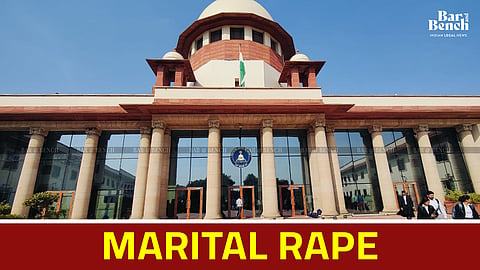
The Supreme Court will commence hearing the batch of petitions seeking criminalisation of marital rape from next month. .Currently, marital rape is excluded from the ambit of the offence of "rape" by way of Exception 2 to Section 375 of the Indian Penal Code (IPC).A similar provision is also present in the newly enacted Bharatiya Nyaya Sanhita (BNS), which replaced the IPC in 2023..A Bench headed by Chief Justice of India Surya Kant , Justice Joymalya Bagchi and Justice V Mohana on Wednesday directed that the matter be listed for final hearing after three weeks on Wednesdays and Thursdays.The Court passed the direction after noting that the Central government has filed its affidavit in the matter."The Union Government has filed its reply in the connected matters also. A copy thereof shall be supplied to all learned counsel appearing in the connected cases within two days. We are informed that the other pleadings are complete. The nodal counsel, on behalf of the petitioners, shall compile the pleadings and prepare a combined compilation, along with a separate set of documents/pleadings relied upon by the parties. The respondents' compilation, as well as citations to be relied upon, shall also be exchanged. List these matters for final hearing after 3 weeks on a Wednesday and Thursday," the Court directed.Pertinently, during the hearing of the case, the Court remarked that marriage cannot result in an “extinction of individual autonomy” of a woman but the Court must reckon with the existing statutory exception under the Bharatiya Nyaya Sanhita (BNS) before permitting prosecution for rape within marriage."We fully appreciate the submission that there is no question of marriage resulting in an extinction of individual autonomy. Point well taken. Now see the law as it stands. It is a penal law. And therefore, before a person can be prosecuted, rightly or wrongly, a constitutional court has to render a verdict that the exception is unreasonable or manifestly arbitrary. Only then can prosecution on that score be permitted," Justice Bagchi said in response to the demand by the petitioners that rape within marriage must lead to prosecution.Thus, the Court said that it will examine two questions: one, whether a prosecution can be sustained even if the marital rape exception survives, and two, whether the exception itself is constitutionally valid."We will answer both questions. One, suppose the provision is sustained, despite that, whether it constitutes an offence. (Two), their direct challenge is to the provision itself, that it is not liable to be sustained," the CJI remarked.In this regard, the Court said that it will examine the implications of reading down the exception, and whether an act expressly excluded from the offence can nevertheless be brought within it through interpretation.The Court also highlighted that violence within marriage is covered other penal provisions and the exception to rape does not protect a perpetrator from other offences like grievous injury or culpable homicide."The question before us is whether, despite such status as a victim, the State defines it as rape or not. Where grievous injury or harm is caused, there are other provisions. There may be offences under Sections 323, 324 or culpable homicide. So it is not that the offence is restricted only within the four corners of rape as defined under the Indian Penal Code. The exception does not protect a perpetrator if he has caused grievous injury or death," the Court stated..In 2022, the Delhi High Court had delivered a split verdict on whether marital rape should be a criminal offence. .While Justice Rajiv Shakdher had held Exception 2 to Section 375 of the Indian Penal Code (which immunises non-consensual sexual acts by a husband against his adult wife) to be unconstitutional, Justice C Hari Shankar upheld the exception, ruling that the legislature’s classification was based on intelligible differentia.The matter then reached the Supreme Court in September that year.The Central government has backed the existing rape law that carves out an exception for sexual relations between a husband and wife, and asserted that the issue is more of a social one than a legal one..Senior Advocates Indira Jaising, Gopal Sankaranarayanan, Karuna Nundy and NS Nappinai appeared for various petitioners.Solicitor General Tushar Mehta represented the Central government..[Read Live Coverage]