Mere closure of FIR does not entitle accused to compensation: J&K High Court

There is nothing to show that the FIR was registered without any basis or with any oblique motive, the Court pointed out.
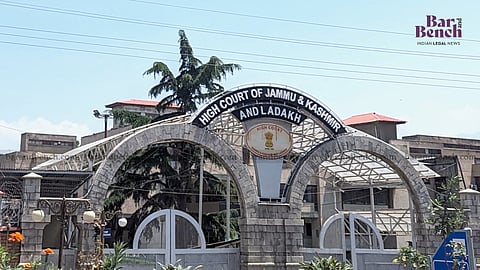
Srinagar Bench, Jammu & Kashmir and Ladakh High Court
Published on
3 min read
Listen to this article

The Jammu and Kashmir High Court recently dismissed a plea by four persons seeking compensation of ₹50 lakhs each for their alleged wrongful implication in a drug case, which was eventually closed by the police citing lack of evidence [Javid Ahmed Lone & Ors. v. Union Territory of J&K].
Justice Shahzad Azeem observed that the mere registration of an FIR does not violate the fundamental rights of the accused, unless there is some element of malice.

The Court held the registration of an FIR alone would entitle an accused to claim compensation by claiming he was wrongfully named in the criminal case.

Compensation in writ jurisdiction or under inherent powers is an exceptional public law remedy available only when there is an established violation of fundamental rights, coupled with malafides or gross abuse of process causing demonstrable harm. Mere registration of FIR on receiving information of commission of a cognizable offence and closure as 'not admitted' do not constitute violation of any of the fundamental rights of the petitioners (formerly accused)," the High Court observed.

Justice Shahzad Azeem
Mere registration of FIR on receiving information of a cognizable offence and closure as 'not admitted' do not constitute violation of the fundamental rights of the (accused).
Jammu and Kashmir High Court

High Court was hearing a petition filed by Javid Ahmad Lone, Raja Ikhlaq Akbar, Safeer Ahmad Gadwal and Basit Khan. They were earlier accused of cross-border smuggling drugs. The FIR registered against them cited Sections 8A, 27B and 29 of the Narcotic Drugs and Psychotropic Substances Act, 1985 (NDPS Act).

The police said that they registered the FIR based on credible information that narcotic drugs were being smuggled across the Line of Control in Jammu and Kashmir. It was also suspected that the proceeds from the illicit drug trade were being invested in movable and immovable properties.

However, after investigation, the case was eventually closed by the police on the ground that sufficient admissible evidence could not be gathered to enable filing of a charge sheet before the trial court.

Meanwhile, the accused moved the High Court to quash the FIR. They maintained that they were respectable persons with clean antecedents and modest means of livelihood and that the FIR against them was vague, omnibus and based on a concocted story, particularly since no contraband had been recovered from them.

They alleged that the FIR had been registered with an ulterior motive to harass and extort them. Therefore, they also sought compensation from the State.

The Court noted that since the criminal case itself has been formally closed by the police, the petitioners' (accused) prayer to quash the FIR need not be examined.

The Court went on to dismiss their plea for compensation as well after noting that there was nothing to show that the FIR was registered with malice or that they had been harrassed during the investigation.

"There is nothing discernible from the Case Diary that the FIR was registered without any basis or with any oblique motive at the threshold stage ...There is no material to indicate any lapse, high-handedness, or malafide on the part of the Investigating Officer or the SHO concerned... Had the Investigating Officer been acting with any malafide intention or with the object of harassing the petitioners or extorting money, he could have attempted to somehow manipulate or fabricate evidence to file a false charge sheet and drag the petitioners into prolonged trial. Instead, the I.O. has bonafidely closed the investigation when the evidence was found insufficient. Therefore, the closure itself is a manifestation of the bona fide intention of the Investigating Officer," the Court observed.

The Court proceeded to dismiss the petitioners’ claim for compensation as being misconceived and unsupported by any material demonstrating mala fides or violation of fundamental rights.

Advocate Waseem Ramzan appeared for the petitioners.

Government Advocate Faheem Nisar Shah appeared for the Jammu and Kashmir administration.

[Read Order]

Attachment
PDF
Javid_Ahmed_Lone_&_Ors._VS_UT
Preview
Bar and Bench - Indian Legal news
www.barandbench.com