

The Brihanmumbai Municipal Corporation (BMC) has informed the Supreme Court that it is preparing India’s first city-wide master pedestrian network plan for Mumbai to create a continuous, connected and universally accessible pedestrian network across the city.
In an affidavit filed before the Court, the BMC said the proposed plan would be prepared using its 3D city model integrated with Geographic Information System (GIS) mapping, satellite imagery, LiDAR surveys, drone mapping, development plan data and other geospatial datasets.
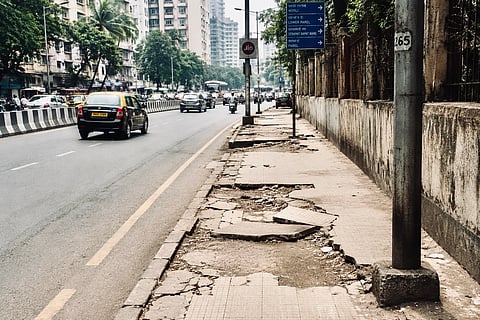
The civic body said the exercise would move Mumbai away from fragmented footpaths that begin and end abruptly. The plan will instead take the city towards a scientific, city-wide approach to pedestrian planning.
The affidavit was filed in response to an application moved in the long-pending public interest litigation (PIL) petition concerning pedestrian safety and implementation of the universal footpath policy.
According to the BMC, it has already begun collecting ward-wise data on existing footpaths, missing links, discontinuities, connectivity gaps and inaccessible stretches for preparation of a comprehensive geospatial inventory of pedestrian infrastructure.
It said a city-wide geospatial mapping exercise is currently underway to identify existing footpaths, roads where footpaths are absent, missing pedestrian links, discontinuous stretches and accessibility gaps across Mumbai.
The civic body added that this mapping would be integrated with its 3D city model, enabling authorities to digitally visualise roads, footpaths, transport corridors, public utilities and other urban infrastructure on a single platform.
According to the affidavit, the platform would also help identify missing footpath links, encroachments and accessibility gaps while facilitating preparation of a city-wide master pedestrian network plan.
The BMC further said the proposed master plan would identify missing pedestrian links, prioritise connectivity corridors, improve accessibility and integrate pedestrian infrastructure with public transport through coordinated efforts of various municipal departments.
It also told the Court that it was establishing an institutional mechanism under its Chief Engineer (Roads & Traffic) Department to coordinate data collection, GIS mapping, planning, implementation and monitoring of pedestrian infrastructure projects.
On the issue of street vendors, the BMC said regulation and rehabilitation of hawkers would continue to be governed by the Street Vendors (Protection of Livelihood and Regulation of Street Vending) Act, 2014, the Maharashtra Rules of 2016 and the Street Vendors Scheme, 2017 through the Town Vending Committee. Appropriate steps would be taken while balancing pedestrian movement and accessibility, the affidavit said.
In November 2025, a Bench of Justices JB Pardiwala and KV Viswanathan had issued notice on an application by advocate Sunil Ahya seeking directions to authorities to undertake geospatial mapping of pedestrian networks, prepare city-wide master pedestrian plans, integrate street vending into footpath planning and establish phased implementation and accountability mechanisms.
The application also specifically sought directions to the BMC to prepare and publish a geospatial digital inventory of all existing and missing footpaths in Mumbai in accordance with its universal footpath policy issued in May 2023 and to submit periodic compliance reports.
When the matter came up in January this year, the Supreme Court asked the BMC to consider auditing defined stretches of footpaths across the city, suggested that at least one kilometre of footpaths in every ward - particularly in crowded areas - be audited, and permitted the applicant to identify stretches requiring urgent remedial action.
With the BMC's May 20 affidavit taken on record, the matter will be heard next on September 3.