
Subscribe
Subscribe
- Latest Legal News
- News
- Law Firms
- Columns
- Interviews
- Law School
- Legal Jobs
- हिंदी
- ಕನ್ನಡ
It is deeply problematic if one can predict the outcome of an arbitration based on the composition of the arbitral tribunal, former Supreme Court Justice Indu Malhotra recently said.
Justice Malhotra raised concerns over party-appointed arbitrators acting as partisans and warned against predictable decisions in multi-member tribunals.
“That is something which I feel is a very serious matter of concern, because if you can predict the result from the constitution of the tribunal, it is problematic,” she said.
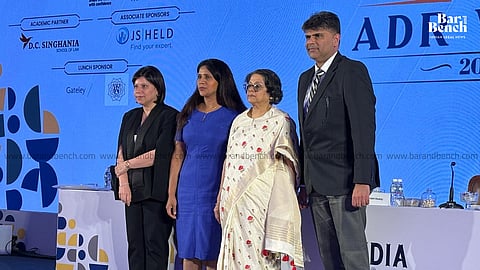
She was speaking at a panel session during the India ADR Week 2026 in Mumbai. The discussion focused on conflicts, repeat appointments, and perceptions of bias.
Advocates put forth the cause of the parties, and arbitrators should not be doing that, she opined.
“You cannot expect the arbitrators to be taking a partisan view. They are not required to advocate the cause of the party. That is what I think is the biggest challenge to arbitration today,” she emphasised.

She further remarked that partisan arbitrators fail their primary mandate.
"You cease to be an arbitrator and adjudicator. You cannot be advocating the cause of the party,” the judge said.
This is why disclosure by arbitrators about conflict of interest becomes important, she opined.
Justice Malhotra praised India's mandatory statutory disclosure framework and urged foreign jurisdictions to adopt similar statutory requirements.
The panel discussion was moderated by JSA Partner Farid Karachiwala.
The panel also featured Sherina Petit, Partner and Head of International Arbitration at Stewarts, and Pavani Reddy, Legal Director at Clyde & Co.
Petit defended repeat appointments of arbitrators as something driven by genuine expertise.
“Principally, if you're good at what you do, the parties are going to want you again,” she said.
“What you don't want is a one-hit wonder!” she added.
On navigating potential conflict issues, she offered a practical rule:
“The test is, when in doubt, disclose."
Reddy contrasted English and Indian legal frameworks. She explained how English courts rely on an objective 'fair-minded observer' test rather than rigid statutory schedules.
Karachiwala noted that India's 2015 statutory reforms were years ahead in codifying key disclosure standards.
“Fairness and neutrality is something which really needs to stand out right on top in any arbitration," he said.