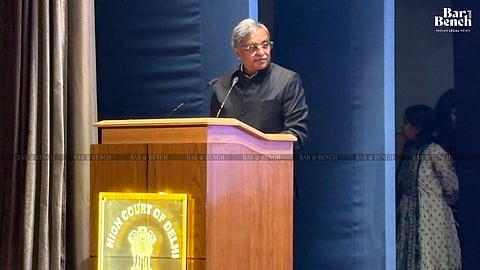
Oral remarks made by judges in court become viral on social media in a jiffy and are circulated widely before the judge even reaches his residence after the day's work, Supreme Court Justice Vikram Nath said on Tuesday. .He was speaking at the Delhi High Court during the launch of IBC Mantra: The Law and Practice of Insolvency and Bankruptcy, a free and open online commentary authored by Senior Advocate Tarun Gulati and Advocate Kumar Sambhav.“You say something in court, sometimes even in passing, and before you even reach home, it is everywhere. It has found its way into Twitter, Instagram, LinkedIn and every other platform,” Justice Nath said..He also contrasted the speed at which information travels today with the manner in which legal research was undertaken when he entered the profession. Young lawyers today, he said, have access to entire libraries on their laptops.In the past, lawyers depended on physical libraries, which often had only one copy of the book they needed. If someone else had borrowed the book, they had to wait or try another library, he recounted..Justice Nath was the chief guest at the event. Supreme Court Justices Manmohan and Sanjeev Sachdeva, Delhi High Court Chief Justice Devendra Kumar Upadhyaya and former Supreme Court Justice Sudhanshu Dhulia were the guests of honour. Delhi High Court Bar Association President and Senior Advocate N Hariharan also addressed the gathering..Justice Nath said that although legal research took longer in the past, the process was not necessarily a disadvantage. Lawyers often read much more than they had intended and, while searching for one proposition, discovered another that proved even more useful.“Those accidental discoveries were among the great pleasures of legal research,” he said.He added that while technology has unquestionably transformed legal research for the better, it has not diminished the need for quality legal scholarship.“Information is available in abundance. What is much harder to find is perspective,” Justice Nath said.The judge added that a good commentary does not merely state what the law is but explains why it has developed in a particular direction and identifies the principles underlying that development.Turning to insolvency law, Justice Nath said the Insolvency and Bankruptcy Code (IBC) remains a relatively young statute despite having fundamentally reshaped India’s commercial law landscape over the past decade.“Every few months, there is a fresh question before the courts, something the statute did not anticipate or a provision that two benches have read differently or an entirely new situation that was not anticipated,” he said..Justice Nath added that a commentary could bring order to these developments by explaining how statutory provisions had been interpreted, where courts agreed and where the law continued to shift.He also praised the authors for making the commentary freely accessible. He said every lawyer benefited from the labour of others, whether through a reasoned judgment, an academic paper, guidance from a senior or a commentary that brought clarity to an evolving field..Justice Manmohan said that making the commentary freely accessible was a meaningful way of giving back to younger members of the legal profession..Justice Sanjeev Sachdeva said that the IBC should not be viewed as a mechanism for shutting down defaulting companies.“A common misconception is that IBC is a corporate death warrant designed to shut down companies. It is not. The primary object of IBC is resolution, not liquidation. Liquidation, in fact, is the last resort,” he said..Delhi High Court Chief Justice Upadhyaya described the IBC as one of the most significant economic and legal reforms in independent India. He said that it had fundamentally altered the treatment of financial distress by shifting the focus from prolonged recovery proceedings to timely resolution, preservation of enterprise value and balancing the interests of stakeholders..Justice Dhulia, who wrote the foreword to the commentary, stressed the role of judicial interpretation in shaping legislation.“Any law is as good as its interpretation. It is merely skeleton and flesh. The life and blood of a statute is given by interpretations,” he said..Senior Advocate Hariharan said that modern insolvency law must distinguish genuine commercial failure from fraud and diversion of assets.“Insolvency is not necessarily wrongdoing, and commercial failure cannot always be treated as culpability,” he said..Senior Advocate Tarun Gulati said the commentary has been organised section-wise because lawyers ordinarily begin their research with the statutory provision. Explaining the decision to make it freely accessible, he said legal knowledge should not remain behind a price tag.“Knowledge can never lie behind a price tag. The younger members of the Bar and the student community need access to content which they may not be able to afford,” Gulati said.The online platform contains section-wise analysis of the IBC, case law, footnotes and a searchable database..Kumar Sambhav delivered the vote of thanks