
Subscribe
Subscribe
- Latest Legal News
- News
- Law Firms
- Columns
- Interviews
- Law School
- Legal Jobs
- हिंदी
- ಕನ್ನಡ
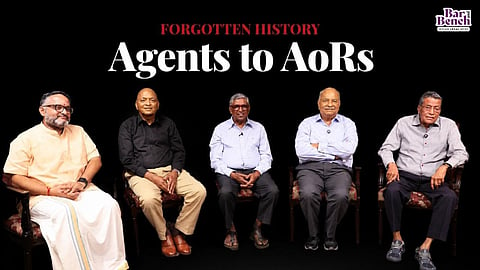
Doyens of the Supreme Court Bar recently reminisced the past, recalling lesser-known lawyers and Advocates-on-Record (AoRs) forgotten in days gone past.
Moderated by Senior Advocate K Parameshwar, the discussion featured veteran Senior Advocates KK Venugopal, Raju Ramachandran and CS Vaidyanathan, as well as former Supreme Court Justice BP Singh.
The panel also spoke about the agent system that was a precursor to the AoR mechanism, lawyers-turned-politicians and more.
[Watch Video]
Venugopal recalled the late R Gopalakrishnan, father of Senior Advocate Gopal Subramanium, who was his AoR right through from the 1960s until he passed away. The former Attorney General recounted an instance when Gopalakrishnan appeared in court despite suffering from internal bleeding.
“He went about asking for adjournment on the last day, saying I have to have an operation. He told the Chief Justice that he was bleeding internally. And the Chief Justice was horrified. And nevertheless, he was trying to handle cases from court to court. Chief Justice said, Gopal, listen, do you know what you are doing with your life? You better go straight away. I won't listen to you for a moment.”
The other names recalled by the panel included JB Dadachandji, Naunit Lal, Nuruddin Ahmed, AG Ratnaparkhi, Ganpat Rai, Arun Bahadur Saharya, RB Datar and BR Agarwala. Recalling Agarwala, Ramachandran said,
“He was an avid book collector and he had a great work-life balance and he was a very efficient work manager…He would finish his work every day by around 6 o'clock, spend half an hour wandering around the second-hand bookshops of Connaught Place looking for a rare book to add to his collection. And he had an amazing private library...So among the books in his library was a fabulous collection of Kama Sutras in different languages published across the world. I didn't attempt to look, but I saw the shelf, which he proudly showed me!”
Justice Singh spoke of a time when “agents” would manage cases in the Supreme Court before the formalised AoR system. The agents, who were not necessarily law graduates, would manage the cases. They corresponded with the lawyers, but they were not allowed to address the court, he said.
“Then the judges decided that we should discontinue this agency and have AoRs When they said on record, they wanted to have a separate record of the advocates in the Supreme Court for the reason that we have cases from all over the country. So, they insisted that you have an office within the 10 kilometres of the Supreme Court. That was one. And two, that there should be law graduates. So, all those agents who were law graduates became advocates on record.”
The panelists also discussed the relationship between senior advocates and AoRs back in the day, with Vaidyanathan recounting,
“When there was criticism, something is missing, etc, they (senior advocates) would take it upon themselves. Unlike some of the seniors today, they were so generous and protective of the advocates on record. They would never expose the faults of the advocates on record.”
The discussion moved on to lawyers-turned-politicians and the panelists listed Bengali lawyers who went to serve in positions with the government. They spoke of Somnath Chatterjee, Ashoke Sen, Siddhartha Shankar Ray, Sachindra Chaudhuri, Debi Prasad Pal and Sankar Ghose.
Parameshwar then pointed out that Venugopal had two Cabinet Ministers – P Chidambaram and Rangarajan Kumaramangalam - working with him in chambers. Responding to a question on whether they indulged in politics during their time in chambers, Venugopal said,
“No. See, when the emergency was declared, I was appearing for Karunanidhi challenging the dismissal of the government, alleging malafides against Indira Gandhi. They straight away had to leave my chambers…And at one time, when I was appearing in other emergency cases, when they were detained in Bangalore. When I went to Delhi, I was told that some IB man was inquiring as to which was my home and so on.
Therefore, I was under the impression that it could be possible that along with all the other lawyers who had been detained, I could be with them. But I believe that these two former juniors of mine were responsible for telling the government that look, this will be a very wrong thing because so far as the Madras Bar is concerned, it has not been raising its voice against the Emergency. But if you do something, arrest him or raid him, then there may be a reaction.
And I said, I don't mind the raid because all that they will find is an extra bottle of whisky, more than my permit permitted!”